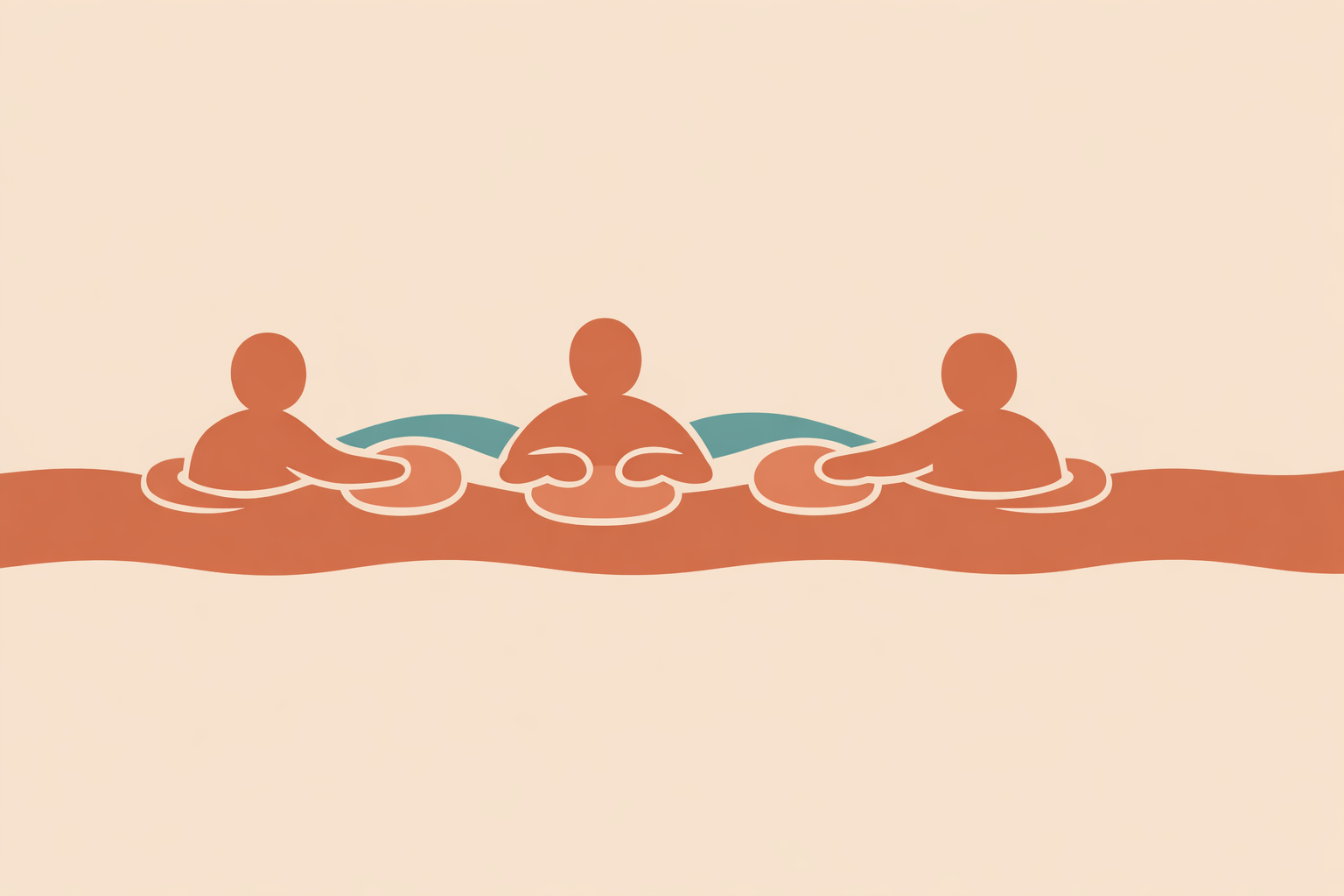
Group movement in water offers a rare mix of ease and honesty. Buoyancy can lower threat, yet the pool also highlights differences—boundaries, culture, confidence, and each person’s history with touch. That’s why trust in the water is best built deliberately: start with agency, keep contact negotiable, and deepen only when readiness is clear.
These five aquatic movement plays follow that natural arc. They begin with individual support, then move into partner guidance, whole-group coordination, shared story, and a closing experience of collective holding. Each is straightforward to facilitate, full of consent micro-choices, and easy to adapt for modesty needs, mobility, and cultural context.
Key Takeaway: Aquatic trust builds fastest when activities progress from low-arousal, individual support to partner guidance and group holding, while keeping every touch optional. Use clear signals, frequent check-ins, and simple repair steps so participants can pause, renegotiate boundaries, and re-enter connection at their own pace.
Play 1 – Floating Trust Bridge
Supported floating lets the water do some of the trust-building for you. Done well, it offers a direct experience of being supported—by the pool and by another person—without the pressure to “get it right.”
In comfortably warm, chest-deep water, many people feel physically lighter. In traditional water-based practices and in modern facilitation alike, that lightness often shows up as softer eyes, less gripping through the shoulders, and a calmer group tone. The aim isn’t surrender for its own sake—it’s support with choice.
That choice is the practice. Say it plainly: “Your choice is the practice.” Participants can say yes, no, not yet, or change their mind mid-way. When floating is built on clear permission, it becomes a skill in self-honoring as much as connection.
Many cultures have treated water as a threshold—a place of transition, reflection, and return. Bringing that sensibility into group facilitation keeps the exercise grounded and meaningful. Water doesn’t need spectacle to be powerful.
As one therapist-reviewer noted about televised conflict work, inviting “high-intensity confrontation with limited containment” may be dramatic, but it rarely builds real trust. Floating Trust Bridge moves the other way: low arousal, clear boundaries, and enough slowness for people to feel what’s actually happening.
How to facilitate Floating Trust Bridge
- Set conditions: warm, chest-deep water; quieter pool zone; modesty options available.
- Consent script: “You choose the degree of touch. You can change your mind anytime with ‘pause’ or ‘no.’”
- Signals: hand squeeze = slow down; open palm = stop; two taps = ready to stand.
- Partner roles: one Holder, one Floater. Support under upper back and back of head; no sudden shifts.
- Timing: 60–90 seconds per float, then switch.
- Debrief: “What happened to your breath?” “Where did you feel ease?”
Keep the first round brief and successful. You’re building a bridge the rest of the group process can stand on—not chasing intensity.
Play 2 – Blind Current Voyage
Once the group has felt basic support, the next layer is guidance. Eyes-closed navigation in shallow water gives a practical way to explore listening, pacing, feedback, and repair.
Water changes the experience. Compared with land-based blindfold activities, eyes-closed movement in a pool often feels more forgiving—people can test trust without bracing as hard.
The heart of the play is synchrony: moving together, not “leading” someone through. Studies on interpersonal synchrony suggest that matching pace and timing can increase affiliation and cooperation. In the pool, that can be as simple as matching breath, slowing to the same rhythm, and making guidance collaborative rather than controlling.
Choice stays central. Eyes closed must always be optional. Some participants will choose voice-only cues; others prefer a light hand on the shoulder, or a noodle tether that preserves space. The play gets stronger when people can pick the support that fits.
What makes this exercise especially valuable is repair. If someone startles, loses orientation, or feels rushed, the pair pauses and names it, agrees a new signal, and continues only after consent is renewed. One clinician-commentator captured the spirit well: “Right when people move from hurt to attack is the moment I slow everything down and teach micro-skills of repair.” Water naturally invites that slowing down.
Designing cues and resets so eyes-closed work stays choice-based
- Menu of cues: voice-only; voice plus one light touch; or hands-free noodle tether.
- Stop words: “Pause” = freeze; “Park” = reopen eyes; “Back” = return to wall.
- Repair steps: name what happened, say what is needed, agree the new pace or cue.
- Path design: begin with straight lines and gentle arcs before adding complexity.
- Timebox: 45–60 seconds per round, then switch roles.
By the end, it’s more than a game: participants are practicing how to ask, adjust, and continue with respect.
Play 3 – Human Wave Knot
After pairs build confidence, widen into whole-group coordination. Human Wave Knot keeps the classic “knot” puzzle, but buoyancy makes it feel lighter—physically and socially.
Using noodles or float rings as connectors reduces strain while keeping the cooperative challenge. The group still has to negotiate space, communicate clearly, and stay responsive, but the pool offers more room to experiment without forcing solutions.
The water also shifts the atmosphere. The shared warmth, hush, and small movements can make the group feel more connected than it might on land, and many facilitators notice people lingering afterward and talking more openly.
As the knot loosens, patterns show themselves: who takes charge, who waits to be invited, who uses humor to ease tension. Humor isn’t just “nice”—research on interpersonal closeness suggests it can reduce anxiety and make connection feel safer. Put simply, laughter helps bodies relearn that proximity can be warm rather than threatening.
And of course, the choreography isn’t the whole story. Class, migration, family roles, modesty expectations, and cultural scripts around touch can shape what feels easy—or what feels impossible. Strong facilitation holds those realities with quiet respect.
From playful web to “living river”
- Start with 6–10 people, each holding a noodle end; cross and weave for 30 seconds, then freeze.
- Invite one minute of silent problem-solving before spoken coordination begins.
- Rules: no yanking, no sudden dips, and anyone can call “pause.”
- Finish with: 30–60 seconds of slow group swaying in unison.
The laughter matters as much as the logic. A group that can untangle with kindness is building something sturdier than simple cooperation.
Play 4 – Stories Under the Surface
Once bodies are attuned, words can enter naturally. Warm-water story circles invite participants to share lived experience while the group practices listening without fixing.
This is old circle wisdom: speak into the circle, let the circle hold the words, and trust that being heard changes the space. Child and family practitioners have long used structured story circles to build empathy and a confident voice. In water, the same structure often feels softer; gentle swaying or synchronized arm movements can help emotions move with less bracing.
Reflection should stay in proportion to action. Many experiential facilitators keep a simple rhythm—more play than processing—so insight can land without the group getting heavy. Think of it like weaving: movement is the thread, reflection is the knot that holds it.
Agreements matter more than eloquence. This is not a space to correct or advise one another; it’s a space to witness. Karen Doherty’s reflection on a popular couples show captured something true for group work as well: it offers a “rare look” at how relational work really unfolds, with defensiveness, tenderness, and unfinished moments all present at once.
Cultural context is especially important here. In some communities, personal sharing follows ritual preparation or belongs in gender-specific spaces. Good facilitation can honor that with opt-outs, parallel formats, and language that respects values without pushing disclosure.
Facilitating story circles in water without slipping into fixing
- Opening: “One breath together. One story at a time. Listening is our main skill.”
- Prompts: “A time I felt supported,” “A time I asked for help,” “A boundary I honored.”
- Structure: 60–90 seconds per share; 30 seconds of shared breathing or swaying after.
- Responses: “I heard…” or “I felt…” rather than advice or interpretation.
- Opt-outs: “Pass” and “Later” are always respected.
Keep returning people to the body—hands on the water, feet grounded, breath steady. That’s what makes the learning stick.
Play 5 – Tidal Circle of Support
The final play returns to full-body trust, now held by the whole group. One person leans into many steady hands, buoyed by the water and supported by collective presence.
Because water offers reduced load, this kind of circle can be workable for a wider range of bodies. With less effort spent bracing, participants can pay more attention to pacing, listening, and clear communication.
This play belongs later in a sequence, after the group has practiced clear no’s, pauses, and small repairs. It should feel like the next obvious step—never a leap.
Culture and dignity sit at the center of the design. Groups often participate more fully when modesty needs are planned for (including modest swimwear options), when touch agreements are explicit, and when gender-specific groups are available where appropriate. These aren’t add-ons; they’re how real support becomes possible.
Representation shapes felt safety too. As Omotola M. observed about a popular series, seeing a Black woman professional name gaslighting, financial control, and emotional neglect in public can matter because it normalizes expectations of structured care for Black couples. The wider principle holds in group spaces: people open more easily when respect and rigor are visible.
Keeping leaning circles ethical, inclusive, and genuinely optional
- Pre-brief: demonstrate hand placements; the center person names what contact is welcome.
- Roles: anchors at shoulders and upper back first; any lower-body support only with explicit agreement.
- Signals: one tap = slow; two taps = upright; open palm up = step away now.
- Adaptations: eyes open by default; wall-supported or seated versions available.
- Inclusion: offer non-contact roles such as breath leader or edge-side rhythm keeper.
Close with one short sentence from each participant: “What I felt behind me,” or “What I offered from behind.” It helps the group hear its own commitment.
Building These Aquatic Trust Plays Into Ongoing Practice
Together, these plays create a steady progression: support from the water, trust with a partner, coordination with the group, shared story, and finally a collective experience of being held. Each layer prepares the next.
In real facilitation, sequencing matters more than perfection. Many groups settle into more reliable trust behaviors over a handful of sessions, especially when you consistently build from gentler to more demanding forms of contact. Many facilitators also find 60–90 minutes with 6–12 participants offers a workable balance between depth and manageability.
There’s also a broader return to water. Research on blue spaces reflects rising interest in water environments for reconnection, calm, and shared well-being—an echo of older traditions that have long understood water as regulating, relational, and restorative. Here’s why that matters: people are hungry for support that’s embodied and communal, not only verbal.
None of this requires spectacle. The strongest aquatic facilitation often looks simple: clear structure, paced contact, respectful language, and enough repetition for trust to become tangible.
Cautions still matter—best held clearly at the end of the process rather than sprinkled everywhere. Keep touch negotiated, offer modesty and mobility options, avoid pushing intensity for effect, and treat opting out as full participation.
As one commentator put it, we often need to unpack reality-therapy as entertainment before we can help groups practice genuine safety and repair. Water supports that shift beautifully by slowing everything down and making outdoor sessions and relational skills easier to feel in the body.
Train in Blue Therapy
Deepen these water-based trust skills with the Blue Therapy Certification’s structured approach to embodied, consent-led facilitation.
Explore Blue Therapy →