Anyone who uses guided imagery learns quickly that a beautiful room doesn’t automatically create a steady session. The Hobbit Vault’s earth-cooled quiet and enclosure can invite depth fast—and so can a client’s inner pictures. If the opening is loose and the closing is casual, that speed can show up as spikes of intensity, rushed transitions, or clients who leave feeling dysregulated or “floaty.” Guidance on guided imagery emphasizes a structured container before, during, and after the imagery—not just a pleasant environment.
The most reliable approach is simple: prioritize predictable flow over “performance.” Build grounded entry and exit rituals that teach the body a repeatable arc. Pair an inner “safe-enough” place with tangible cues in the room to anchor calm. Then add container imagery to pace what is too much for now, without shutting down the work.
Start with the outer frame—the arrival and return that signal the vault is a held, time-limited space—then develop the inner home base and the tools for pacing. When structure, choice, and pacing are consistent, clients can regain agency over intensity. That shift often reduces drama, protects nervous systems, and makes integration feel steadier.
Key Takeaway: In a Hobbit Vault, steadier guided imagery comes from a repeatable container: clear entry/exit rituals, a portable “safe-enough” home base anchored to room cues, and simple inner containment to set aside “not now” material. Consistent pacing and orientation reduce overwhelm and help clients leave grounded, not floaty.
Technique 2: Safe-place anchoring so the vault evokes calm on arrival
Safe-place anchoring works best when calm is linked to both inner imagery and something tangible in the room. Done well, the Hobbit Vault begins to cue steadiness on arrival, so clients don’t have to rebuild regulation from scratch every time.
“Safe place” imagery is a long-standing resource in guided imagery. It isn’t about perfection; it’s about a scene—often from nature—that feels peaceful enough and familiar enough for the system to settle. This kind of safe-place imagery is widely used to support regulation.
The classic practice invites all five senses. Multisensory imagery that brings in visual, sound, touch, scent, and taste can enhance engagement and relaxation compared with visual imagery alone, so inviting all five senses often increases embodied ease. The client can also notice where that ease lands in the body—chest, belly, jaw, shoulders—so it becomes something felt, not just imagined.
In a Hobbit Vault, the real power is pairing inner and outer experience. A client imagines a sheltered grove, a sun-warmed stone, a grandparent’s garden path—and then links that felt sense to the real wood bench, the earth-cooled walls, soft daylight, or the texture of a blanket. Cue-based relaxation training shows that external cues paired with calming imagery can become conditioned stimuli for relaxation. Over time, the room becomes less of a backdrop and more of a somatic reminder.
And importantly, the goal isn’t dependence on one setting. Across guided imagery approaches, the “safe place” is meant to become an internal felt sense that can be accessed quickly anywhere. The vault teaches the pathway; eventually the pathway belongs to the client.
Language matters here. Not everyone resonates with the word “safe.” Adjusting language can reduce defensiveness while keeping the same regulating aim, so alternatives like “steady,” “soothing,” or “more okay” can soften resistance to safety language. Put simply: the doorway into calm should feel invitational, not evaluative.
Set up the vault to reinforce that inner place with care rather than clutter. Naturalistico’s guidance highlights biophilic elements such as soft daylight, wood textures, earth contact, privacy, and thermal comfort—features that help the body soften instead of staying on alert.
A simple anchoring process is usually enough:
- Invite the client to imagine a place that feels calm, steady, or resourcing
- Explore sensory detail: light, texture, scent, temperature, sound
- Ask where that feeling lands in the body
- Pair it with one object in the vault: a cushion, shawl, stone, wooden armrest, or view line
- Repeat the same pairing across several sessions
With repetition, that object becomes a bridge. A hand on the same armrest can call up a familiar exhale; the sight of a certain lamp can signal that shoulders may drop. Conditioning research supports that cues paired with relaxation can later elicit relaxation. It also helps explain why regular imagery practice has been linked with reduced anxiety and greater stability: the nervous system learns through rehearsal.
Naparstek describes protective imagery as creating “a cushion of… protective images and built‑in emotional safety,” a phrase that captures the spirit well.
In a Hobbit Vault, that cushion isn’t only imagined. It’s reinforced by thoughtful sensory choices in the room—and by the practitioner’s steady consistency session to session.
Once the inner home base is established, clients are ready for the next skill: setting aside what feels like too much for now, while staying connected to the work.
Technique 3: Inner container and vault imagery to hold what is too much for now
Container imagery gives clients a practical way to pace deep material instead of being swept up by it. Trauma-focused imagery resources often teach visualization “containers” to temporarily hold overwhelming material, helping clients pace material rather than be overtaken by it.
Once entry/exit rituals are stable and the inner home base is reliable, a common question appears: what happens when strong images, memories, or emotions arise before the person feels ready? Inner container work is a respectful answer. Instead of pushing through, clients learn to place material somewhere held and return to it later with more support. These containers are described as a way to have material set aside until there are more resources.
Containers can be a box, chest, vault, trunk, drawer, folder—whatever fits the person’s inner language. The point isn’t denial; it’s pacing. The experience is acknowledged, respected, and stored intentionally rather than flooding the session.
Pacing restores choice. The client decides what goes in, how it’s sealed, where it’s kept, and whether it will be reopened. Containment imagery is recommended to build agency and pacing. Here’s why that matters: “this is happening to me” can shift into “I can choose the distance.”
Naparstek describes this process as a way to “gain distance by locking pain away in a safe [space]… floating it away… or erasing it.”
Even with gentler language, the core principle remains: imagery can modulate contact. Imagery-based distancing strategies can reduce intensity while preserving engagement, so the person stays connected without being overwhelmed.
The Hobbit Vault offers an ideal metaphor. Invite clients to imagine an inner vault door that mirrors the outer one: thick, sturdy, well-fitted, and fully under their control. Some will picture shelves and labeled boxes; others prefer a wooden chest with iron hinges, a basket lowered into earth, or a streamside place where burdens can be set down temporarily. The exact image matters less than the felt sense of containment.
Small gestures can make the container easier to access quickly. Somatic approaches often pair gestures with imagery so the movement becomes a rapid cue, and gesture-imagery pairings may make techniques more accessible in the moment. For example:
- closing the hands gently as if securing a lid
- pressing both feet into the floor while imagining the container settling into place
- making a small turning motion with the wrist as if locking a key
- placing one hand over the heart and one over the lower belly to signal “enough for now”
These gestures work because they give the body something clear to do while the mind imagines the boundary. Instead of only talking about limits, the client is practicing limits.
It also helps to name what a container is for: temporary, respectful storage—not exile. Guidance emphasizes framing containment imagery as respectful storage so it doesn’t become avoidance dressed up as technique. What goes in isn’t judged; it’s held until there’s more capacity, more time, or more support to meet it well.
A practitioner might guide it simply: “Notice what feels workable right now and what doesn’t. If something is too much for today, let your inner vault hold it. Choose the container. Choose the door. Choose how secure it feels. You can come back another time if and when you want.”
When clients have this skill, the vault becomes less intimidating. It’s no longer a place where anything might happen—it’s a place where they have tools. Phase-oriented guidance emphasizes that framing, pacing, and containment are what make deep inner work safer, more than adding extra techniques in the middle.
Conclusion
Keeping deep imagery steadier inside a Hobbit Vault isn’t mainly about making the space look mystical or impressive. It’s about making the experience predictable, paced, and embodied. A repeatable entry and exit ritual teaches the body there is a beginning, middle, and end. Safe-place anchoring builds a portable inner home base. Container imagery helps clients choose what’s workable now and what can wait.
Together, these practices turn the vault into more than a beautiful setting. They make it a reliable coaching container—one that honors traditional threshold wisdom alongside modern understanding of regulation and integration. Research on contemplative and retreat spaces suggests quiet, enclosed environments with clear rhythms can support self-regulation and deep inner work, which matches what many practitioners observe: less overwhelm, more trust; less intensity-chasing, more steadiness.
For practitioners, the craft is in consistency. Keep the room comfortable, private, and warm enough. Let the land be part of the grounding. Use the same rituals until they become familiar. Avoid pushing for depth simply because the atmosphere invites it; imagery tends to unfold best when clients know they can slow down, opt out, or return to basics at any point.
A final note of care: guided imagery can bring up strong emotion quickly, especially in an enclosed, quiet space. Building in time for orientation, consent, pacing, and a thorough closing is what keeps the work supportive and sustainable.
Train in Hobbit Vault practice
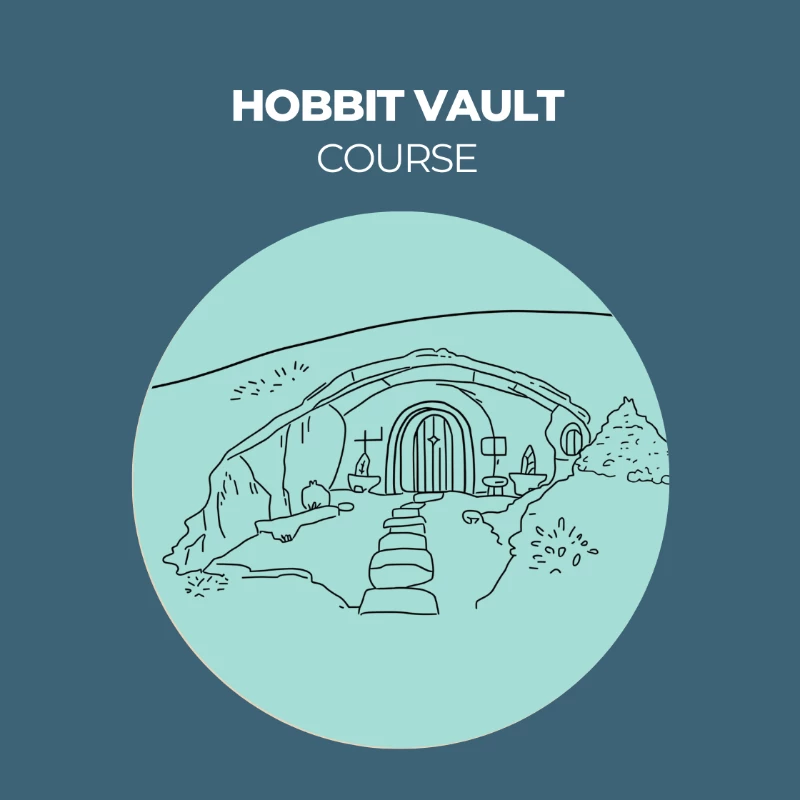
Apply these pacing and containment principles with the Naturalistico Hobbit Vault Course.
Explore Hobbit Vault Course →