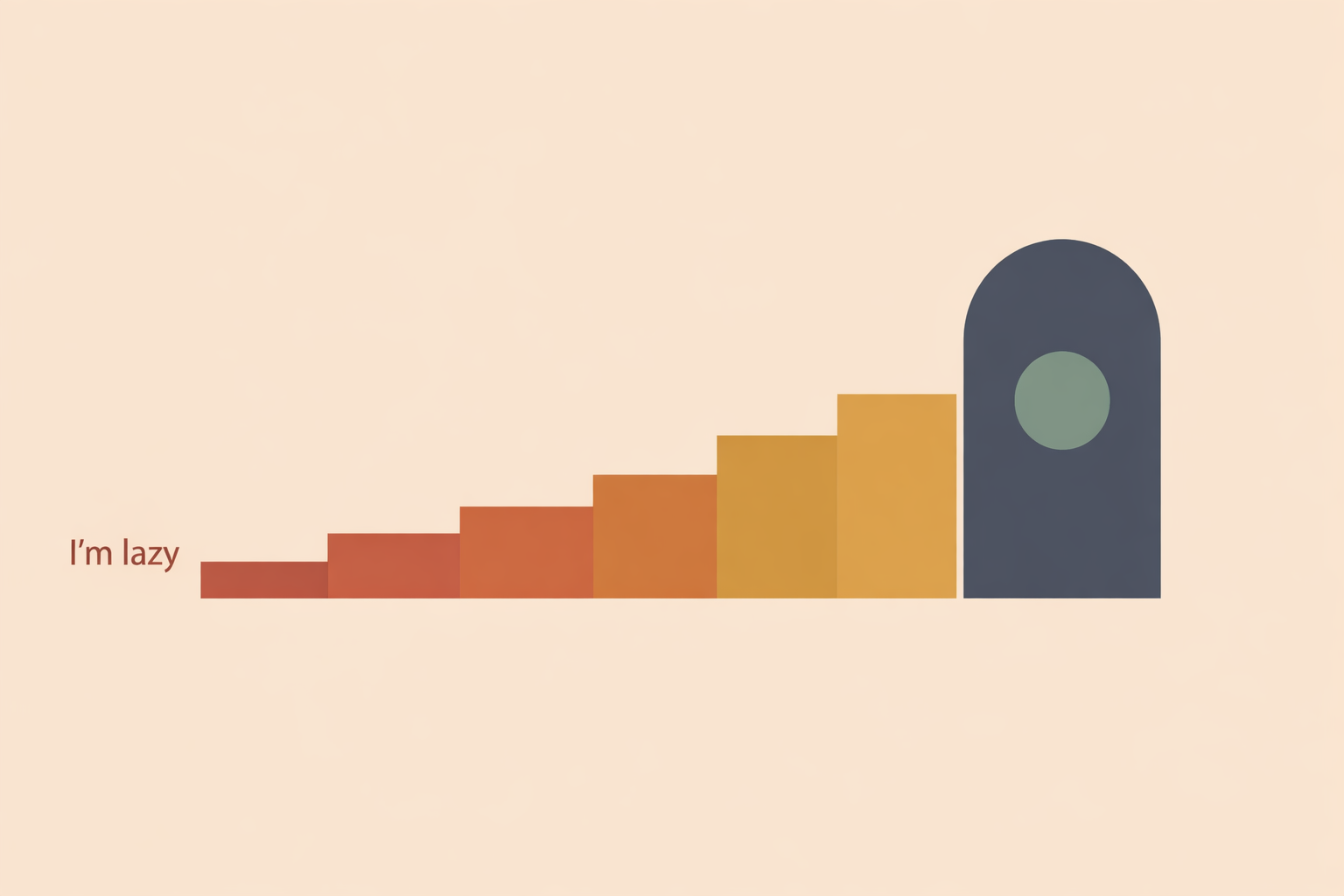
Most practitioners hit the same wall: a capable client shrugs, “I’m just lazy,” and the work stalls. Intakes are full of procrastination goals, yet skills and intentions are rarely the real bottleneck. Energy drops the moment the real task appears, and the options shrink to pep talks, stricter deadlines, or yet another tool the client won’t use. When the story stays at the identity level—“I am the problem”—it’s harder to create movement, and if that label isn’t translated into a specific next step, shame increases and follow-through starts depending on “good days.”
The more useful move is simple: turn “I’m unmotivated” into something observable, workable, and repeatable. In NLP practice, that means shifting from identity labels to clear outcomes, values, state, imagery, and practical follow-through.
Key Takeaway: Motivation problems often soften when structure improves. A five-step NLP sequence can help clients move from identity labels to repeatable action: define a context-specific micro-outcome, link it to meaningful values, create a grounded start ritual, change the inner movie that fuels avoidance, and install a simple start script that supports steady follow-through.
Key Takeaway: When “I’m lazy” is translated into a clear micro-outcome, values link, steady start ritual, supportive inner imagery, and a simple start script, action becomes more repeatable. Motivation often returns as a byproduct of aligned cues, state, and follow-through rather than willpower or pep talks.
Step 1: Turn “I’m Lazy” into a Specific Outcome
Start by changing the frame. When a client says, “I’m just lazy,” the aim isn’t to argue with the label—it’s to translate it into a clear pattern and a specific outcome they actually want.
With Luis, a creative professional stalling on a proposal, I asked, “If today went your way, what would you do differently—what, where, and when?” That shift matters because identity labels can shut down curiosity, while situational language opens options. It aligns with the finding that situational descriptions can expand perceived choices.
From there, we co-created a well-formed outcome: “Draft the first two slides of the proposal at the coffee shop from 2–3 pm.” Clear what/when/where statements support follow-through, and what/when/where statements improve the likelihood of acting.
From problem story to pattern map
In many traditional lineages, one of the first supportive moves is re-storying—naming the struggle in a way that restores agency. NLP echoes that: instead of “I am the problem,” you map how the pattern runs and where to interrupt it.
- Trigger: When does the stall begin?
- Internal movie: What do you picture or say to yourself right then?
- Behavior: What do you do instead?
- Desired micro-outcome: What 10-minute action would count as a win?
That map keeps the work practical and protects the session from collapsing into self-judgment.
As the Association for Neuro Linguistic Programming reminds us, “Good Practitioner training should thoroughly cover the core skills and principles … and should include live practice, interaction, feedback and supervision, rather than just teaching theory.”
Step 2: Link the Goal to Values That Matter
Once the pattern is clear, motivation often returns when the action is connected to something personally meaningful. A client may resist the task, yet deeply care about what the task represents.
For Luis, the real driver wasn’t “finish the proposal.” It was contribution—sharing ideas that help small teams work more sanely. When we linked the micro-step to that value, his energy changed. This fits with the idea that meaningful values tend to support persistence more reliably than pressure.
Here’s a clean structure for shaping a well-formed outcome:
- Positive: State what is wanted, not what should stop.
- Evidence: Make completion visible and concrete.
- Context: Define where and when it happens.
- Agency: Keep the action within the person’s control.
- Ecology: Make sure it fits the wider life of the person.
Then future pace it. I guided Luis to imagine arriving at 2 pm, opening the laptop, hearing the café murmur, and feeling his shoulders settle. That kind of mental rehearsal tends to land best when paired with a specific cue and plan; cue-specific planning strengthens visualization.
We added a simple if-then cue: “If it’s 2 pm and I sit down with coffee, I open Keynote and draft Slide 1.”
Keep the first action small. Near steps build confidence and momentum, and small steps reliably create traction.
As ANLP puts it, “A solid NLP Practitioner Certification should be competency‑based – you are evaluated on your ability to demonstrate the patterns in live interaction, not just on passing a written exam.”
Step 3: Create a Grounded Start Ritual with Anchoring
Even with a meaningful goal, the moment of starting can feel heavy. This is where state work shines. Instead of waiting for inspiration, clients learn to enter a steadier, more available state before they begin.
Before Luis’s 2 pm work block, we designed a 60-second start ritual: stand, roll shoulders back, hand on chest, three paced exhales. Small shifts in physiology can shift perceived energy; upright posture is linked with less fatigue than a collapsed posture.
Then we set an anchor: a simple finger press paired with that grounded, purposeful feeling. This follows basic conditioning logic, where a touch cue can begin triggering the desired response after repetition.
Use steadiness, not hype
A short, repeatable start routine usually beats a burst of high-energy motivation. Think of it like laying tracks: calm state + clear first move tends to carry farther than intensity that fades overnight.
Across cultures, people have long used breath, rhythm, gesture, incense, or song to call in the qualities needed for the task at hand. NLP gives modern language to something traditional practitioners already understand: repeated sensory cues can reliably shape inner state.
Skillful state work deepens with feedback and repetition. As ANLP emphasizes, foundational training is strongest when rooted in interaction, feedback, and live practice.
Step 4: Change the Inner Movie That Fuels Avoidance
If the internal movie of a task feels huge, punishing, or overwhelming, avoidance makes sense. One of the most practical NLP moves is to change the qualities of that inner experience so the first step feels more approachable.
When Luis pictured the proposal, he saw a giant, blurry wall of text and heard a stern inner voice. We experimented: move the image to arm’s length, brighten it, lower the critic’s volume, and strengthen a supportive voice. Evidence suggests adjusting imagery can reduce avoidance, and first-person imagery can increase readiness to act.
We also used mental contrasting. Instead of only imagining success, Luis named the likely obstacle—perfectionism—and rehearsed a coping response: “If I freeze on wording, I write a rough placeholder and keep going.” In practice, mental contrasting tends to outperform positive visualization alone for sustained effort.
Soften perfectionistic self-talk
Language can either tighten the knot or loosen it. I invited him to shift from absolutes like “This must be flawless” to process language: “I’m learning to make clear points quickly.” That aligns with the finding that process-based self-talk reduces paralysis more effectively than harsh inner pressure.
We also reframed effort as skill-building and experimentation. A growth-oriented frame helps people stay in motion, and skill-building effort supports persistence.
Many ancestral traditions use metaphor, story, and symbolic reframing to make a daunting path feel walkable. story, imagery, and submodality work carry that same spirit: change the felt meaning of the task so the next action is easier to claim.
Step 5: Align Inner Parts and Install a Start Script
When someone is stuck, it’s often an inner conflict rather than a discipline issue. One part wants progress; another wants safety, rest, or protection from disappointment. When you work with both, change tends to become steadier.
With Luis, I invited dialogue between the “Eager Builder” part that wanted to share ideas and the “Careful Steward” part that wanted quality and recovery. We negotiated a plan both could support: two light slides today, then 20 minutes of rest. This fits with the view that internal conflict can drive stuckness, and that exploring both sides supports more stable change than blunt pressure.
Next, we modeled a past success. “Think of a time you started quickly,” I said. We unpacked the sequence—coffee first, timer on, rough first draft, then polish—and turned it into a repeatable strategy. These early wins matter because small wins build self-efficacy.
Build a one-page Start Script
- Cue: 2 pm, coffee shop table
- Ritual: three paced exhales + anchor press
- Micro-goal: two rough slides
- Coping plan: placeholder text if stuck
- Completion: stop at 60 minutes and log the win
This works because layered support tends to outperform single tactics; multi-component plans generally beat one-off strategies. Over time, it also encourages an identity shift—from “someone who delays” to “someone who shows up”—and identity shift supports sustainable change.
It’s also deeply human. Across many traditions, inner tendencies are personified and brought into dialogue through story, ritual, and reflection. NLP offers a structured way to do that respectfully and practically.
And again, as ANLP underscores, mature practice is best cultivated through competency‑based learning and real supervision.
Putting the 5 Steps into Practice
By the end of this work, Luis wasn’t waiting to feel motivated—he was running a simple system. We named a clear outcome, linked it to values, created a start ritual and anchor, softened the inner movie, and aligned the parts involved. The result wasn’t dramatic; it was better: two slides, then two more, then a small block the next day.
That’s the lesson for practitioners: motivation is rarely one lever. It’s a pattern made of meaning, language, imagery, state, cues, and follow-through—and when those pieces align, movement becomes more natural.
You’ll often see early signs the shift is real: more specific language, a calmer posture, and immediate micro-commitments. Sustainable growth usually comes less from one-off techniques and more from regular practice in community, and community practice supports more enduring change than isolated events.
Used well, these tools can sit comfortably beside older ways of working with story, ritual, and personal agency. Keep it respectful, stay grounded in ethical, client-centered coaching, and avoid borrowing cultural practices without clear context, permission, and care.
Train NLP Practitioner Skills
Build repeatable motivation and follow-through patterns with the NLP Practitioner Certification.
Explore NLP Practitioner →