Many practitioners begin inner child work with reflection prompts and clear explanations. Yet people can name their patterns and still feel braced, stuck, or flooded when a familiar trigger hits. When words get ahead of the body, the “adult analyst” takes over and the younger emotional states that drive reactions stay untouched.
Structured play for adults often changes that. It externalizes experience, slows the pace, and lets the adult self practice steady, reliable care in real time.
Key Takeaway: Play-based inner child work for adults tends to land best when the inner child is held as a metaphor and reparenting is practiced through attuned action. Useful approaches include imaginative meetings with the child-self, sand trays and object worlds, expressive arts rituals, playful parts dialogue, and somatic regulation games. Together, they help insight become felt experience, choice, and follow-through.
1. Imaginative Meetings With the Child-Self
Guided imagination is often the simplest doorway into inner child work. It creates a contained space to practice care, choice, and return. Research on guided imagery suggests reduced anxiety and improved quality of life, which fits with how many people experience this work when it’s paced well.
In practice, the inner child is best held as a living metaphor for younger emotional states and learned protective patterns, rather than a separate being. That framing keeps the work grounded. From there, reparenting is the adult self practicing attunement, validation, and boundaries with these younger states.
Across many traditions, guided journeys and inner-figure blessings have been used for emotional repair for generations. Imaginative inner work has deep human roots, even if the modern language around it is new.
The core move is steady and repeatable: meet the child-self with curiosity, then respond as the adult you needed.
Guided Script: A First Inner Child Dialogue
- Set a 12-minute timer. Sit comfortably, one hand on your heart and one on your belly. Whisper, “I’m here.”
- Picture a place your younger self felt drawn to: a backyard tree, a library nook, a beach at dusk. Let the scene have color, sound, and temperature.
- Invite the child-self to appear at a comfortable distance. Notice posture, expression, and age without forcing detail.
- Say silently or out loud: “Hi, I’m your adult. I won’t push. I’ll listen.” Wait for three slow breaths.
- Ask one gentle question: “What do you need today: comfort, space, play, or protection?” Listen for words, images, or sensations.
- Offer a brief response. For example: “I hear you want comfort. I can make us tea and wrap us in a blanket after this.”
- Close the meeting: “I’ll be back tomorrow. You’re not alone.” Picture the child-self returning to the safe place, then open your eyes.
Example: Jordan, 38, imagines his eight-year-old self clutching a school notebook. When he asks what is needed, tightness in his chest answers: protection. His adult self replies, “I’ll speak up in tomorrow’s meeting if we’re interrupted. I’ve got us.” That one promise becomes the week’s anchor.
2. Sand Trays and Object Worlds
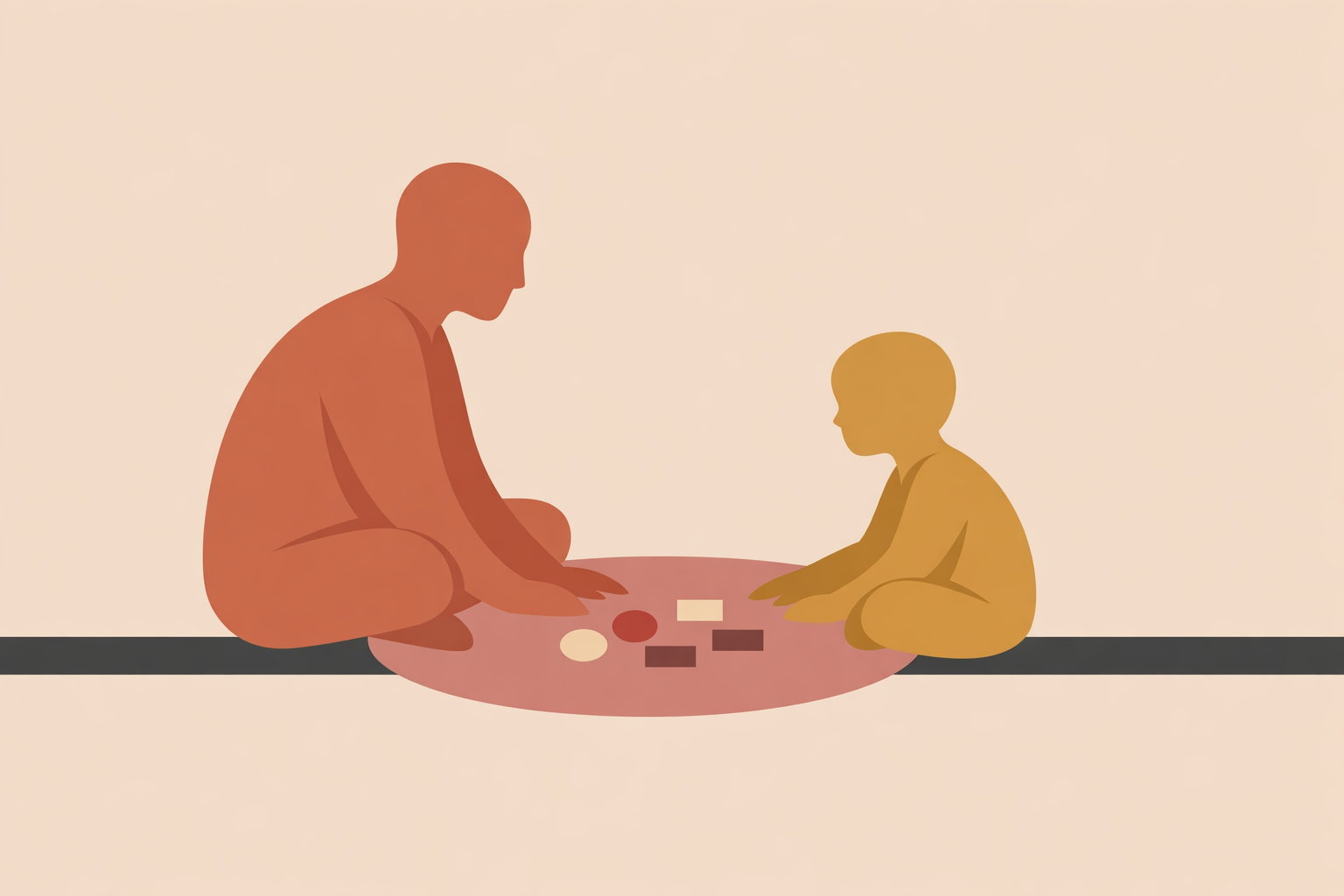
A shallow tray, a bowl of sand, and a few small objects can turn an inner knot into something visible and workable. Externalizing experience makes it easier to observe, adjust, and care for, especially for adults who feel overwhelmed by talk-first approaches.
In practitioner experience, adult-focused sandplay is often linked with more emotional steadiness and overall well-being. The process matters more than interpretation. Long before formal sand trays, many communities used shrines, altar-building, and nature bundles to symbolize relationship, memory, and protection. Object work follows the same logic: meaning is made through placement, distance, and gesture.
Non-directive guidance keeps this work respectful and effective. Avoid fixed meanings for colors, objects, or positions. Ask instead about felt sense and choice: What changed when the stone moved closer? What makes this scene feel 5% safer?
Guided Script: A Three-Object Scene
- Gather 10 to 15 small items: stones, leaves, figurines, coins, beads. Place sand, salt, rice, or a cloth in a tray or bowl.
- Choose three objects: one for the child-self, one for the adult self, and one for a protector such as the critic or pleaser.
- Place them without overthinking. Notice first impressions: “The child is far from the adult,” or “The protector is blocking the path.”
- Ask: “What one change would help the child feel 5% safer?” Make that change slowly.
- Watch your body as you adjust. A deeper breath, softer jaw, or lowered shoulders can be useful signs that the change is landing.
- End with a deliberate choice: “I leave the bridge in place,” or “I’m moving the protector to the side.” Photograph the scene only if you genuinely want to keep it.
Example: Priya uses a tiny house for her adult, a blue bead for her child, and a coin for the protector. The coin sits between house and bead. She slides the coin aside and places a twig behind the bead. “Now the child has somewhere to lean,” she says, and her breathing slows.
3. Expressive Arts and Creative Reparenting
When insight alone doesn’t shift the pattern, creative practice often opens the next door. Drawing, writing, humming, weaving, or movement can hold truths that stay out of reach when everything must be explained.
Practitioners value multimodal expressive-arts work because it supports emotion regulation, meaning-making, and reflection without forcing a neat verbal story. Traditional cultures have long known this. Song, story, drumming, and seasonal ritual have supported communities through grief and transition for generations.
Process matters more than polish. Creative work helps you name a need, and then reparenting turns that need into care, boundary, or follow-through.
Guided Script: A Two-Part Letter
- Part 1, from the child-self, 5 minutes. Begin: “Dear Adult Me, here’s what I’ve been carrying...” Write without stopping. If words stall, draw a quick symbol instead.
- Part 2, from the adult self, 5 minutes. Begin: “Dear Little Me, I’m here now. I believe you. Today I will...” Offer one concrete action and one soothing phrase.
- Ritual seal, 2 minutes. Fold the pages together. Place them under a stone, candle, or plant. Whisper, “I’m keeping this safe.”
Sample lines adults often write:
- Child-self: “Dear Adult Me, I hide my report cards in dreams. I’m scared of the red pen. Please don’t make me earn love.”
- Adult self: “Dear Little Me, I won’t grade your joy. Today I’ll block one hour for messy art. Tomorrow, I’ll say no to the extra shift.”
Optional movement add-on: stand as the child-self with shoulders curled and eyes down. Then slowly lift your chest, plant both feet, and turn your palms outward as the adult self. Say, “I’m here now.” Let your body mark the difference.
4. Playful Parts Dialogue and Role-Play
Another strong approach is to give different inner states a clear place to speak. Three cushions on the floor can become the protector, the child-self, and the adult self. Moving between them turns reflection into an embodied choice you can feel.
Parts language softens judgment. Instead of “Why am I like this?” the questions become: “What is this part trying to prevent, provide, or protect?” Many cultures have long used circles, story, masks, and role-play to meet inner forces and social roles with care. Modern parts work fits alongside that older wisdom when it’s done with respect.
Reparenting stays central: the adult self validates the child, thanks the protector for its efforts, and sets boundaries that support steadiness and growth.
Guided Script: Three-Part Dialogue
- Set a 15-minute container. Label three cushions: Protector, Child, Adult.
- Sit on Protector. Speak in first person for two minutes. Example: “I interrupt you before others can. I’m here to prevent embarrassment.”
- Move to Child. Speak for two minutes. Example: “When you interrupt, I feel small and freeze. I want time to finish my thought.”
- Move to Adult. Address both: “Protector, thank you for trying to keep us safe. I’ll handle meetings now. Child, I’ll raise a hand and finish our points. If we’re interrupted, I’ll say, ‘I wasn’t finished.’”
- Close with one boundary and one care action. Example: “Boundary: no volunteering for extra tasks this week. Care: a quiet walk after work.”
Composite example: Mateo’s pleaser says, “I say yes so no one gets mad.” His child-self replies, “I’m tired.” The adult concludes, “I’m saying no to tonight’s request. I’ll send a kind, clear message by 6 p.m.” After sending it, he texts a friend: “Kept my promise to us.”
5. Somatic Play and Regulation Games
To make inner child work more workable, bring it back to the body. Gentle, game-like practices widen the space where emotion feels manageable. Public guidance on the window of tolerance describes how breathing, movement, and sensory support can help people return to steadiness.
Somatic work here means noticing sensation, breath, posture, and movement without pushing for a big story. Preferences matter: some people settle through rhythm and pressure, others through visual orientation or voice. Traditional lineages have also long used drumming, humming, shaking, and breath to support settling and reconnection.
You’ll usually feel when a practice is landing: breathing deepens, the jaw softens, the shoulders drop, or the room feels easier to stay with.
Guided Script: A Playful Grounding Sequence
- Five-Color Orientation, 2 minutes. Name five objects of five different colors in the room. Let your eyes move slowly.
- Rhythm Tap, 3 minutes. Tap left thigh, right thigh, left chest, right chest in a steady pattern. Whisper, “Here now.”
- Shake and Sweep, 2 minutes. Shake hands and feet for 20 seconds, pause, then sweep your arms downward as if brushing off dust.
- Humming Anchor, 2 minutes. Hum one comfortable note. Feel the vibration in your chest, lips, and face.
- Boundary Rehearsal, 3 minutes. Stand and practice a clear “No” with palms out, then an open “Yes” with hands to heart. Switch several times.
- Close and Choose, 1 minute. Hand on belly: “What’s one small choice I can make now?” Write it down.
Example: Alia does the sequence before a difficult call. By the end of tapping, her jaw has softened. After humming, she feels warmth in her chest. The choice she writes is: “Speak slowly. One point at a time.” The call goes better, and she finishes it feeling proud of how she showed up.
Weaving These Approaches Into Ethical, Grounded Practice
These five approaches are most effective when they’re woven together. A brief imaginative check-in can help you find the thread, a regulation game can build steadiness, and a two-part letter can capture what you want to live differently. For hands-on thinkers, objects and sand often make the safest starting point in trauma and emotional healing work.
Ethics are what make experiential work trustworthy. Consent, privacy, choice, and cultural respect form the container. If you keep images, writings, or object scenes, do so only with explicit agreement and clear boundaries.
Scope matters too. Self-guided inner child exercises are not enough on their own for overwhelming distress or high-risk situations. If someone becomes persistently disoriented, feels unsafe, or cannot manage daily basics, pause the self-guided work and seek additional support.
Honor cultural roots as well. If you draw from song, drumming, ritual, or ancestral forms, acknowledge lineage, avoid appropriation, and stay teachable.
Close every session, whether personal or client-facing, with integration:
- What did I learn about my need?
- What boundary honors it?
- What one action will I take this week?
That’s how play-based inner child work becomes more than insight. It becomes a lived practice of offering yourself reliable care, and for practitioners building inner child work skills, that consistency is what helps the work carry into daily life.
Train in Inner Child Work
Deepen these play-based reparenting skills with the Inner Child Work Certification.
Explore Inner Child Work Certification →