Most practitioners recognize the moment: a client’s effort stalls, so you tighten the plan, add more accountability, or build another habit stack. Progress picks up briefly, then the old pattern returns. The other common move is a dense mapping exercise that looks impressive and changes very little between sessions.
Both miss the same reality. Clients move through networks of people, places, incentives, and stories. Weekly notes can capture tasks, yet miss the cross-pressures shaping behavior. And when the issue is framed as pure willpower, the client gets isolated from the very leverage points that make change easier.
Key Takeaway: Systems maps work best when they are simple, collaborative, and tied to action. Used well, they help clients see relationships, patterns, structures, and next steps without turning the process into homework they will never revisit.
1. Stakeholder Ecosystem Map: Make the Web Around the Client Visible
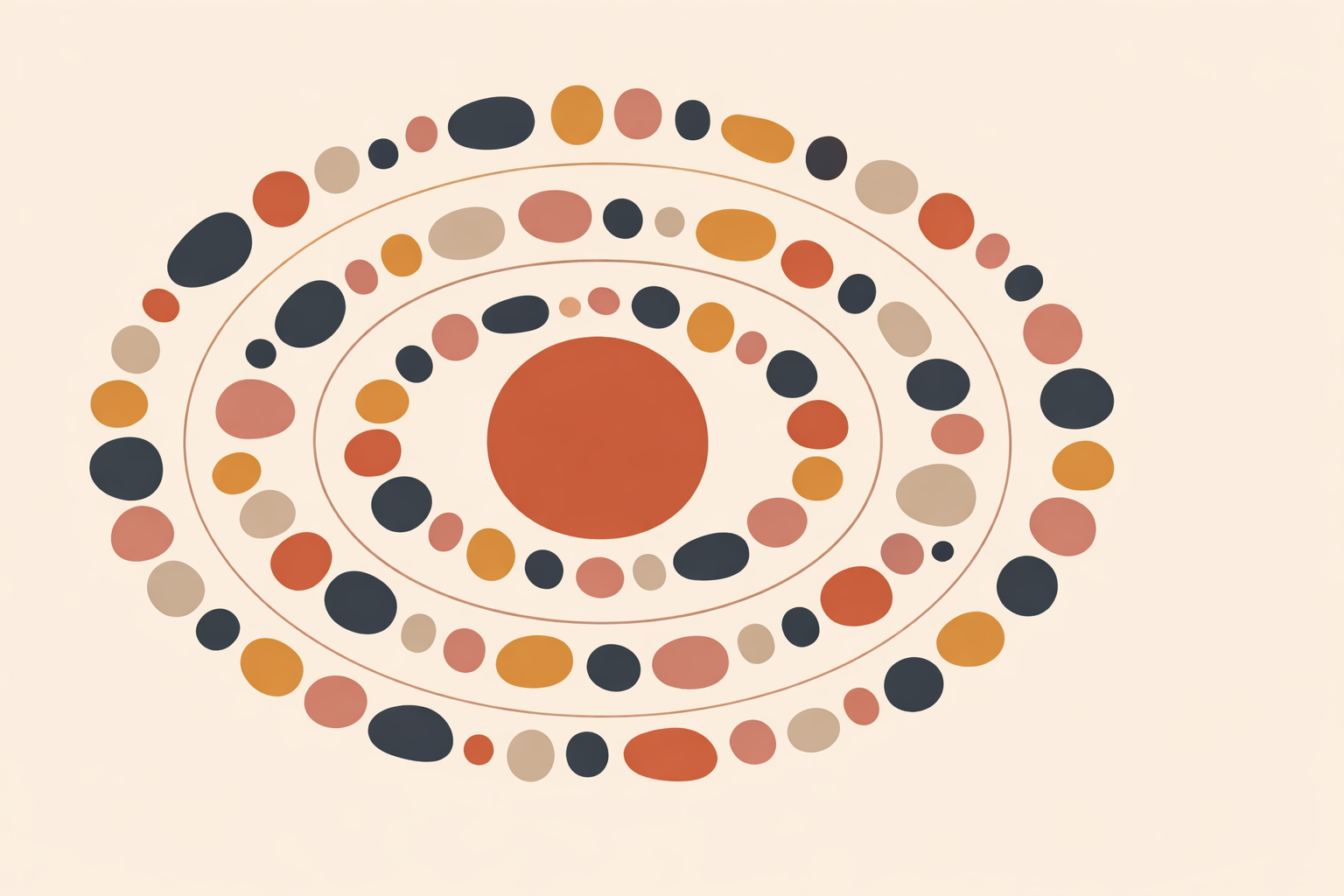
Start here when a client feels stuck, unsupported, or solely responsible for everything. A stakeholder ecosystem map makes the surrounding web visible: relationships, expectations, environments, routines, and pressures that quietly steer day-to-day choices.
Write the client’s name (or main focus) in the center. Around it, add the people, groups, spaces, and influences shaping the situation. Arrange them by closeness, influence, or emotional weight. Neatness is optional; shared clarity is the goal.
Helpful prompts include:
- Who nourishes your energy?
- Who drains it?
- Who sets the rules?
- Who quietly softens those rules?
- Who carries wisdom, memory, or lived experience that matters here?
- Who is affected if this pattern changes?
- Who is missing from the picture?
A simple example: a client names stress as a personal struggle. Once the map is on paper, you can see the aunt who encourages them, the co-worker who interrupts breaks, the crowded home environment, the faith community that restores them, and the unspoken expectation to be available to everyone. The question often shifts from “Why can’t I stay consistent?” to “What around me keeps pulling me off course?”
Keep it revisable. Systems thinking guidance describes mapping as an iterative process, so revisit it as conditions change. Date updates, circle shifts, and redraw when the client’s world reorganizes.
2. Client Journey Map: Trace Where Energy Rises, Drops, or Gets Blocked
Once the ecosystem is visible, bring time into the picture. A journey map follows what actually happens across a day, week, or repeating situation, which is often where hidden friction shows itself.
People don’t live in categories; they live in moments. The rushed morning, the heavy afternoon, the tense commute, the quiet hour that settles everything. A journey map respects that lived rhythm and turns it into useful detail.
Keep it practical with a few simple lanes:
- Stages or time points
- Visible actions
- Thoughts or inner commentary
- Feelings or energy shifts
- Support and barriers
Move through the timeline together and watch for reliable rises, drops, and stuck points. A client might say, “My afternoons always fall apart,” and the map reveals something more workable: no pause between meetings, no food until late, and a difficult call placed right before a focus-heavy task.
Journey mapping keeps coaching grounded. It reveals repeated transitions that drain energy, duplicate effort, or create avoidable friction, and those are often the easiest places to redesign in whole person coaching.
One prompt that consistently helps: “Let’s mark the bump, then ask what would cushion it: a person, a practice, or a pause?”
3. Causal Loop Diagram: Show Recurring Patterns Without Blame
When the same pattern keeps returning, a causal loop diagram helps you shift from isolated events to the dynamics that keep the cycle moving.
Causal loop diagrams highlight feedback loops that shape behavior over time. Once you can see reinforcing forces, the conversation becomes less personal and more practical.
Start with a handful of neutral factors, such as:
- Rest
- Clarity
- Available time
- Requests from others
- Confidence
- Support
- Perceived risk
Connect them with arrows and ask, “When this rises, what tends to happen next?” Keep the wording observational rather than moral. That small choice often softens self-judgment and opens room for experimentation.
Example: a client keeps overcommitting. The loop might look like this: weaker boundaries lead to more obligations; more obligations reduce rest; lower rest reduces clarity; lower clarity makes it harder to say no; and weaker boundaries return again. The pattern starts to look like momentum, which means you can interrupt it.
These diagrams also help you aim beyond quick fixes and toward underlying structures. Systems-thinking guidance uses causal loops and the Iceberg Model to look beneath events toward deeper structures.
Keep early versions rough. Systems tools can start simple and grow only when the client needs more detail. A five-minute sketch is often enough to find the next experiment.
4. Iceberg Model: Go Beneath Events to Patterns, Structures, and Stories
The Iceberg Model is a steady template for deeper reflection. It helps clients move below a visible event and explore what keeps it repeating.
The four levels are simple:
- Events: what happened
- Patterns: what keeps happening
- Structures: routines, conditions, roles, and incentives that make the pattern more likely
- Mental models: beliefs, assumptions, inherited stories, and identity-level meanings
This matters because deeper layers shape the surface. The Iceberg framework points to mental models beneath events, helping people understand why familiar situations reappear.
This is also a natural place to honor traditional knowledge and family memory with care. A client’s pattern often makes more sense alongside migration stories, cultural expectations, spiritual commitments, and long-held family roles. These roots can be named respectfully and explored without rushing to erase them.
To keep the work light enough to use, add a second column called “new possibility.” Next to the event, note one immediate shift. Next to the pattern, one interruption. Next to the structure, one practical redesign. Next to the mental model, one gentler belief to test.
It also helps to label what is observed versus inferred. Notes like “seen,” “reported,” or “assumed” keep the map honest and usable.
5. Leverage and Action Map: Turn Insight Into Small Experiments
After mapping relationships, journeys, loops, and deeper structures, the next step is choosing what to try first.
A leverage and action map helps the client translate insight into small experiments that fit real life. The aim is to spot the few shifts with the biggest payoff.
A simple four-part layout works well:
- Influence now: actions within immediate reach
- Influence with support: possible with help, coordination, or timing
- Learn more first: areas that need observation before action
- Outside current control: realities to acknowledge, work around, or address collectively
Then define each option as an experiment: the first step, the time frame, what the client will notice, and what would count as useful learning. This keeps the map alive between sessions.
In practice, that might mean choosing between moving a phone charger out of the bedroom, asking a relative to share an evening responsibility twice a week, or tracking which nights are most disruptive before changing anything else. Usable beats dramatic.
The best maps survive the client’s actual day. If an action can’t fit into real routines, the map still needs editing.
How to Use These Templates Together
These five tools form a natural sequence, but you don’t need to follow it rigidly.
- Use the stakeholder ecosystem map when the client feels alone or over-responsible.
- Use the journey map when the pattern is happening across time and daily transitions matter.
- Use the causal loop diagram when the same cycle keeps repeating.
- Use the Iceberg Model when the visible struggle clearly has deeper roots.
- Use the leverage and action map when the client needs a kind, realistic next step.
Some sessions only need one map. Others move naturally from one to another. Let the client’s capacity lead, and keep the work proportionate to what they can carry between sessions in purpose and life design.
Keep the Maps Collaborative and Revisable
These tools work best when built with the client, not for the client. In complex change work, participatory mapping helps involve stakeholders instead of relying on a single fixed viewpoint.
Co-creating improves accuracy and ownership. Clients revisit maps when they can recognize their own words, rhythms, and priorities on the page.
It also pays to stay humble about what any map can capture. In complex systems, knowledge is partial and evolving, so maps serve best as learning companions rather than final answers.
When uncertainty shows up, label it clearly: known, reported, assumed, contested, or still exploring. That one habit keeps the work grounded without draining its momentum.
Closing Reflection
Good systems mapping is not about producing impressive diagrams. It is about helping clients see their situation more clearly, with more compassion and more options.
Reveal the surrounding web. Trace the journey. Notice the loops. Look beneath the surface. Then choose one small respectful action to test in real life.
Used this way, systems maps become living companions for change. They honor complexity without overwhelming the client, and they leave room for both practical insight and deeper wisdom. Most of all, they remind people they are not failing in isolation. They are moving inside a larger pattern, and patterns can be redrawn through systems-based life coaching.
Master Systems-Based Coaching
Apply these mapping tools more confidently in the Systems Based Life Coaching Certification.
Explore Systems Coaching →