


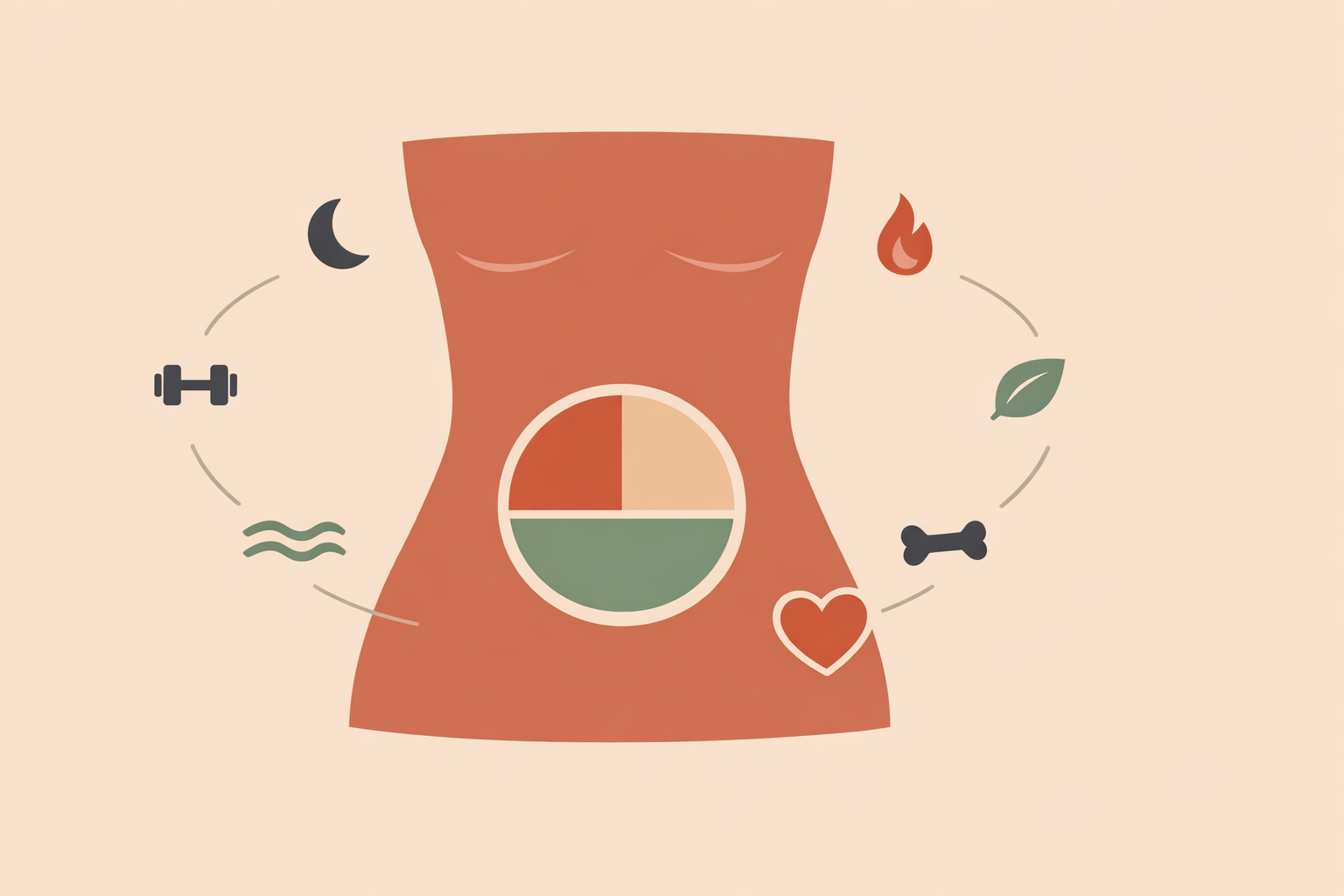
Menopause nutrition groups often reveal a familiar pattern. You may plan to talk hormones, but the room goes straight to belly changes, stalled weight loss, afternoon crashes, and sleep that won’t settle. Someone says, “I’m doing what worked at 35, and it’s not working now,” and you can feel the relief in the nods around the circle.
Good group guidance starts with those lived concerns and turns them into small, workable experiments. The aim is body literacy, steadier meals, and habits that support strength, energy, rest, and confidence without perfectionism.
Key Takeaway: Menopause nutrition support lands best when it follows the concerns women actually bring into the room: weight shifts, energy swings, hot flashes, bone strength, mood, and sleep. A practical structure starts with body literacy around abdominal weight gain, then builds into protein and resistance work for strength, steadier meals for cravings and energy, simple trigger-tracking for hot flashes, bone-supportive nutrition, Mediterranean-style food patterns adapted to culture, and calming evening routines. The goal is not rigid compliance but collaborative experimentation and durable change.
Menopause weight and the “meno-middle”
Start where the room already is: “same habits, different results.” That experience is real. As estrogen declines, fat storage often shifts abdomen-ward, and abdominal fat is also linked to lower insulin sensitivity.
A steadying frame for groups is: your body is not broken; it’s asking for different support. That one idea can reduce shame and make change feel possible again.
Keep first steps modest and visual. A balanced plate works well:
- About one-quarter protein
- About one-quarter whole-grain or other satisfying carbohydrate
- About half vegetables
Then bring curiosity to “unseen extras” that add up without much satisfaction: flavored coffees, habitual evening drinks, handfuls while cooking, and ultra-processed convenience snacks. No moralizing, just pattern-spotting.
- Ask: “Where did extra energy slip in yesterday without adding much satisfaction?”
- Try pleasure-preserving swaps: crisps before dinner to olives and carrots; nightly ice cream to yogurt and berries a few nights a week.
A question that reliably keeps the tone kind: “On a scale of 1 to 10, how kind did your eating feel this week?”
Protein, muscle, and midlife strength
Once the weight conversation feels calmer, move to strength. Many women arrive focused on shrinking, but building resilience often changes everything: more stable energy, more capability, and more trust in the body.
Lower estrogen is associated with age-related muscle loss, which is one reason protein matters more in midlife than many women expect. A practical target for many is 20–30 g at main meals, with around 10 g at snacks if needed.
It also helps to distribute protein across the day. Reviews suggest spreading protein across meals can support satiety better than saving most of it for one sitting.
Keep examples culturally flexible:
- Eggs, yogurt, or fortified dairy alternatives
- Fish, poultry, or other animal proteins if chosen
- Tofu, tempeh, and fermented soy foods
- Beans, lentils, and chickpeas
- Nuts, seeds, and seed butters
Breakfast can be simple: tofu scramble with whole-grain toast, or yogurt with hemp hearts, walnuts, and fruit. The goal is a steady signal for strength, not perfect eating.
Pair protein with basic resistance work. In groups, that can be sit-to-stands from a chair or wall push-ups. Eat protein, ask your muscles to work, repeat often.
Cravings, afternoon slumps, and steadier energy
“Why am I craving everything at 3 p.m.?” comes up constantly. Most of the time, it’s not willpower. It’s a disrupted rhythm.
In midlife women, sleep disturbance is common, and sleep disruption can contribute to increased intake, more cravings, and uneven energy. When stress and life-load layer in, the afternoon crash makes sense.
Regular, satisfying meals are often the fastest correction. Many women do well with three anchored meals and, if needed, one planned snack that combines protein and fiber.
Useful snack pairs:
- Apple and almonds
- Hummus and carrots
- Oatcakes and cheese
- Dates with tahini
Fiber is a quiet ally here. A daily baseline of about 25 g is practical, and some women do well with more when increases are gradual. Fiber supports fullness, digestive comfort, and steadier energy.
Try this group prompt: “Name one high-fiber food you already enjoy. How can it show up twice a day this week?”
For a worked example, keep it ordinary: oats with chia and yogurt; lentil soup and toast; fruit and peanut butter; salmon or tofu with quinoa and salad. Most groups immediately recognize how different that day would feel from coffee, grazing, and a large late meal.
Food triggers, hot flashes, and cooling-night experiments
Food doesn’t erase hot flashes, but it can shape intensity for some women. Traditional practice and day-to-day observation both point to common personal triggers: caffeine, alcohol, spicy foods, and hot drinks.
Keep this experimental rather than prescriptive. Instead of a forbidden list, offer a two-week “cooling nights” lab:
- Reduce afternoon and evening caffeine
- Pause hot drinks after dinner
- Notice whether alcohol changes night comfort
- Test lighter evening meals for a week
If the group is interested in soy foods, flax, or tempeh, evidence suggests modest effects from phytoestrogen-rich foods for some people. That’s a fair message: sometimes helpful, individual in response.
For longer-range support, overall patterns matter. Greater adherence to a Mediterranean-style pattern is associated with milder symptoms in postmenopausal women, so it’s a strong foundation even when the immediate aim is sleeping cooler.
Keep tracking light for two weeks:
- What they ate or drank after 4 p.m.
- Bedtime
- Night waking
- Morning sense of rest
Then ask: “What changed enough to be worth keeping?”
Bone support: calcium, vitamin D, protein, and traditional foods
Bone health deserves a dedicated moment in menopause nutrition. Lower estrogen is linked to faster bone loss, especially early after menopause, so everyday choices start to carry long-term weight.
Helpful pillars for many women are:
- Calcium-rich foods
- Vitamin D support
- Adequate protein
- Regular weight-bearing and resistance work
Over time, combined calcium and vitamin D can help. Research suggests co-supplementation supports bone mineral density in postmenopausal women.
Food-first options are easier to apply:
- Yogurt or fortified alternatives
- Tofu set with calcium
- Beans and lentils
- Sesame and tahini
- Tinned fish with soft bones
- Leafy greens
Traditional kitchens already do this well: sardines on toast with lemon, tofu with sesame and greens, yogurt with nuts, beans simmered with dark leafy vegetables.
Vitamin C belongs in the picture too, because of its role in collagen synthesis. Fruits and vegetables support tissue integrity alongside minerals and protein.
Mood, gut comfort, and Mediterranean-style eating
Food isn’t the only influence on mood in midlife, but it is one of the steadiest daily levers. Traditional foodways that emphasize whole ingredients, regular meals, and shared eating often create a more even internal rhythm.
In peri- and post-menopausal women, healthy dietary patterns appear protective against depressive symptoms. By contrast, higher intake of ultra-processed foods is associated with higher risk in adults. The takeaway is pattern over perfection.
Women's health coaching often returns to this same principle, and Mediterranean-style eating works well in groups because it’s broad and adaptable:
- Vegetables and fruits
- Legumes
- Whole grains
- Nuts and seeds
- Olive oil or other traditional fats
- Fish, dairy, or animal foods if chosen
It also supports the long game. In postmenopausal women, Mediterranean-style eating is associated with bone benefits, making it a strong foundation for this life stage.
Keep the conversation rooted in cultural continuity. Invite participants to adapt ancestral dishes rather than replace them: dal with added greens, rice bowls with beans and fermented vegetables, soups enriched with pulses, stews built around vegetables and intact grains.
From practitioner experience, antioxidant-rich plant foods and intact grains often leave women feeling lighter and more comfortable through the transition, even when changes are subtle. For some, increasing plant foods may also modestly improve vasomotor symptoms, especially alongside weight changes.
Sleep support through evening nutrition and calming routines
Sleep sits underneath almost every menopause nutrition concern. When sleep is short or fragmented, cravings rise, mood gets more variable, and tomorrow’s choices get harder.
Evening nutrition works best when it’s simple: a balanced dinner that isn’t too heavy and isn’t too late, with enough protein and satisfying carbohydrate to prevent hunger-driven wake-ups.
Common adjustments:
- Finishing dinner earlier when possible
- Reducing late caffeine
- Limiting alcohol in the evening
- Using a light snack if bedtime hunger is a pattern
Calming routines help many women. A review found relaxation practices and similar nonpharmacologic approaches improved menopause-related insomnia. In everyday life, that may look like dimmer lights, gentle stretching, slower breathing, a warm non-caffeinated drink, and fewer stimulating inputs before bed.
Some practitioners also find a gentle 12–14 hour overnight fast suits certain women, especially when it feels grounding rather than depleting. Treat it as an optional experiment. If energy dips, sleep worsens, or evening eating becomes tense, drop it.
Simple week-long tests:
- Light dinner by 7:30 p.m.
- Screen curfew one hour before bed
- Swap post-dinner wine for sparkling water with herbs or citrus
- If needed, choose a small snack such as banana with tahini or oatcakes with cheese
A closing prompt that tends to land: “What part of your evening genuinely settles your system?” Keep that, and build from there.
Running menopause nutrition groups as collaborative labs
These themes naturally build: body literacy, strength, steadier energy, cooler nights, stronger bones, more even mood, and better rest. The real skill is turning guidance into experiments women can live with.
A lab mindset keeps groups practical and respectful. Use shared observation more than rules. Invite women to test one or two changes at a time, then review what happened without judgment.
- Track meals and symptoms briefly, not obsessively
- Choose one weekly experiment
- Review what felt supportive, neutral, or unhelpful
- Keep what works and release what does not
This approach has room for modern evidence and traditional wisdom. Across cultures, natural menopause support often starts with the same everyday foundations: beans and broths, greens and grains, ferments, seeds, herbs, and shared meals that calm the nervous system as much as they satisfy appetite.
When guidance respects those roots and stays workable, women respond. The focus shifts toward repeatable rhythms and away from rigid rules. As with any nutrition change, individual needs, preferences, and existing health conditions matter, so encourage participants to personalize experiments and seek qualified support for complex situations, including through menopause coaching certification.
Train in Menopause Coaching
Deepen your group-ready strategies with the Menopause Coaching Certification.
Explore Menopause Coaching →










