Designers drawn to bio-architecture often hit the same wall: the concept wants shells, vaults, earth-thick walls, and interior planting, but the toolchain keeps snapping back to straight lines and surface styling. Stakeholders ask for polished visuals before you’ve even settled structure or climate strategy. You can mass a dome in an afternoon—yet turning that image into a coherent, climate-wise organism (with deliverables others can actually work from) takes a more dependable pipeline.
Key Takeaway: Organic bio-spaces become buildable when you follow a disciplined 2D-to-3D sequence that keeps intention, natural geometry, and climate strategy linked. Sketch by hand to clarify relationships, then model and test light, structure, and living systems together so your visuals and exports stay true to the organism you’re designing.
Step 1: Set intention and choose 2D–3D tools for organic bio-spaces
Start with what the space is meant to hold—quiet, community, food, learning—and let that intention steer your tools. Organic work lives in spirals, domes, vaults, and earth-shaped transitions, so your software needs to “speak curve” without constantly fighting you.
Honouring ancestral wisdom with modern software. Traditional building cultures have long trusted natural geometry because it performs: it holds weight elegantly, moves air, and softens light. Digital tools should support that same intelligence. Rhino handles free-form geometry through NURBS, while SketchUp is typically happier with orthogonal shapes. SketchUp is also popular for beginners, and it can be a perfectly good starting place until your curves demand more precision.
AI can help you move faster in early exploration, especially when you need something tangible to react to. Plan7Architect supports auto-generated 3D, and Floor-Plan.ai can turn a simple sketch into explorable 3D. In the property-tech world, plan-to-3D is increasingly treated as creative infrastructure—useful as long as you remain the one making the real decisions.
Choose based on the forms you’re committed to. If you’re pursuing catenary curves, earthen vaults, and shell structures, Rhino will usually carry you further. If you’re shaping rectilinear spaces with softened edges and planting-rich interiors, SketchUp (plus AI for quick massing) can be enough to begin. Either way, keep your compass set toward geometry that mirrors natural forms and living processes.
As one respected bio-architecture educator puts it, “biomimetic forms and systems are structurally stronger, more cost-effective, and more harmonious with natural landscapes” (Alosha). That’s a useful standard to return to whenever a tool tempts you toward convenience over coherence.
- Starter stack: hand sketching + AI floorplan-to-3D + SketchUp
- Curves-first stack: hand sketching + Rhino for NURBS + rendering plug-in
- Collaboration stack: shared cloud drive + model viewer + annotated PDFs
Step 2: Turn your bio-space story into hand-drawn 2D plans
Before any 3D work, draw by hand. This is the phase where traditional lineages shine: simple tools, clear proportions, and a direct relationship with land, climate, and daily use.
On graph paper, map the relationships that make the place feel alive: hearth to garden, entry to prevailing wind, bed to morning light. Modern trainings aligned with bio-architecture still lean on this stage because it builds graph paper precision and climate-aware orientation before software adds complexity.
Draw the vertical story—not just the footprint. A north–south elevation through a dome or vault reveals how thickness, openings, and curvature shape comfort. An east–west section shows how people move, where light lands, and how spaces shift from day to night. Many practitioners refine on paper, then rebuild digitally in a “graph-to-digital” loop that strengthens judgement and organic curves (graph to digital). Naturalistico’s pathway follows a hand-drawing-first approach for the same reason: you earn clarity before you chase polish.
As one set of instructors notes, this is where “traditional wisdom meets modern tools,” and where drafting becomes true spatial understanding (traditional wisdom).
“Organic architecture seeks superior sense of use and a finer sense of comfort, expressed in organic simplicity.” — Frank Lloyd Wright
- Plan: orientation, adjacencies, water and wind paths
- Elevation: openings, shell lines, shading elements
- Section: thicknesses, thermal mass, vertical flow
Step 3: Lift your 2D plans into 3D so the space can speak back
When your 2D drawings feel honest, lift them into 3D and start “listening” from the inside. Proportion, curvature, and light become immediate—this is where the space begins to speak back.
Many toolchains now let you extrude directly from plan outlines and adjust heights, thicknesses, and openings quickly. Some even generate walls with near-live updating as the 2D changes. In Naturalistico-aligned workflows, learners take their outlines into 3D and begin shaping foundations, earth walls, domes, and vaults—then orbit the forms to sense whether they “breathe” (Rhino 3D).
Volumetric modeling also makes practical truths visible. Curves show how forces travel through the structure and how openings affect load paths. Sun studies preview the daily and seasonal arc—shadow length, bounce light, and warm zones—so you can read light paths early, before decisions harden.
“Architecture is really about well-being... On the one hand it’s about shelter, but it’s also about pleasure.” — Zaha Hadid
- Test: walk-throughs, sun studies, section cuts
- Adjust: curve radii, opening sizes, wall thickness
- Sense: quiet corners, communal thresholds, views
Step 4: Sculpt structure, climate harmony, and stability in 3D
Now give the model its bones. Bring foundations, earth-based walls, domes, vaults, and openings into one integrated organism—always in conversation with your climate.
In nature-aligned practice, structure and climate are inseparable. Many trainings guide designers to model the whole system—foundation to shell to stair—through the lens of passive solar thinking. The goal is thermal self-regulation: forms and materials that steady temperature swings and reduce reliance on external inputs.
Refine these “climate moves” directly in 3D. Explore thermal mass in thick walls, protected south-facing glazing for winter gain, and earthen berms that buffer wind and stabilize indoor conditions. Curved forms—earthbag domes and earthen vaults—matter here not only for beauty, but for structural logic and thermal performance. For mass and infill, natural building traditions often draw on earthbags, rammed earth, soil-filled tires, and recycled components to create spaces that feel grounded and responsive.
We are “preaching organic architecture… determining form by way of the nature of materials.” — Frank Lloyd Wright
- Structure: shells, vaults, and tied openings
- Climate: sun angles, massing, glazing, berms
- Materials: local soil, stone, timber, reclaimed elements
Step 5: Weave life systems, interiors, and landscape into one organism
Once the bones feel right, invite the living layers. Plants, water, furniture, and pathways turn a shell into a functioning ecosystem.
Model the cycles you want the space to support. Many bio-architecture studios integrate interior planters, edible beds, and greywater wetlands directly into the building model, so water and soil cycles stay central rather than becoming afterthoughts. Outside, extend the 3D into berms, trees, and outdoor rooms—then place shade, windbreaks, and movement routes with intention.
Think in guilds and zones. Naturalistico’s sustainability offerings—including courses in permaculture and allied disciplines—support planning plant relationships, soil building, and food production as part of the design itself. Seeing these layers in 3D helps you plan for growth and seasonal change over time, so your paths and furnishings evolve with the landscape instead of competing with it.
Architecture should be able “to excite you, to calm you, to make you think.” — Zaha Hadid
These living layers often carry the emotional resonance people remember. A learner from Naturalistico’s urban food pathway shared that the expert guidance and practical exercises helped her feel confident planning her own projects.
- Indoors: planters, green walls, herb spirals, water features
- Outdoors: trees, swales, kitchen gardens, sitting stones
- Interiors: furniture aligned with sun, views, and plant care
Step 6: Render the sensory experience so people can feel the bio-space
With structure and living systems integrated, rendering turns the atmosphere into something others can feel. The goal isn’t just “nice visuals”—it’s communicating light, texture, and mood so collaborators understand the experience you’re designing for.
Strong rendering begins with honest modeling and careful choices around materials and lighting. Practical guidance highlights the impact of nuanced lighting and realistic materials, especially for earth, timber, and stone where subtle variation is part of the truth. If time is tight, AI-enabled workflows can accelerate the jump from working model to visuals; roundups of leading AI tools show how widely used this has become, including options that stay inside familiar pipelines like SketchUp AI.
Use the tech, but keep the soul. Some platforms can generate multiple decor themes and smooth walkthroughs from one model—handy for testing palettes like limewash, adobe tones, and local woods without losing momentum. Bio-architecture pipelines also pay close attention to living materials: leaf translucency, water shimmer, and earth tones under diffuse light.
Think of rendering as storytelling through sensation. A quiet winter sunbeam across an earthen bench often communicates the project’s values more clearly than any caption.
- Light: daylight studies, warm/cool balance, night scenes
- Materials: earth textures, local stone, regional timber
- Story: human scale, rituals, plants as co-inhabitants
Step 7: Export, review, and prepare to share your bio-space design
Finally, package the work so it can travel—clearly and respectfully—into collaboration. Export drawings, renders, and walkthroughs, then review them against your values before you share them with builders, communities, and supporters.
Most pipelines let you export high-res images, simple tours, and dimensioned PDFs that support clear discussion. Rhino and SketchUp models can also be exported into other tools for annotation, documentation, or higher-fidelity rendering when needed. In some bio-architecture curricula, the Wautillarium is used to show the arc from concept to a complete visual package (Wautillarium), including workflows that produce permit-ready drawings while keeping organic character intact.
Beyond files, bring a short narrative. A clear intent statement, one “mood” render, and a dimensioned plan are often enough to unlock grounded feedback. From there, Naturalistico’s ecosystem can support next steps across land care, planting, and place-based practice.
Keep a values checklist beside your exports. Do the spaces invite calm and connection? Do water and plants feel central rather than decorative? Are materials honest and locally grounded? As one course creator frames it, the aim is to design homes “self regulating in temperature—shaped by natural forces and geometry—adapted to climate, landscape, and materials.”
- Export set: key plans/sections, 3–5 renders, short walkthrough
- Review lens: sun, wind, water, soil, community rituals
- Share pack: intent summary, values checklist, collaboration notes
Conclusion: From sketch to sanctuary—integrate 2D–3D bio-design into your practice
This seven-step arc—intention, hand drawing, first 3D, structural climate work, living layers, rendering, and sharing—turns a feeling for place into a design others can understand and strengthen with you. Done in order, it protects what matters most: relationship with land, clarity of flow, and the quiet strength of natural forms.
Keep building skills that serve real landscapes and real communities. Naturalistico’s sustainability offerings help root space-making in living systems—courses in permaculture, geobiology, sylvotherapy, and more—so your models reflect the cycles you aim to support. Learners often describe the programs as well-structured and easy to put into motion, with the confidence to apply immediately in their own projects.
As one graduate shared, the balance between principle and practice made implementation feel natural—“exceptionally well-structured and easy to follow,” with a clear line from ideas to action. The main caution is simple: don’t let speed tools (AI, rendering presets, template assets) decide the design for you. Let them support your judgement, and keep returning to intention, climate, and living systems as your north star.
Master 2D–3D Bio-Architecture
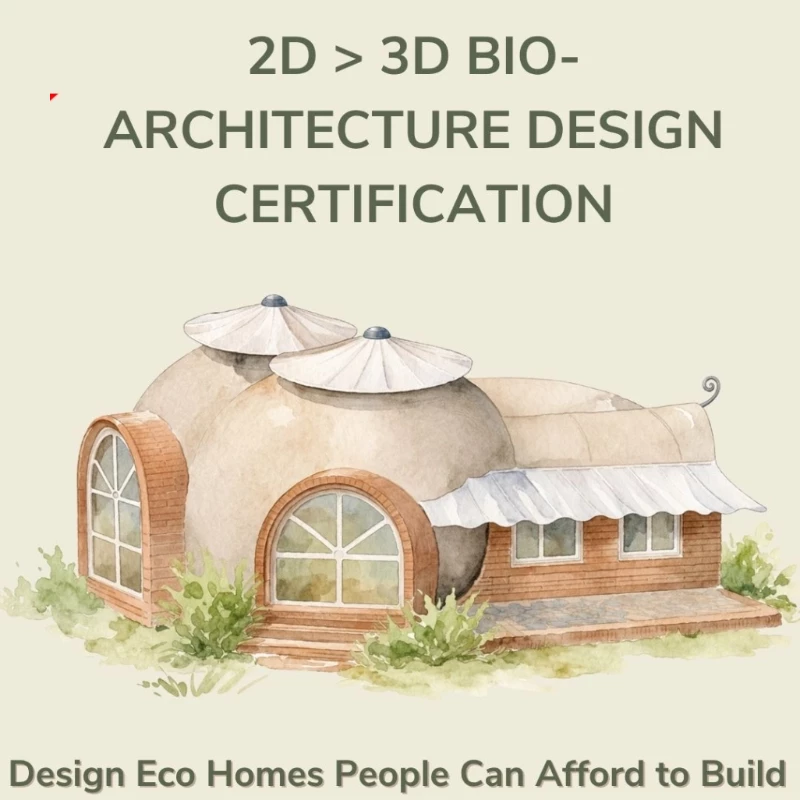
Apply this workflow end-to-end in the 2D-3D Bio-architecture Design Certification.
Explore 2D–3D Certification →