Art-based coaching becomes far more useful when a person can return to what they made and see their own progression. The real skill is choosing an activity that suits the person in front of you, then holding a simple structure so each session leaves a clear thread to pick up next time.
Advanced art skills are not required. What matters is offering prompts that feel spacious for honest expression and consistent enough to track change over time.
Key Takeaway: These seven art-based activities help turn creative expression into something visible, reflective, and trackable over time. Used thoughtfully, they support emotional awareness, pattern recognition, and richer coaching conversations without reducing the artwork to a test.
1. Visual Emotion Mapping with Color
A color map is one of the quickest ways to externalize an inner state. When feelings are present but hard to name, color, shape, and pressure give them a form that can be seen and shared.
Keep it simple:
- Offer 6–8 colors.
- Invite the person to name a few feelings that feel most present today.
- Assign one color to each feeling.
- Represent each feeling with lines, shapes, patches, or textures.
This kind of image-making helps express feelings that aren’t ready for words yet. It’s especially supportive for people who recognize shifts first through image, sensation, or atmosphere.
To make the page easy to revisit, add a small legend and a title. A 0–10 intensity rating in the corner can help too. With repetition, the map becomes less about a single moment and more about patterns.
Used regularly, it becomes a mood log that stays reflective without turning the session into an analysis exercise.
Useful prompts:
- Which color takes up the most space today?
- Which feeling feels loudest? Which feels quietest?
- If this page had a title, what would it be?
For your notes, stay close to what’s visible and what the person says it means: color choices, placement, intensity, and their own words.
2. Body Outline Mapping for Felt Experience
Once emotion is visible on the page, many people naturally start noticing where it sits in the body. A body outline map connects inner experience with location, sensation, and support.
Draw or print a neutral silhouette and invite the person to mark:
- areas of tension
- areas of ease
- places that feel heavy, hot, empty, or protected
- symbols for support around the body
This works well because many experiences are sensed before they’re explained. It also gently moves the conversation from abstract emotion into felt awareness.
Keep it person-led. One person may place dense marks around the chest; another may surround the figure with symbols of safety, memory, or belonging. Both offer valuable information for coaching.
If a literal body image feels too direct, offer an abstract alternative like a tree, a vessel, or a cluster of shapes. The value is in locating and witnessing experience, not in the outline itself.
Helpful prompts:
- Where does this feeling seem to gather?
- Which area wants more space or support?
- What belongs around the body to help it feel steadier?
In your notes, document what appeared and the person’s meaning. That is enough.
3. Music-Guided Abstract Painting
Sound often opens expression quickly. When words feel overworked, painting to music lets rhythm and intensity move through the hands.
Choose one track and keep instructions minimal:
- Let tempo guide the speed of your marks.
- Let volume influence the size or force of your gestures.
- Notice if the music shifts your colors.
This works best when it stays spacious. Too much explanation can pull people out of the experience.
A short pause before beginning helps many people settle. A few breaths, a moment of stillness, or a quick “check-in color” is often enough.
Afterward, invite brief reflection:
- Where did the music feel strongest on the page?
- Did any color arrive unexpectedly?
- What changed from the beginning of the song to the end?
This also suits before-and-after ratings (calm, activation, clarity). Tracking a small shift keeps the session grounded while the art stays expressive.
For notes, record the track, the person’s starting and ending state, and what you saw in the marks (layered, sparse, jagged, contained, sweeping).
4. Mandala Drawing for Focus and Settling
The circle has served as a steadying container across many traditions. In practice, mandala-making often brings focus because it offers a boundary while still allowing freedom inside it.
Provide a pre-drawn circle or invite the person to create one. From there, they work from the center outward with repeating shapes, lines, and colors.
Mandalas have long been used for focusing attention and as an aid to meditation. In coaching, that same quality supports structure, rhythm, and a calmer pace when someone feels scattered.
Many people find repetitive patterning reduces mental noise. Research also suggests mandala-based art may reduce some stress indicators, with a growing evidence base.
If the page feels too open, divide the circle into sections. If the process feels effortful, limit the color palette. Small constraints often increase ease.
Over repeated sessions, shifts in pattern, density, and color become easy to spot. That’s part of the method: the page reflects attention and inner climate without forcing a long explanation.
Helpful prompts:
- What changes when you work from the center outward?
- Which pattern feels most settling to repeat?
- How would you title this circle today?
5. Collage for Identity, Mood, and Meaning
Collage is ideal when drawing feels intimidating or overly exposing. Found images create a little distance, and that distance often makes honesty possible.
It’s a strong way to explore identity, values, roles, and present-moment mood. Collage can hold contradiction without needing to resolve it: longing beside strength, rest beside ambition, grief beside hope.
Good prompts include:
- Who I am becoming
- What I need more of
- What steadies me
- My safe place
Collage brings layered storytelling to the surface. Images, fragments of text, and placement reveal what matters, often before someone is ready to say it directly.
A “safe place” collage is especially practical. Invite images, textures, and words that evoke comfort, stability, beauty, or refuge. Kept somewhere visible, it can quietly remind a person what supports them on harder days.
After the collage is complete, ask:
- Which image feels most central?
- What did you choose immediately?
- What almost made it onto the page but did not?
For notes, capture the theme, the kinds of images selected, and the person’s own summary. Let the maker define the meaning.
6. Visual Journaling as an Ongoing Practice
A single image can be powerful, and a journal lets meaning accumulate. Over time, visual journaling shows how someone’s inner world is evolving, not just what they felt on one day.
Keep the structure light:
- create or paste an image
- add a title
- write one to three lines
- date the page
This rhythm turns scattered insights into a steady practice. It doesn’t need to be daily. Weekly pages are often just as revealing when done consistently.
A 10–15 minute window works well for many people: manageable, yet long enough for something real to land.
You can rotate formats inside the journal:
- color maps
- small mandalas
- mini collages
- symbol sketches
- image-and-word pages
Across weeks and months, images plus titles and ratings form a personal archive that supports grounded coaching conversations about change.
Helpful prompts after each page:
- What stands out most?
- What surprised you?
- What does this page want more of?
For your records, brief notes are enough: date, format used, a simple rating (if relevant), and one line on what the person noticed.
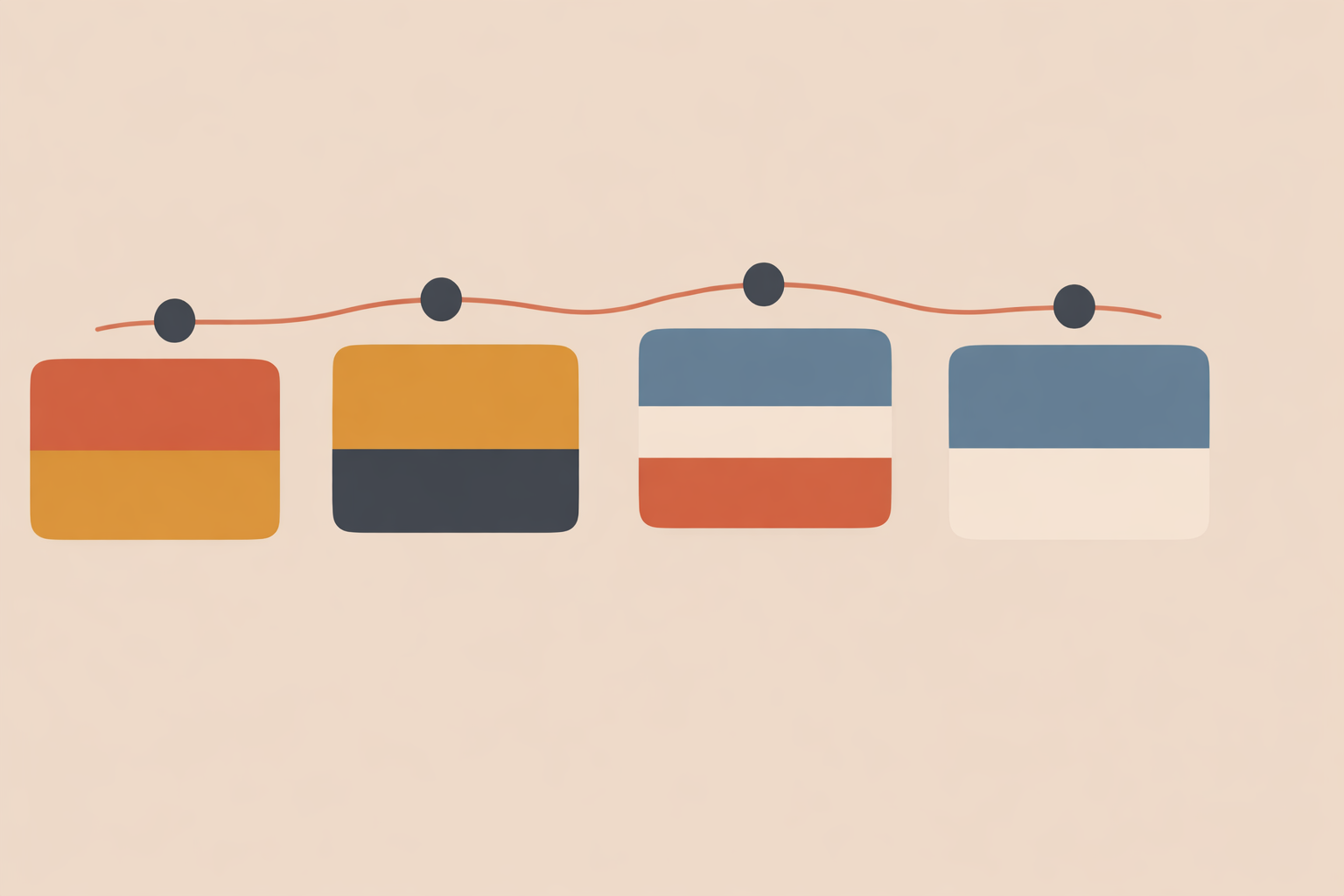
7. Life Timeline with Colors and Symbols
When enough pages have accumulated, a timeline widens the view. It helps someone place experiences in sequence and notice transitions, continuity, and resilience across time.
On a long sheet of paper:
- draw a horizontal line
- mark a beginning point and the present
- add key periods, chapters, or turning points
- assign colors and symbols to each section
The aim is meaning through arrangement, not a perfect life summary. The visual sequence often helps people see how they moved through what happened, not only what happened.
Timelines are especially useful for highlighting strengths, supports, and recurring themes. Many people are relieved to see that difficult periods were never the whole story.
To keep it workable, narrow the scope:
- one year
- a transition period
- important relationships
- chapters of belonging
- moments of change
Helpful prompts:
- Which chapter still carries the strongest color?
- Where do you see growth?
- What helped you keep going?
- What color belongs to the next chapter?
For notes, record the time span, visible recurring motifs, and the person’s own summary of key turning points.
How to Document Art-Based Sessions Clearly
Across all seven activities, the same principle applies: document what is observable, repeatable, and meaningful to the person.
A strong note usually includes:
- the activity used
- the prompt or intention
- visible elements such as color, density, placement, or repetition
- any rating used
- the person’s own words about the piece
This keeps records practical while the creative work stays alive and personal.
Closing Thoughts
These seven activities work well because they move from immediate feeling into broader meaning. Color maps capture the moment, body mapping locates felt experience, music-guided painting releases energy, mandalas support focus, collage layers identity, journaling builds continuity, and timelines reveal the wider arc.
Together, they offer a respectful bridge between ancestral creative practices and modern coaching structure, including broader mental health frameworks. They help people notice what’s shifting, what’s returning, and what now wants more care and space.
Start simply and repeat one activity long enough for patterns to emerge. Save deeper cautions for the end of a process: if strong emotions surface, slow the pace, offer grounding, and stay within your scope through mental health frameworks by encouraging additional support when it’s needed.
Train in Therapeutic Arts
Build on these practices with the Therapeutic Arts Certification to guide sessions with clearer structure and reflection.
Explore Therapeutic Arts →