Most point-based practitioners eventually meet the same crossroads: some clients want practical support they can use at home, others ask for needles, and local rules draw lines you can’t step over. Beyond technique, your choice affects training, facilities, consent, safety systems, and how you guide people between sessions.
Key Takeaway: Acupressure and acupuncture share TCM foundations but differ in scope, dose, and responsibility. Acupressure is easier to teach and repeat for daily self-care, while acupuncture requires formal training, sterile procedures, and clear practice systems—so the best choice is the one that matches your setting, values, and safety obligations.
Checklist Step 1: Clarify your scope before you choose your tools
Start with role clarity. If your work centers on coaching outcomes, body-based support, stress support, and self-care education, acupressure often fits naturally. It’s hands-on, easy to teach, and simple for people to carry into daily life.
If you plan to add needles, the responsibility changes. Safety depends on aseptic technique, and that calls for consistent practice standards. You’ll also need systems for sharps handling and whole-space infection prevention.
None of this takes away from acupressure’s depth. It simply means the two paths come with different obligations. Acupressure can be a strong foundation for everyday regulation and home practice. Acupuncture may suit practitioners who want more targeted point stimulation and are prepared for the training and safety standards that come with it.
“The training in traditional Chinese medicine prepares you to help others find balance, resilience, and health… it is as much a discipline of personal transformation as it is a professional qualification.”
Write your scope in plain language: what you offer, what you don’t, and where your boundaries sit. That single step keeps your sessions, policies, and communication consistent.
- Acupressure-led path: Strong fit for self-care teaching, coaching sessions, group work, and body-based support.
- Acupuncture path: Better fit if you want to work with needles and are ready for formal training, procedural rigor, and suitable facilities.
- Blended path: Useful when you want both in-person depth and practical between-session support.
Checklist Step 2: Ground both methods in shared TCM roots
Acupressure and acupuncture come from the same lineage. They aren’t competing systems; they’re two ways of working with the same map. Both draw on Qi, meridians, yin-yang, and the Five Phases, and both use the pattern-thinking at the heart of Traditional Chinese Medicine.
Here’s why that matters: the work stays rooted in meaning, not just method. Whether you use a thumb or a needle, you’re still engaging meridian pathways and the relationships that shape balance over time.
TCM’s worldview is shaped by classical Chinese philosophy, including Daoist ideas of harmony, rhythm, and relationship with the natural world. That’s one reason point-based work often feels bigger than “fixing a symptom.” It naturally brings in season, routine, emotional tone, stress patterns, and lifestyle.
Because the point locations and pattern logic overlap so strongly, many practitioners teach self-acupressure alongside in-person sessions. The philosophy remains coherent across both.
Modern tools can help translate TCM into newer languages, but the older framework stands on centuries of observation and practice. Tradition and lived practitioner experience belong at the center of this work.
TCM practitioners “must not only accrue clinical experience and accumulate wisdom, but also increase their awareness to perceive life and nature.”
Checklist Step 3: Understand the difference in stimulation and dose
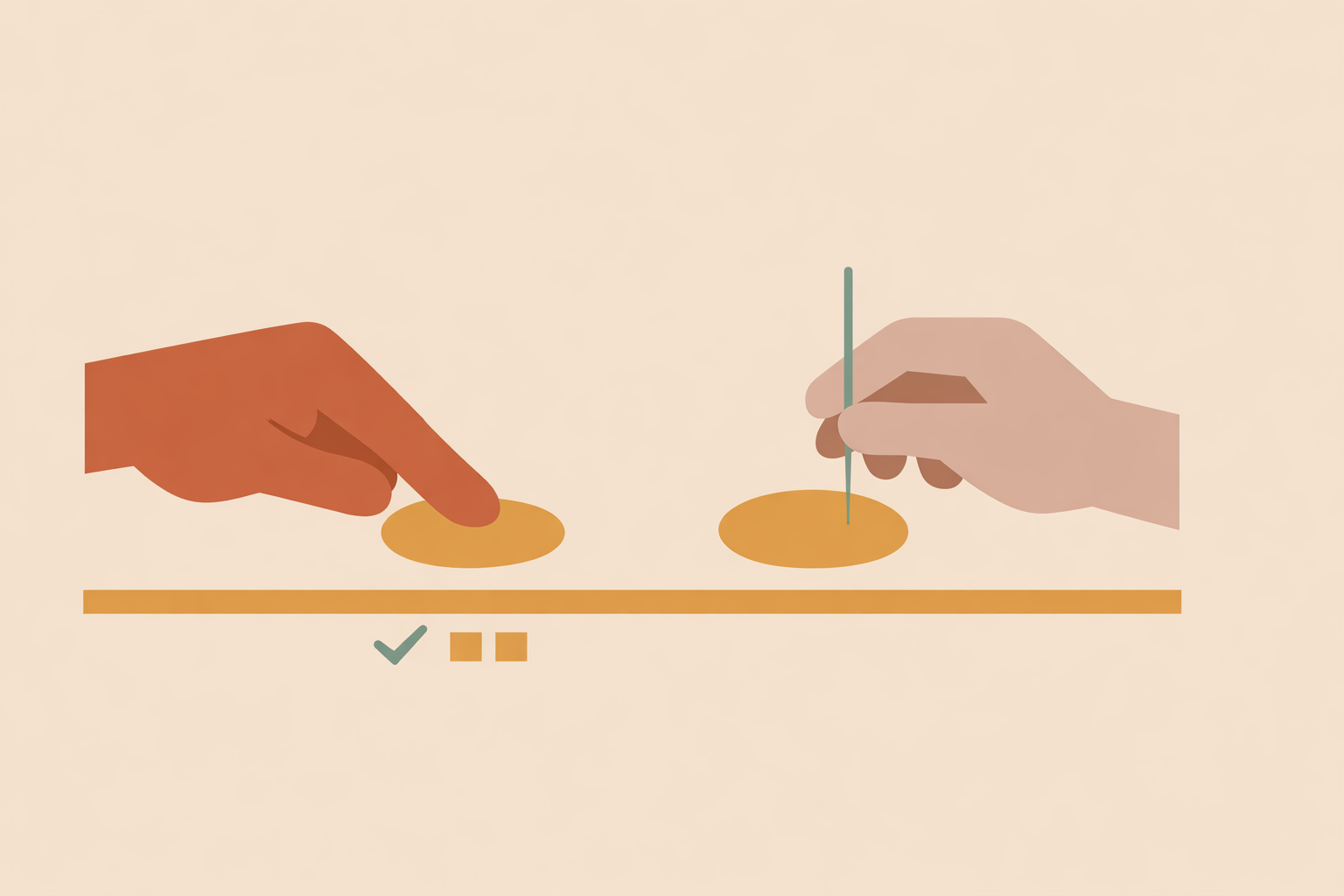
The headline difference is simple: acupuncture uses needles; acupressure uses pressure. In real life, that changes the “dose”—how strong, precise, and sustained the input feels.
Acupuncture uses fine, single-use needles inserted at specific depths and angles. Research suggests it can trigger tissue responses in nerves, muscles, and connective tissue.
Acupressure works through fingers, thumbs, palms, elbows, or simple tools, using the same points without skin penetration. Put simply, it’s often easier to teach, easier to repeat, and more comfortable for people who prefer a gentler approach.
Think of it like this: acupuncture can create a stronger in-session shift; acupressure builds momentum through repetition. One tends to be “structured session work,” the other “daily rhythm work.” Both can be powerful when used well.
- Acupuncture dose: More focused stimulation, usually delivered in dedicated sessions.
- Acupressure dose: Lighter input, but easy to repeat daily and teach for home use.
- Best use of both: Acupuncture for targeted in-person support, acupressure for continuity and habit-building.
Checklist Step 4: Match the method to the person, not the theory
Choose what suits the real person in front of you. Preference, sensitivity, readiness, lifestyle, and goals often matter as much as theory—sometimes more.
For children, needle-averse people, or anyone who needs a gentle start, acupressure is often the natural first step. It’s approachable, easy to demonstrate, and simple to weave into daily routines. Many practitioners begin with non-needle approaches and only consider needling later if it fits the person and the plan.
Acupuncture may be a better match when someone wants more concentrated in-person support, feels comfortable with needles, and can commit to a session rhythm that allows the work to unfold.
Some points are especially practical for self-use. P6 (Neiguan) is widely used in Chinese tradition for nausea and certain headaches, which helps explain why it shows up so often in home routines and travel support plans.
A simple way to decide:
- Start with acupressure when: the person is cautious, new to point work, younger, highly sensitive, or needs something practical for home.
- Consider acupuncture when: the person is open to needling, wants more targeted support, and can commit to structured sessions.
- Combine both when: you want in-session depth plus a daily rhythm that keeps the work alive between visits.
- Stay conservative when: there are important safety concerns, uncertainty, or a need for wider context from the person’s existing support team.
The strongest plans feel human. They fit real schedules, real limits, and real preferences.
Checklist Step 5: Put safety, ethics, and boundaries in writing
Safety builds trust, and clear boundaries keep your work clean and professional. Put both in writing.
With acupuncture, this is essential. Serious problems can occur when standards aren’t followed, which is why hygiene, training, and procedural discipline matter so much.
Acupressure has a different risk profile, but it still calls for judgment. Pressure should be modified or kept light in situations like pregnancy, severe osteoporosis, joint instability, inflamed tissue, bruising, or recent injury. Gentle isn’t the same as careless.
Ethics matter just as much as technique. Be transparent about what point-based support can reasonably help with, avoid exaggeration, and encourage people to stay connected to their usual support structures when extra context is needed.
If you practise acupuncture, your systems should cover consent, hygiene, records, sharps disposal, and incident procedures. If you practise acupressure, you still benefit from clear intake questions, written boundaries, and simple aftercare guidance.
A one-page safety sheet can include:
- What I offer: point-based support, self-care education, and lifestyle-oriented guidance.
- What I do not offer: services outside my training or scope.
- When I stay cautious: recent injuries, unexplained swelling, significant frailty, pregnancy-related concerns, bleeding risks, or severe structural instability.
- Aftercare: rest, hydration, reflection, and a simple home routine where appropriate.
Checklist Step 6: Build a rhythm people can actually sustain
The best plan is the one people can keep. Point-based work often shines when the rhythm is realistic, kind, and steady.
Acupuncture usually works well in a structured cadence. Evidence reviews note pain-related benefits in some chronic low back pain research, which helps explain why many practitioners start with regular sessions and then space them out.
Acupressure, in traditional practice, leans into repetition rather than intensity. A few well-chosen points done daily can become a morning reset, an evening wind-down, or a short midday pause—small enough to be doable, consistent enough to add up.
As a practical guide:
- Acupuncture rhythm: begin with a regular short-term series, then reassess and taper according to response and capacity.
- Acupressure rhythm: choose a small number of points and repeat them consistently each day for several weeks before changing the plan.
- Combined rhythm: use in-person acupuncture for targeted support and daily acupressure to reinforce the pattern between sessions.
- Habit support: attach self-acupressure to an existing routine such as waking, tea breaks, or bedtime.
Essentially, consistency usually beats intensity. Small actions, repeated with care, tend to create the most stable change.
Checklist Step 7: Keep the practice modern without losing the roots
A respectful modern practice doesn’t strip away lineage. It brings old wisdom into contemporary formats without flattening the culture that carried it.
As TCM meets newer forms of analysis, fresh tools can help with communication and structure. At the same time, acupressure adapts beautifully to modern life through guided routines, digital resources, and online teaching.
Group teaching can be especially effective: a short seasonal point routine, a weekly guided reset, or an online circle built around breath, touch, and rhythm helps people embody TCM principles rather than just think about them. It also builds steady accountability.
What matters is how the material is held. Use accurate terminology, acknowledge Chinese cultural roots, and avoid vague “energy” talk that disconnects the work from its origin. Respect makes the practice clearer—and stronger.
Modern delivery can include:
- Short guided routines: simple home sequences built around a few foundational points.
- Group sessions: seasonal or theme-based classes that help people practise together.
- Tracking tools: brief check-ins for energy, sleep, tension, or stress patterns.
- Clear visuals: accurate point maps and concise cultural context where useful.
Used well, modern formats don’t dilute tradition—they help it stay alive in everyday practice.
As one educator reflects, weaving classic wellness habits—rest, food as daily support, emotions at the center—turned recovery from episodic to steadily sustainable.
Conclusion: Choose the method that fits your path
Acupressure and acupuncture aren’t rivals. They share the same roots, but they ask different things of the practitioner. Acupressure is often the easiest doorway for coaching, education, and daily home support. Acupuncture offers more intensive point stimulation, along with higher training demands and stronger procedural responsibilities.
The best choice depends on your scope, your setting, and the kind of practitioner you’re becoming. If your path is touch-based, educational, and habit-focused, acupressure may be exactly what you need. If you feel called toward needles, meet that call with full respect for the discipline and its standards. If you choose both, let them work as a team: depth in session, continuity between sessions.
To finish with the essentials: keep your practice coherent—rooted in tradition, clear in scope, steady in rhythm, and careful with safety and communication.
Explore Chinese Medicine Practitioner
Deepen your point-based practice with clearer scope, safer standards, and TCM-rooted decision-making in Chinese Medicine Practitioner.
Explore Chinese Medicine Practitioner →