You’re about to approve a restock: the COAs look clean, the potency is strong, the price fits, and the sales page says “wild” and “ethical.” Then a client asks who harvested it, who set the terms, and how the community and forest benefit—and your file has no answer. Another supplier says they’re “Nagoya compliant” but can’t name the authority or show consent and terms. In a field built on trust, that’s not a small paperwork gap. It’s a practice gap.
Benefit-sharing is the core test of responsible mushroom sourcing. If a mushroom contributes to your revenue, reputation, or teaching, the people, places, and lineages behind it should share in that value in defined, ongoing, and verifiable ways.
Key Takeaway: Benefit-sharing turns mushroom ethics into daily practice. In practical terms, that means tracing who grows, gathers, processes, and teaches; confirming consent and clear agreements; matching sourcing methods to species ecology; and building fair pricing, ongoing benefits, and cultural respect into the way you buy, teach, and communicate.
Ask who actually provides your mushrooms
Most labels give you a species name and a marketing mood. What’s usually missing is the human chain: who grows, gathers, dries, extracts, and sets the terms. That missing layer is where fairness lives or fails.
Four questions clarify the picture quickly:
- Who provides the mushroom?
- Who governs access to the material and any associated knowledge?
- Who benefits financially and practically?
- What protects future ecological and cultural continuity?
Because labels rarely answer these, traceability has to be requested, not assumed.
Ask for the basics: species, origin region, cultivation or harvest method, batch dates, processor, exporter, and chain of custody. If a supplier uses words like “ethical,” “wild,” “traditional,” or “community sourced,” ask what documentation exists and what ongoing benefits are built into the deal.
Good transparency doesn’t require exposing what should remain protected. Producer identities and community roles can be shared where consent exists, while sensitive habitats and private knowledge stay confidential. The point is knowing whether your sourcing rests on real relationships or borrowed language.
A useful prompt: “Could you share the cultivation or harvest method, the producer group’s role in price setting, any community benefits linked to this ingredient, and how sensitive ecological or cultural information is protected? If origin details are restricted, what can be disclosed with consent?”
Consent and clear terms come before ethical claims
Consent is not a decorative principle. It is the baseline.
The Nagoya Protocol expects access to be based on prior informed consent and mutually agreed terms. In everyday sourcing, a supplier should be able to explain what rules apply, who gave permission, and what was agreed before use began.
When knowledge belongs to Indigenous or local communities, the Protocol also anticipates approval and involvement in line with applicable law. That includes teachings, preparation methods, stories, habitat knowledge, and cultural framing, not only the physical material.
In practice, ask three things: do they know whether access and benefit-sharing rules apply in the origin region; can they identify the rights-holders (not only a broker); and do agreements clearly cover the resource, intended use, confidentiality, payment and non-monetary benefits, monitoring, and what happens if use changes?
If those answers are vague, your sourcing is vague too.
Two contract lines often make a real difference:
- “Community retains the right to withdraw consent if terms are breached or use changes materially.”
- “Buyer will not publicize sensitive locations or knowledge without explicit written consent and will follow community guidance on what remains confidential.”
This still matters in small educational settings, including herbalism and plant medicine teaching. If you plan to share a region-specific teaching or a traditional preparation approach, clarify what is public, what stays private, how attribution works, and what reciprocity is appropriate. Everyday consent is still consent.
Wild vs. cultivated mushrooms: match sourcing to ecology
“Wild” can sound pure and impressive. It can also hide overharvest, habitat stress, low pay, unsafe work, and unstable livelihoods when demand rises faster than safeguards.
Cultivation brings its own questions: substrate choices, energy use, transport, local control, and pricing. The better question is, “What does this species require for long-term integrity, and who benefits from the chosen model?”
For sensitive species, cultivation can reduce pressure on wild populations, improve consistency, and create local employment when paired with fair pricing and transparent governance. For other species, carefully governed wild harvest remains a strong path. Species-level discernment is the skill to build.
Chaga makes the point clearly. Responsible sourcing is also about birch health, harvest intervals, repeat collection pressure, and whether demand is outpacing the forest’s ability to recover. For slow-growing or habitat-sensitive fungi such as alpine Cordyceps and mature Chaga, safeguards should focus on host and habitat: non-destructive techniques, confidential management zones, seasonal closures, and multi-year no-repeat collection agreements for the same trees or slopes.
Reishi often offers a different path because it generally cultivates well on logs or sawdust blocks. Prioritizing growers who disclose substrate, drying methods, and sourcing standards can reduce pressure on sensitive wild systems while keeping your medicinal mushrooms work strong and consistent.
A practical habit: keep a one-page ecology sheet for each species you use. Note whether it’s wild or cultivated, the habitat or substrate it depends on, the main sensitivities, and your minimum sourcing standard. This supports better buying decisions and clearer client communication.
Cultural respect means sharing value for knowledge too
Benefit-sharing is not only about biomass. It also applies to knowledge.
In mushroom traditions, a lot of value sits in identification, seasonality, preparation, ceremonial context, ecological understanding, and lineage-based teaching. When that knowledge is lifted from its cultural setting and repackaged as branding or authority without permission, the relationship becomes extractive.
The Nagoya framework recognizes traditional knowledge associated with genetic resources. Respect, in practice, means asking who holds the right to share a teaching, what should remain private, how attribution should be handled, and how value returns to the source.
This has become especially visible around psilocybin. An ethics review describes significant inequities affecting Indigenous communities connected to traditional psilocybin knowledge. The same review found those communities were not parties to identified psilocybin-related patents, characterizing the pattern as appropriation, bioprospecting, and colonization.
Those lessons extend beyond psilocybin. If you reference ceremonial lineages, sacred language, community teachings, or traditional preparation methods, make sure you’re in relationship with the source rather than borrowing its authority.
What helps is clear and grounded: seek permission, clarify boundaries, compensate fairly, direct benefits through community-governed channels where appropriate, and accept that some knowledge is not available for public teaching or marketing use. Attribution may be welcome, but it doesn’t replace consent or reciprocity.
What fair sourcing looks like in business terms
Fairness should show up in numbers, timelines, and decision-making power, not just in beautiful language.
Strong fair-sourcing models often combine guaranteed minimum price, quality premiums, advance or seasonal payments, multi-year commitments, and locally retained processing value. Together, these reduce pressure to underpay in markets that can swing quickly.
Benefits can be designed in several forms:
- Guaranteed floor pricing
- Quality premiums
- Pre-season or seasonal advances
- Multi-year purchasing commitments
- Paid training and quality support
- Local drying, extraction, or packaging to retain value near origin
- Community-governed funds linked to sales
- Support for conservation and cultural continuity
A simple structure for a wildcrafted ingredient might include a floor price, a quality premium, partial advance payment at season start, a three-year purchasing agreement, co-investment in local processing, and a small percentage of sales allocated to a community-governed fund. This is what “ethical” looks like once it’s measurable.
Useful contract principles include:
- Avoid blanket exclusivity unless it is time-limited, fairly compensated, and freely chosen.
- Define permitted uses clearly, then renegotiate if the product or educational use expands.
- Set a shared monitoring plan for ecology, labor conditions, and community feedback.
- Make sure community benefit funds are governed with local decision-making, not buyer branding.
One of the clearest signs of integrity is whether a supplier can explain not only what they pay, but when they pay, who decides, and what happens when the market shifts.
Use certifications carefully and do not confuse them with relationship
Certifications and audit programs can help, but they don’t settle the ethical question on their own.
In wild-harvest and ethical-trade supply chains, audits can miss informal labor realities, seasonal dynamics, cultural harm, or weak local bargaining power. A seal can support due diligence, but it can’t replace direct questions about consent, pricing, governance, and ecological limits.
The same caution applies to “direct trade.” In mushroom sourcing, the phrase is used loosely. Sometimes it reflects real producer relationships and shared decision-making; other times it’s a nicer story attached to an exporter. That difference affects people’s lives and ecosystems.
Use certifications as one input among many. If a supplier leans on badges but can’t explain who benefits, who decides, or how safeguards work day to day, you still don’t have a solid foundation.
How to vet suppliers and explain your choices to clients
Clients don’t need trade-policy language. They need clear, honest guidance you can stand behind.
A practical checklist keeps standards consistent:
- Species and material clearly named
- Origin region and production method stated
- If wild: harvest protocols and rest periods described
- Batch testing available
- Cultural references matched with consent and benefit pathways
- Community benefits explained in concrete terms
- Marketing language kept within a well-being and education scope
Then translate it into plain client-facing language. For example: “We chose this Reishi because it is cultivated on hardwood logs, batch-tested, and purchased through a multi-year agreement that includes seasonal advance payments and local training support. It is not the cheapest option, and that is part of the reason why.”
That kind of transparency builds trust and keeps you honest about what you’re still improving. You don’t need a perfect supply chain to speak with integrity. You do need to know where the gaps are and have a plan to close them.
Weaving benefit-sharing into daily mushroom practice
Mushroom practice is relational by nature. If fungi support your work, the people and places behind them should experience meaningful, agreed, and lasting benefits as part of that exchange.
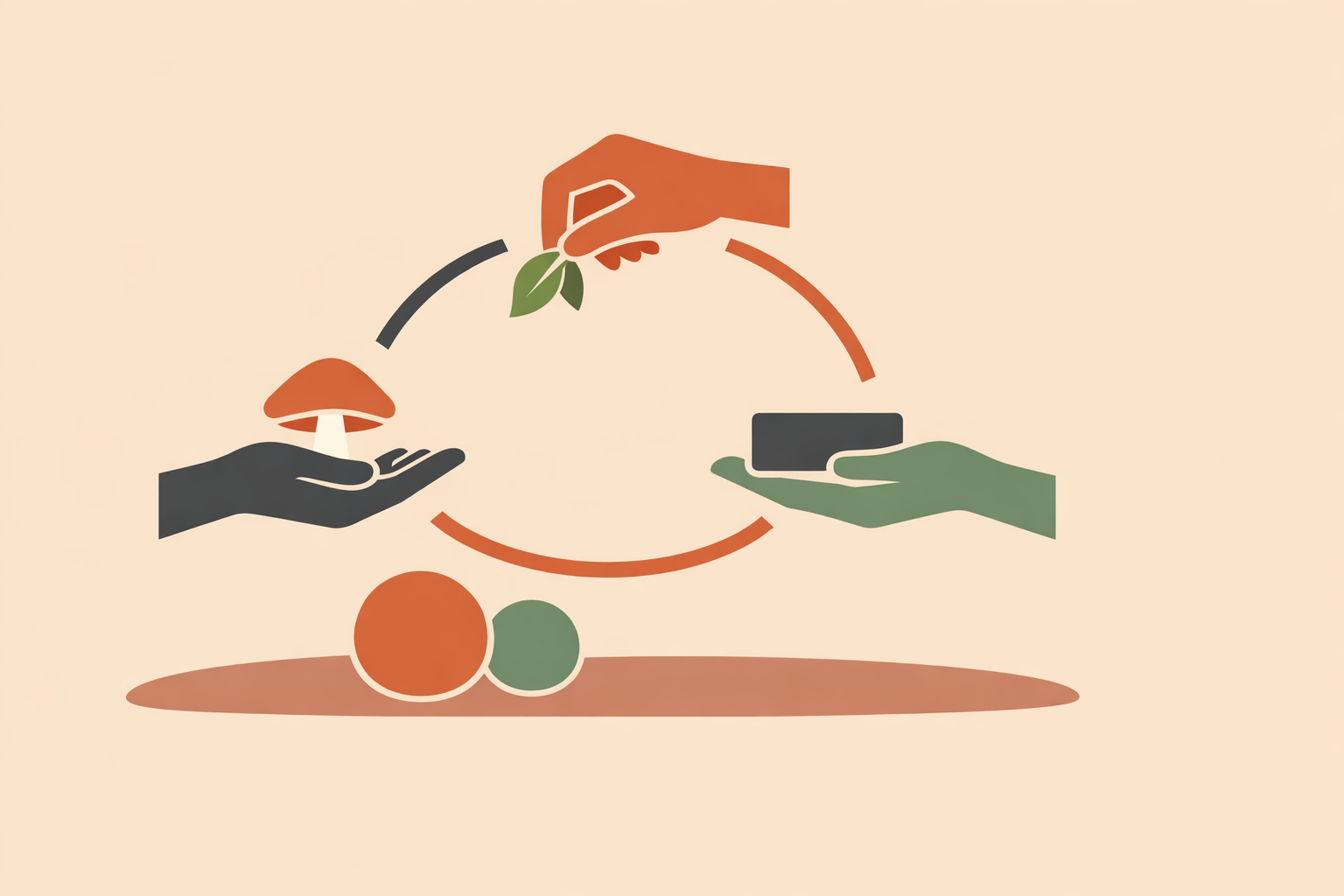
A grounded sequence helps: identify rights-holders, confirm consent, agree terms before use, price fairly, protect ecosystems, document the chain, share value over time, monitor what is happening, and revise when needed. Build these steps into purchasing and teaching from the start.
It also helps to stay human about it. Avoid purity politics that shame people with limited budgets or access. Offer transparent tiers where appropriate, name trade-offs clearly, and keep improving your standards over time.
If you want a practical place to begin, choose one change this month: map a supply chain, ask a harder sourcing question, add an advance payment structure, review whether a cultural reference in your materials is actually held with permission, or create a species ecology sheet for the mushrooms you use most.
Hold the guiding principle in any supplier conversation: when a mushroom supports your practice’s growth, make sure the guardians of its habitat and knowledge grow with you.
Explore Medicinal Mushroom Foundations
Build practical sourcing and teaching confidence in the Foundations of Medicinal Mushrooms Certification.
Explore Foundations of Medicinal Mushrooms →