Clients are already experimenting with YouTube “focus” tracks and asking which Hz to use. It’s easy to dismiss the whole trend, or to hand over a playlist and hope for the best. The most helpful middle path is practical: treat binaural beats as a brief, headphone-based ritual with one task, a short time window, clear expectations, and a simple check-in afterward.
Key Takeaway: Binaural beats can be a useful focus support when framed as a brief, headphone-based ritual rather than a promise. Used this way, they fit naturally into modern sound work: simple to test, easy to personalize, and grounded in lived results. The most practical approach is to compare one track against silence or neutral noise, match the sound to the task, and keep only what genuinely helps.
Why binaural beats can be useful for focus work
Binaural beats work well in real life because they’re portable, repeatable, and easy to use between sessions. For many clients, the value isn’t theory; it’s the moment a consistent listening cue helps them shift from scattered attention into the first few minutes of meaningful work.
They also fit naturally inside a modern sound-based practice: low-friction to coach, simple to personalize, and easy to follow up on. Rather than becoming “another thing to try,” they can become a small piece of dependable daily structure.
Traditional sound practices have long used steady tones, drones, pulses, and rhythm to gather attention and mark a threshold into intentional effort. Binaural beats are a contemporary format for that same principle: when sound is steady and used with intention, attention often organizes around it.
The goal stays modest. You’re helping a client create a reliable start signal for one chosen task.
What binaural beats actually are
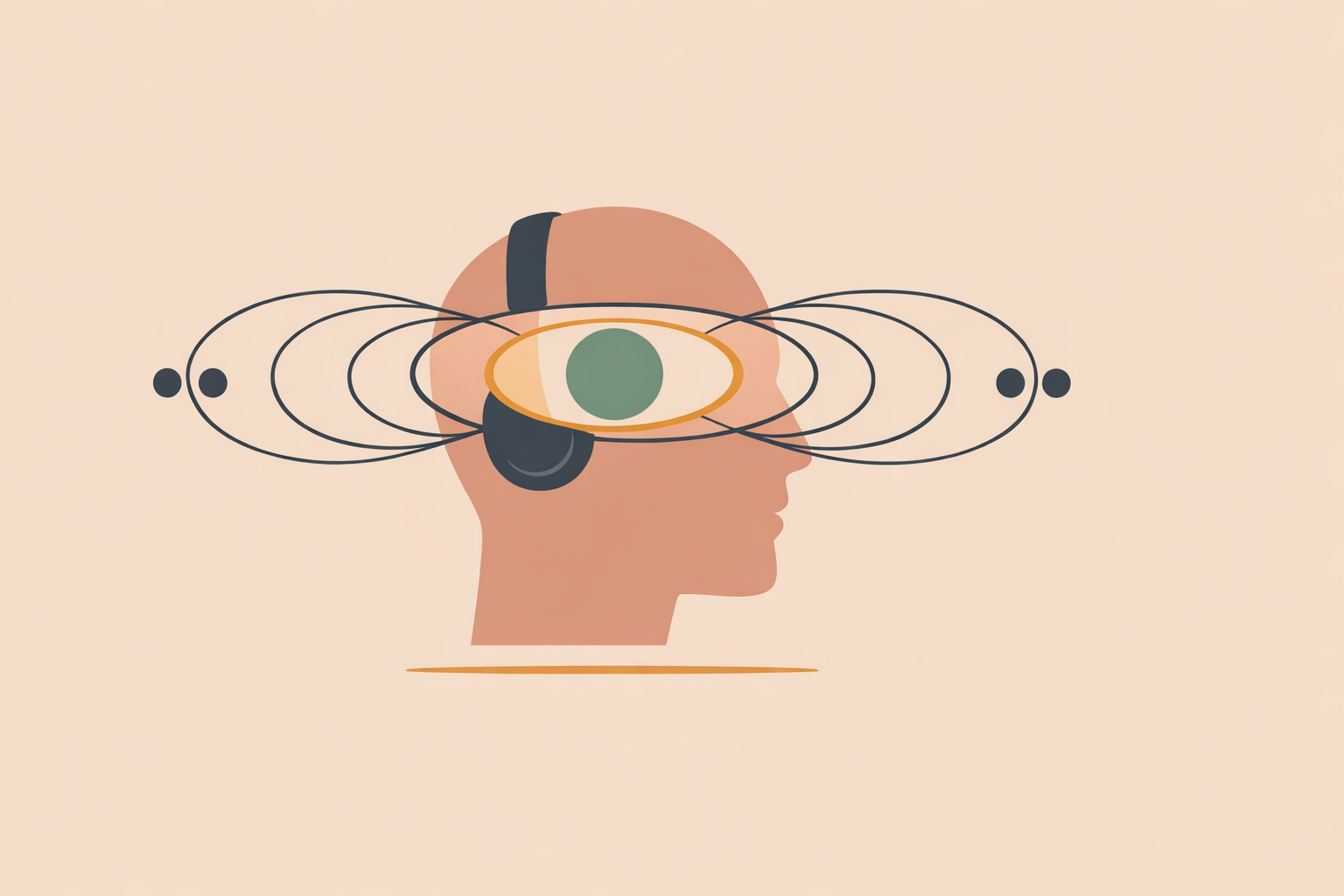
Binaural beats are created when two slightly different tones are presented separately to each ear through headphones. If one ear hears 200 Hz and the other hears 210 Hz, the listener perceives an internal 10 Hz pulse.
That pulse is internally perceived, which is why headphones matter for the classic binaural effect.
It also helps to keep the categories clear. Monaural beats, binaural beats, and isochronic tones are distinct stimulation methods, and clients often respond differently to each.
A broader review suggests these forms of stimulation may affect mood, attention, and memory, but the day-to-day experience remains personal and context-dependent.
For client communication, keep it plain: a gentle hum or pulse, headphones on, one task, and a short listening window. That supports experimentation without inflating expectations.
How practitioners can think about the experience
A clean way to guide clients is to separate signal, experience, and behavior.
- Signal: two nearby tones, one in each ear.
- Experience: a soft internal pulse, hum, or steady auditory frame.
- Behavior: the listener settles enough to begin and stay with a task.
This lens keeps the work grounded. Even when people debate mechanisms, the practical question stays simple: does this setup help the client start and sustain a useful block of work with less friction?
That focus on repeatable experience also aligns with traditional sound work, where results you can feel and recreate carry real weight.
Do binaural beats help with focus?
For some people, yes. For others, no. In practice, binaural beats are most useful when treated as a structured experiment, guided by the client’s actual outcomes.
Research on attention is mixed. Some findings suggest binaural beats combined with background white noise improved attention in certain setups, while overall results still don’t support a single “best” setting for everyone.
This matches what many practitioners see: some clients settle quickly with a steady auditory cue, while others work better with silence, brown noise, or a different texture. The skill is setting up a fair comparison and tracking what changes.
Traditional sound lineages offer a helpful frame here. Steady rhythm and drones have long been used to gather attention and mark the start of practice. In modern life, binaural beats can serve the same purpose for screen-based work: a repeatable threshold that says, “now we begin.”
That’s why a ritual frame often lands best: headphones on, task chosen, timer started, listening begins, work begins.
Choosing frequencies for different kinds of work
It’s tempting to hunt for one perfect frequency. In coaching work, it’s usually more effective to use frequency bands as starting points, then let the client’s comfort and results choose the direction.
- Alpha (8–12 Hz): often associated with relaxed wakefulness. A supportive choice for steady tasks and gentle transitions into work.
- Low beta (14–20 Hz): often associated with focusing and alertness. A practical range for structured work blocks.
- 30–40 Hz: often used for short, detail-oriented sprints. One study reported 40-Hz beats supported overall attention performance under specific conditions.
Carrier tone matters too. Some listeners find lower carriers softer and easier to stay with; in one experiment, a 340-Hz carrier performed better on average than a higher carrier in that setup. It’s a sensible option if brighter tones feel tiring.
It may also be that different settings suit different types of attention. Findings pointing to frequency effects can help explain why one track supports proofreading but feels less useful for planning or reflective writing.
A small starter set is usually enough:
- Soft start: 10 Hz, 10–12 minutes, lower carrier, light background texture.
- Work block: 14–16 Hz, 15–20 minutes, stable carrier, no lyrics.
- Sprint: 30–40 Hz, 8–12 minutes, minimal texture for narrow task focus.
More options rarely helps. One track per task type is often the sweet spot.
A simple binaural-beat focus ritual
The strongest setup is short, repeatable, and easy to compare against “normal.”
- Choose one task: specific and realistic.
- Use headphones: binaural beats rely on separate input to each ear.
- Set a comfortable volume: clear enough to hear, soft enough to stay settled.
- Start a timer: 10 to 25 minutes is plenty for testing.
- Stick with one sound: don’t switch tracks mid-block.
- Reflect briefly: note focus, comfort, tension, and task progress.
For many clients, the ritual is the real support. The sound marks the start, the timer contains the effort, and the reflection builds self-knowledge that transfers to other settings.
A clean prompt after each block: What changed in your body, what interfered, and did the task move forward with less strain?
Safety and scope
Binaural beats are generally low-risk when used briefly and at a moderate volume. A recent review found few adverse effects reported in non-clinical use.
Comfort leads. If someone notices headache, dizziness, agitation, or sensory overload, pause and switch to silence or neutral noise. Avoid using these tracks while driving or in any situation where full awareness of the environment matters.
Extra caution is sensible for anyone with a seizure history. For clients who are highly sound-sensitive, start with shorter blocks, keep volume low, and treat choice and consent as part of good practice.
Language matters here too. Present binaural beats as support for focus, settling, and structured experimentation, then let the client’s experience decide what stays.
Turning the ritual into an ethical client offer
For paid work, a simple, transparent format tends to be the most ethical and effective: one real task, one comparison, clear debrief.
- Opening conversation: choose the task and name the usual sticking point.
- Consent and setup: explain headphones, volume, timing, and the option to pause.
- Two-condition trial: compare neutral sound or silence with one binaural-beat track.
- Debrief: review comfort, focus, and actual task progress.
- Home plan: choose one short practice for the coming week.
This keeps the work anchored in lived outcomes. If the beats help, they earn their place; if another sound supports the client better, you follow what works.
It’s also worth holding the cultural context with care. If your wider practice includes mantra, drum, or lineage-based sound therapy work, name those roots respectfully and avoid flattening them into a generic productivity hack. Binaural beats can be a useful bridge, and deeper traditions remain their own disciplines.
Conclusion
Binaural beats can be a worthwhile addition to sound-based practice when used with structure and curiosity. They don’t need grand promises to be valuable; a simple, repeatable listening ritual is exactly what many clients need.
The most reliable approach stays consistent: one task, one short listening block, one comparison, and honest reflection.
Used this way, binaural beats are one more sound-based tool for supporting steadiness, attention, and follow-through in daily life. Keep volume moderate, prioritize comfort, and let results guide the next step.
Explore Sound Therapy Certification
Build practical, ethical sound-based sessions like this in the Sound Therapy Certification.
Explore Sound Therapy →