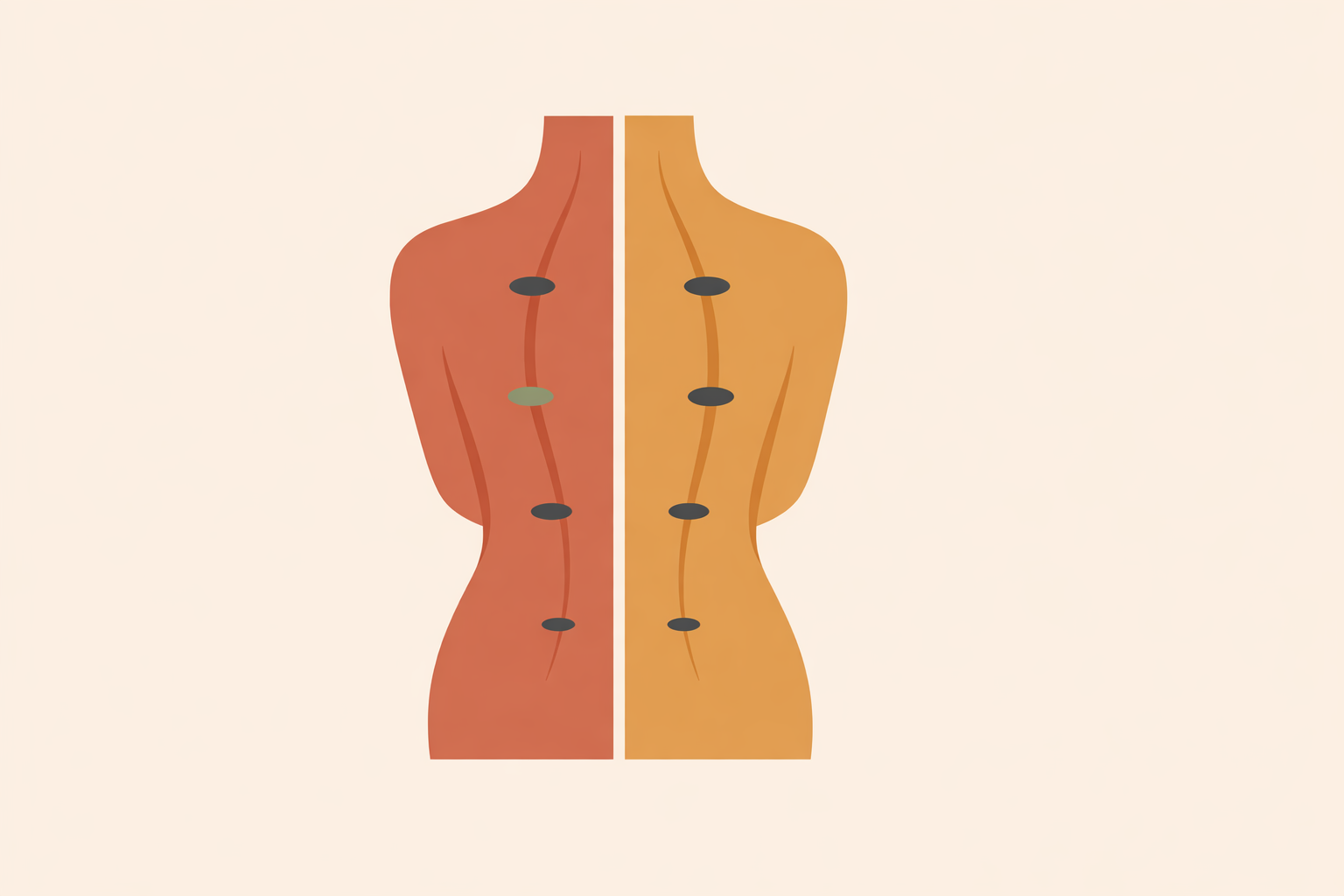
Most practitioners recognize the moment body awareness goes vague: you invite a client to check in, and the answer is “tense everywhere.” Generic prompts help for a while, but without a shared map it’s hard to name sensations clearly, notice change, or build a repeatable self-practice.
One of the enduring strengths of Traditional Chinese Medicine is that it offers that map. The meridian system gives attention a clear direction: front and back, inner and outer, this line rather than everywhere at once. Used gently, it can make body awareness feel more trainable and more practical.
Key Takeaway: The TCM meridian system helps turn vague sensation into something you can notice, describe, and follow over time. With simple orientation cues, light touch, breath, and brief reflection, meridian-based practice can strengthen body literacy and support steadier self-regulation.
Understanding the TCM meridian map
In TCM, meridians are understood as channels of Qi. They create pathways for attention, touch, and movement to follow. Whether you relate to them as energetic routes, a learning framework, or both, they offer an organizing structure that’s easy to return to.
Classic teachings describe 14 main meridians: 12 primary channels plus the Du and Ren vessels. Together, they span limbs, torso, and head, which helps people sense the body as a connected whole.
The Yin-Yang layout makes the map especially usable. In broad terms, Yin meridians tend to run along the front and inner surfaces, while Yang lines tend to run along the back and outer surfaces. For many beginners, this orientation alone is enough to start noticing clear patterns.
- Inner arm to thumb: a classic Yin route.
- Outer arm to face: a classic Yang route.
- Inner leg rising upward: often felt as more inward, rooted, and quiet.
- Back-body or outer-leg lines: often easier to notice through movement and posture.
This is one reason the system remains so useful. It is time-tested, and it gives people a practical language for noticing patterns without needing to overanalyze every sensation.
How meridian sensations often feel
The first question most people ask is: what am I supposed to notice? Usually nothing dramatic. Meridian sensations are often subtle, spreading, and line-like rather than sharply localized.
Many beginners notice warmth that seems to travel along a route. During breath- and movement-based practice, people also often report tingling sensations or a mild buzzing quality as attention settles.
When tracing or stretching a line, it’s also common to feel a longitudinal pull that seems to extend along a pathway rather than staying in a single muscle. Around certain points, there may be a distinct pinpoint ache that feels “good-sore” rather than harsh, sometimes with sensation that seems to travel outward.
These qualities become easier to track with simple paired language:
- warm / cool
- tight / loose
- heavy / light
- surface / deep
- still / moving
- local / traveling
A useful practice note might read: “Inner right arm warm, 2/10, spreading to palm. Outer shoulder cooler, slightly tight.” That level of detail is enough to build real body literacy.
A simple 10-minute meridian scan
A short, regular scan is usually more helpful than a long, occasional one. The aim is to give awareness a steady structure and let sensation emerge at its own pace.
Start with one line only. The Kidney route is a good beginner choice because many people experience it as grounding and easy to follow through touch.
- Sit or stand comfortably with soft shoulders.
- Take three slow breaths.
- Bring attention to the sole of the foot, inner ankle, inner calf, inner knee, inner thigh, and lower abdomen.
- With light touch, trace upward along that route as you inhale.
- Rest your hands on the lower belly as you exhale.
- Repeat 6 to 10 times on each side.
After tracing, pause and notice what changed. You might sense warmth, a clearer line, a subtle pull, deeper breathing, or simply more presence. You might also notice very little at first. Consistency builds sensitivity.
Pairing touch, breath, and brief logging turns subjective sensation into something you can learn from. Over days and weeks, small notes often reveal steady patterns.
Using acupressure and self-massage to feel the whole line
Acupressure can make the meridian map easier to feel because it gives a clear tactile reference. In TCM-based practice, gentle acupressure is used to encourage flow and balance along a channel.
A point is also a doorway into the line. In meridian theory, broader meridian pathway effects matter, which is why tracing and working along a route can feel more coherent than focusing only on the most tender spot.
Acupressure is widely used to support the body’s own settling mechanisms. Research overviews suggest point stimulation may encourage natural self-regulation, and it is frequently used for support sleep and easing stress.
For self-practice, start with forearms, lower legs, hands, feet, shoulders, and the upper back. Use steady, comfortable pressure for 30 to 60 seconds, and keep it mild to moderate rather than intense.
- Press both sides of a tender point and breathe slowly.
- Then trace the full line above and below it.
- Notice whether the sensation stays local or begins to spread.
- End with broad rubbing or sweeping strokes to integrate the area.
Many practitioners find that moving through several major channels in one session supports a stronger sense of circulation, emotional steadiness, and vitality than chasing a single sore spot.
Patterns, emotions, and the organ clock
Once the map becomes familiar, it also supports reflection. TCM has long linked meridians with emotional tendencies, elemental qualities, and daily rhythms. Used well, this invites observation without turning anyone into a fixed type.
Practitioners often explore patterns such as frustration with Liver, worry with Spleen, grief with Lung, fear with Kidney, or overexcitement with Heart. These associations work best as flexible hypotheses that sharpen self-honesty and guide wiser choices.
Time can be another helpful lens. The traditional 24-hour organ clock assigns a two-hour peak window to each meridian. Some people find it surprisingly resonant; others use it loosely as a prompt for tracking.
- When does your energy reliably dip?
- When do certain lines feel tense or inactive?
- Do some emotions show up with repeatable body routes?
- What changes when you add breath, touch, warmth, or movement at that time?
Over a week, these questions often make patterns visible: outer-shoulder tension late in the day, inner-leg heaviness in the afternoon, or chest tightness during periods of grief or pressure. Once you can see a pattern, you can support it with more skill.
Building trust through regular practice
The deeper value of meridian work is relationship. Repeated attention, touch, movement, and reflection help people feel oriented in their own experience, which builds trust over time.
Modern findings and traditional practice meet neatly here. Repeated mind-body practice can improve interoceptive ability, and long-standing practitioner experience shows that a gentle structure helps people feel less lost in their sensations.
Touch, breath, and simple movement can encourage Qi to circulate. A brief scan can settle mental overactivity. Line-tracing can make a vague mood feel easier to understand. Small changes, repeated consistently, often create the most durable shifts.
Conclusion
The TCM meridian system offers a practical way to make body awareness more usable. It gives direction to attention, language to sensation, and structure to self-reflection. Instead of pushing someone to “feel more,” it offers routes to trace, qualities to name, and patterns to follow over time.
Keep it simple: choose one or two lines, trace them daily, pair the practice with slow breathing, and write one sentence afterward. Track warmth, pull, heaviness, ease, direction, and timing, and let the map teach you through repetition.
Approach this work with respect. These teachings carry deep cultural roots and generations of careful observation. If you want a broader grounding in Traditional & Eastern Medicine, or more formal study through Traditional Chinese Medicine Foundations, keep the practice gentle and seek appropriate professional support if you have health concerns, severe pain, or symptoms that feel unusual for you. With steady, gentle consistency, meridian practice can turn the body from a vague background into a place of orientation, relationship, and trust.
Study TCM Foundations
Deepen your meridian-based body awareness with Traditional Chinese Medicine Foundations.
Explore TCM Foundations →