Talk-first sessions can stall for familiar reasons: someone says they’re “fine,” yet their breath stays high and a shoulder will not drop. In those moments, pushing harder with language rarely helps. A better next step is to notice the body’s early cues and let them guide what happens next.
Body intelligence becomes practical when it has a little structure. A brief scan can turn vague discomfort into something clear and trackable. Kinesiology-style muscle testing can be used as biofeedback to explore what brings stress and what brings ease. Short movement patterns can also shift attention and settle the system when stillness or conversation isn’t landing.
Key Takeaway: Body intelligence becomes more reliable when sensing is paired with simple structure. Somatic awareness builds interoception through short body scans, breath anchoring, and noticing location, quality, and intensity. Kinesiology-style muscle testing can be used as biofeedback, with consent, steady pressure, and meridian-informed holds to explore what unsettles or steadies the system. Kinesthetic education, including cross-lateral movement and visual tracking patterns, offers short movement resets that support focus, mood, and presence. Together, these practices can be woven into everyday decisions, emotional naming, nourishment habits, and sustainable practitioner routines.
Somatic awareness: noticing the body’s first signals
Body intelligence often begins in a small, honest moment: a client who arrives “fine” notices a tight jaw, a fluttery stomach, or a guarded breath. Once that signal is named, the session has something real to work with.
Somatic awareness is the skill of sensing and naming what the body is expressing right now. It strengthens interoception: the ability to notice heartbeat, breath, muscle tone, temperature, and gut sensations as they shift through the day.
A short body scan is a dependable way to build that skill. Invite the person to place one hand on the chest and one on the belly, soften the gaze or close the eyes if comfortable, and move attention from head to feet. One cue is enough: “Notice where there is ease. Notice where there is effort.”
For people who struggle to sense much at first, breath is often the easiest doorway. A steady rhythm like inhale through the nose for four counts and exhale for six counts (with soft lips) can change the tone of a room within a couple of minutes.
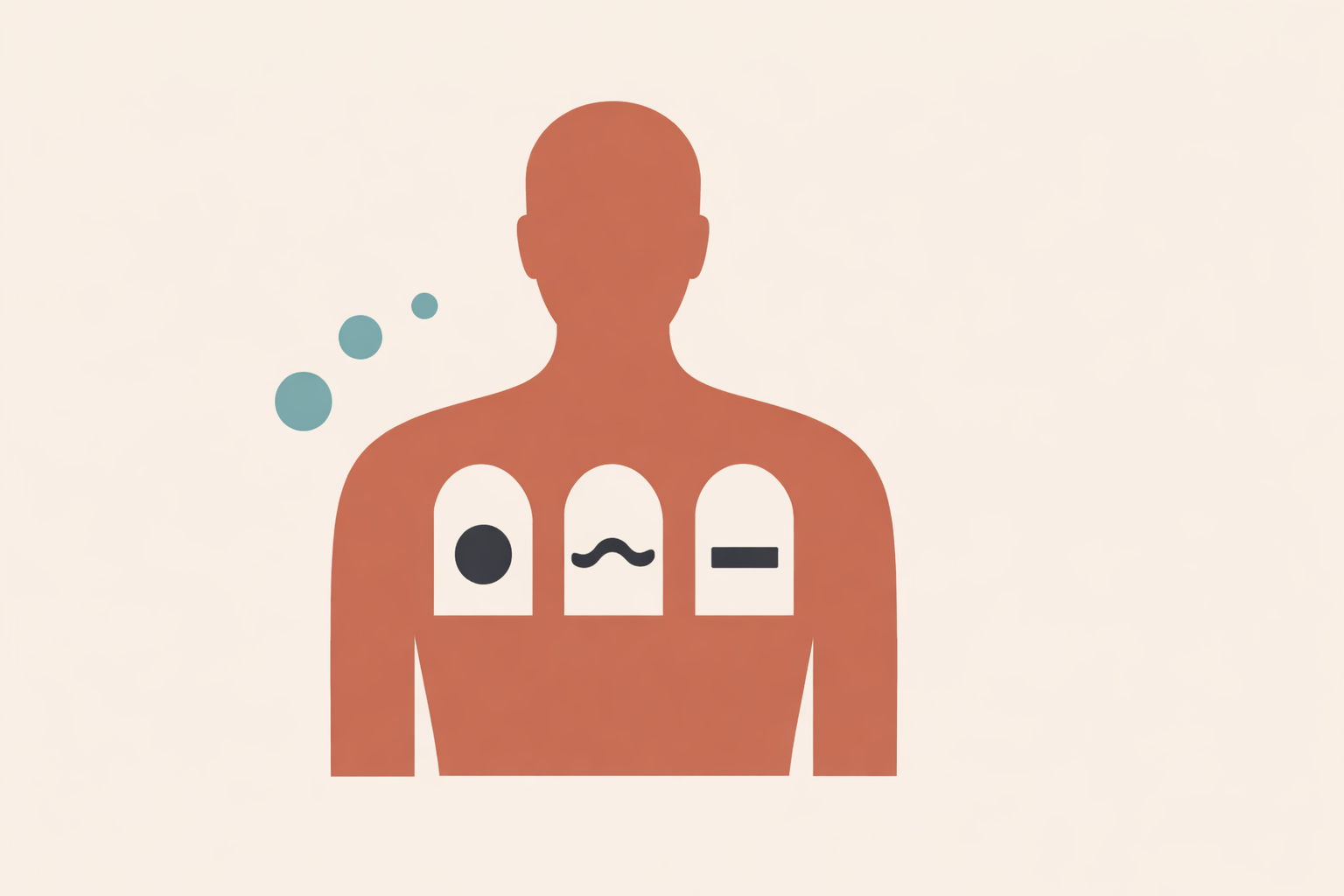
After the scan, turn sensation into usable information with three quick questions:
- Location: “Where do you feel it most?”
- Quality: “Is it tight, hot, buzzy, heavy, dull, wavy?”
- Intensity: “How strong is it right now?”
This gives the body a workable vocabulary. Instead of “I feel off,” a person might say, “There’s a hot knot under my left ribs, about a five out of ten.” That level of detail makes change easier to notice.
It also makes tracking simple. A quick note such as “10:15 a.m., tight chest, 5/10, after three slow breaths 3/10” reveals patterns over time: what activates the system and what helps it settle.
Brief, frequent check-ins usually beat long occasional ones. Two to five minutes before meals, between tasks, or after a difficult conversation is often enough to build a steadier relationship with body cues.
From a practitioner perspective, this work supports steadier emotions and less reactivity because the body is listened to early. The aim isn’t to fix every sensation. The aim is to notice, respond kindly, and include the body in the conversation.
Kinesiology-style muscle testing: using biofeedback with clarity and consent
Muscle testing is often misunderstood. Used well, it’s a grounded form of biofeedback that helps you notice how the system responds to a prompt in real time.
The basic process is simple: gentle, consistent pressure is applied to an indicator muscle while a person holds a thought, touches a point, or brings attention to a topic. You’re looking for a shift toward ease or stress with that input, right now.
For self-use, the standing sway test is an accessible start. Stand with feet under the hips and knees soft, settle the breath, then ask internally for a “yes” and a “no.” Many people notice a forward lean for yes and a backward lean for no. The skill is observation, not forcing a result.
When using muscle testing with another person, structure keeps things clearer:
- Set consent and expectations: “We’re exploring how your system responds right now.”
- Reduce noise with simple pre-tests such as hydration, cross-body tapping, or rubbing points below the collarbones.
- Choose a stable indicator muscle and establish a baseline response.
- Introduce one variable at a time.
- Retest after each change rather than stacking inputs.
This single-variable approach is what makes the feedback useful. If the response changes, you’ve learned something practical about what brings support or stress in that moment.
Traditional kinesiology also draws on meridian-based frameworks, where specific muscles are associated with channels and broader emotional themes. Within that map, tenderness at an alarm point, a change in muscle response, and a person’s felt sense can be read together. Practitioners often find this especially helpful when someone can’t yet describe what feels off, but the body is already showing a pattern.
A simple session sequence might look like this:
- Hydrate and orient.
- Test the indicator muscle for a steady baseline.
- Ask the person to think of a stressful conversation while placing a hand on the upper chest.
- Retest and notice whether the response changes.
- If there is more stress, hold a paired acupressure point with slow breathing.
- Retest and notice whether the response becomes steadier.
Used this way, muscle testing becomes a respectful dialogue with the body. It can suggest where support is needed, which point hold feels settling, or whether a prompt creates contraction or relief.
The tone matters. Curiosity works better than certainty. The body is offering feedback you can work with.
Kinesthetic education and Brain Gym-style movement: shifting state through motion
When stillness is hard, movement is often the better doorway. Many people think more clearly and feel more grounded when they can move while staying connected to their breath and sensations.
Kinesthetic education uses movement, balance, breath, and visual tracking as learning tools. It treats attention as something you can support through motion.
Brain Gym-style patterns are a familiar example. Cross-lateral movements such as cross-crawl, along with visual patterns such as lazy eights, are widely used to support attention and bring the system into a more organized state. Many people feel a shift after only a few minutes.
Here is a simple 3- to 5-minute reset:
- Sip water and rub gently below the collarbones while breathing.
- Cross-crawl for about a minute, moving slowly enough to keep the breath easy.
- Draw large sideways eights in the air with one hand, then the other, then both together, letting the eyes follow.
- Add shoulder rolls and a soft jaw release.
- Finish with one long exhale and notice what has changed.
These aren’t workouts. They’re short state-shifting practices, and clients often notice steadier attention or less bracing after a brief sequence.
This approach also adapts well for sensitive or easily overwhelmed people. Choice, slowness, and smaller motions go a long way. Movements can be done seated, reduced in range, or imagined if that feels more accessible.
Across many movement traditions, the shared principle is straightforward: when attention rides breath and motion, the mind often settles and follows.
A practical cue can help these resets become habitual. One easy version is “3-3-3”: three breaths, three cross-crawls each side, and three lazy eights per hand before changing tasks. It takes under a minute and reinforces that focus can be refreshed.
Bringing the three practices together in daily life
These approaches shine when they work as a set. The scan helps you hear the first whisper. Muscle testing gives you a structured way to explore what supports the system. Movement offers a fast way to shift state when words aren’t getting traction.
Keep the starting point simple:
- A two-minute body scan before lunch.
- A brief sway check before making a small decision.
- A one-minute movement reset between tasks.
Then record what you notice in one honest line a day. Over time, those small notes build trust in body signals and show which practices help you most.
This body-led awareness often deepens decision-making. Many somatic practitioners observe that “gut nudges” become easier to hear when the system is calmer, and choices made from steadiness tend to land better.
It also helps to pair sensation with language. Naming what’s present, such as “tight throat, sadness” or “heavy chest, hesitation,” builds emotional literacy and makes inner experience easier to work with.
Body intelligence can support nourishment habits too. In intuitive-eating guidance, people are encouraged to rely more on hunger cues than on rigid external rules. This fits naturally with body-based practice: pause, notice, respond.
For coaches and facilitators, these tools are just as useful in session design as they are for personal practice. A quick scan can show where to begin, a muscle test can suggest which supportive input to try first, and a short movement reset can make a stuck moment workable.
They also support sustainability. Short check-ins, movement breaks, and quick point holds can reduce burnout risk on full days by keeping access to body cues online.
Traditional kinesiology offers a rich framework here, weaving together muscle-meridian relationships, energetic pre-tests, point holds, and careful observation. Whether you’re exploring these practices for yourself or bringing them into energy healing or kinesiology certification, the thread is consistent: listen early, respond gently, and trust the smallest shift you can genuinely feel.
A softer jaw, a steadier exhale, a clearer yes, a little more room in the chest; these are subtle moments, yet they often shape what comes next.
As with any body-based practice, good work stays consent-led and person-led. If a practice increases distress, slows down, simplify, or pause and seek appropriate support. Used with care, these three tools offer a steady, traditional-and-practical way to build everyday self-trust.
Train in Kinesiology Certification
Deepen these biofeedback and regulation tools with guided practice in the Kinesiology Certification.
Explore Kinesiology Certification →