Most teams respond to strain in familiar ways: add a resilience workshop, offer more one-to-one support, and hope pressure eases on its own. That can lift things briefly, yet by the end of the quarter the same handoffs, rework, and blurred priorities often return. People are still overextended, and the system is still generating friction.
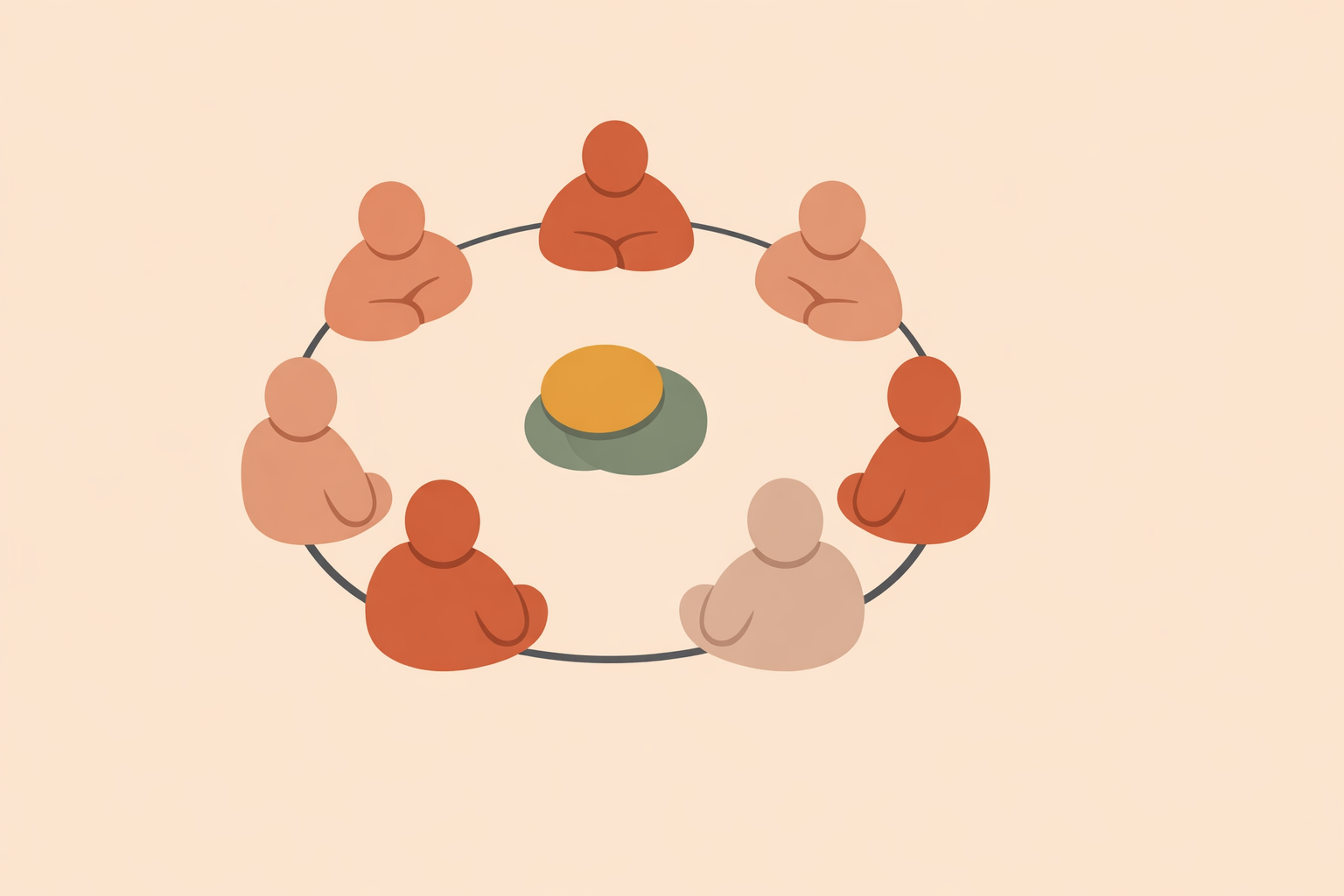
A more reliable lever is collective. Well-held group sessions help people recognize shared patterns, name what is draining energy, and make practical changes together. With skilled facilitation, groups support personal steadiness while also improving how work moves day to day.
Key Takeaway: Group sessions can improve both well-being and workflow when they are structured, participatory, and tied to real working conditions. Their value is not only emotional support, but the ability to surface patterns quickly, build shared language, strengthen voice, and turn reflection into small changes that last.
From individual coping to collective responsibility
Many organizations begin by helping people cope better. That’s worthwhile, and it works best when it’s paired with participatory redesign so the system carries its share of responsibility too.
Organizational reviews highlight flexibility, job redesign, relational practices, and participatory processes. In strong programs, people gain more worker voice over how work happens locally.
This matters because interventions that include concrete work modifications tend to hold up better than efforts focused only on mindset. Multi-level approaches that combine individual learning, team dialogue, and changes to workload or role clarity are associated with reductions in burnout that can remain sustained over time.
In real settings, the group conversation is often the turning point. People arrive thinking they need thicker skin or better time management, then realize the real pressure sits in scheduling norms, impossible response expectations, uneven coverage, or constant interruption.
One prompt that consistently unlocks progress: “If we could change one thing this month to ease pressure without hurting service, what would it be?” Keep answers practical, then choose a tiny experiment the team can test within a week or two.
Why voice matters more than resilience alone
Resilience skills help people stay grounded. Voice changes what a team is able to change. When people can name what isn’t working, suggest alternatives, and influence local decisions, the group becomes a place of co-creation rather than a place to vent.
That’s the deeper promise of this work: not just helping people cope with pressure, but helping teams shape conditions that are workable, humane, and sustainable.
Build group spaces where candor can surface
For group work to help, people need enough safety to speak honestly. Not perfect comfort. Safety for candor.
Clear agreements, consistent facilitation, and trustworthy boundaries make that possible. Without them, groups stay polite and shallow; with them, people name what’s actually happening and what they need.
Set simple norms from the start:
- Confidentiality with clarity: explain what stays in the room and what would need to be escalated if serious risk is disclosed.
- Role separation: when possible, use a facilitator who is not the direct manager, reducing the silencing effect of a dual role.
- Respectful honesty: invite discomfort without allowing disrespect.
- Shared airtime: give everyone a way in, not only the most verbal people.
A simple opening can work well: “What is one thing that is working, one thing that feels heavy, and one hope for this session?” Structure like this helps the group move beyond performance and into real reflection.
Psychological safety is best understood as a shared sense that people can speak up, contribute, and question respectfully without being shut down. In teams, that foundation supports learning, trust, and smoother coordination.
Use simple, ethical communal practices
Some of the strongest group spaces draw on forms that human communities have relied on for a very long time: circle, story, pause, listening, gratitude, and shared witness. These practices are not new, and they don’t need borrowed language to be effective.
Used with care, they help people slow down, notice what’s present, and reconnect with belonging. They also sit comfortably alongside contemporary group methods.
Research lines up with what experienced facilitators see. Workplace mindfulness in groups is linked with improved well-being. Reviews also suggest peer groups and CBT-based or ACT approaches can support stress reduction and clearer coping.
In practice, keep it straightforward:
- Open with a one-word check-in.
- Guide two minutes of grounding through breath or posture.
- Invite a short story about a time work felt smooth or meaningful.
- Name one recurring thought pattern that amplifies pressure.
- Close with one action and one note of gratitude.
The key is respect. If a practice belongs to a specific cultural lineage, don’t borrow symbols, names, or rituals casually. If you’re not in relationship with that tradition, stay with universal forms and acknowledge inspiration honestly.
Turn reflection into practical work redesign
Group insight matters most when it leads to visible change. The bridge is experimentation: small, testable adjustments in workload, roles, communication, or rhythm.
Start by naming friction in plain language. What gets repeated? Where is time lost? Which meetings create more confusion than clarity? What requests interrupt focus all day?
Then turn each theme into a short experiment with an owner and a review date. Evidence suggests programs that focus on workload and participation are more promising than efforts that only tweak schedules. Interventions that change how work is organized can improve well-being and sometimes support performance too.
A visible action board helps teams stay honest and focused:
- Issue: what is creating friction.
- Experiment: one small change to test.
- Owner: who can actually make it happen.
- Review: when the team will revisit it.
- Learning: what improved, what did not, and what to try next.
This is where group work becomes a steady engine for better ways of working. People see that speaking candidly leads to movement, not just momentary relief.
Choose group formats that can actually stick
Format matters. One-off workshops can feel energizing, but they rarely change culture by themselves. Groups work best when they run for several sessions and include follow-up.
Even brief programs can help: workplace programs as short as four sessions have shown benefits for work-related anxiety. More broadly, many teams get better results from a short arc of repeated sessions than from a single event, because there’s time to revisit experiments and strengthen habits.
Reviews also suggest benefits fade more easily with standalone efforts, while multi-level approaches can maintain progress over 12–24 months. Hybrid designs can support short-term gains for hybrid programs, while digital-only approaches can struggle with attrition if human connection is thin.
Useful formats include:
- A four-week focused sprint around workload and focus.
- A monthly reflective circle tied to real team challenges.
- A blended series of live sessions with short practices between them.
- Cross-role circles where leaders participate as learners, not evaluators.
Continuity is the quiet ingredient. Skills can land quickly; culture usually needs repetition.
Embed group sessions into everyday team rhythm
For this work to last, it needs to live inside ordinary working life rather than on the edges of it. That means leadership support, protected time, and a clear message that group sessions are part of how the team learns together.
Quality of follow-through makes a major difference. Reviews consistently point to the importance of implementation, and workplace intervention reviews suggest that top-down approaches without participation often underperform.
By contrast, ongoing circles can become a practical learning ecosystem when they stay tied to real work and visible action. Leader participation can help when leaders show up as genuine participants rather than overseers.
To embed group work well:
- Protect the time as real work.
- Anchor sessions to an existing cadence.
- Let teams adapt the process locally.
- Track visible changes in a simple changelog.
- Explain the purpose clearly during onboarding.
The framing matters. People engage more when sessions are positioned as co-learning rather than correction. The aim is to improve how people support one another and how the work itself is shaped.
Closing thoughts
When work feels heavy, people often assume they need to become harder. Group sessions offer a more humane path: become steadier together while improving the conditions where the work happens.
The strongest results usually come from continuity, participation, and practical follow-through. Groups help people feel less alone, and they also reveal patterns, build shared language, and create momentum for change.
Start small if needed. Hold the space well. Use simple communal forms with respect. Let honest stories surface, then translate them into manageable experiments around workload, roles, and rhythm. Over time, these repeated conversations can become part of how a team supports well-being, learns from strain, and grows into a more grounded way of working.
Coach Systems, Not Symptoms
Systems Based Life Coaching Certification helps you guide group insight into practical, sustainable changes in work and life.
Explore the Certification →