When disruption hits, requests often arrive faster than any system can hold them. Group chats fill with mixed priorities, elders without smartphones are left out, and a handful of dependable people end up carrying too much. Goodwill can quickly turn into coordination debt. What helps most isn’t day-one intensity, but a network that stays dependable when things get messy.
Key Takeaway: Durable mutual aid depends less on urgency and more on sustainable roles, clear boundaries, and layered communication that includes offline options. When networks map local assets, protect privacy, and practice with small pilots, they stay inclusive and reliable under pressure without burning out the same few people.
Root the network in local culture, lineage, and place
Strong mutual aid networks rarely appear from nowhere. They grow from place, memory, and shared habits of care. If you want a network people trust, start with traditions that already know how communities endure.
Across many cultures, mutual aid has deep roots in reciprocal labor, shared harvests, kinship systems, faith communities, commons stewardship, and neighborhood exchange. These aren’t abstract ideas—they’re living patterns that teach people how to organize support without waiting for perfect conditions.
Honoring cultural roots also keeps the work ethical and grounded. Name the practices and people you’re drawing from: your grandparents’ preserving methods, a neighbor’s irrigation knowledge, the local seed swap, a mosque’s meal train, or a church’s phone tree. If a tradition isn’t yours, ask how to reciprocate appropriately, or support a local cultural bearer rather than repackaging their knowledge as your own.
“Associate with the noblest people you can find… But learn to be self-reliant.”
That balance is the heartbeat of mutual aid: build capacity inside your circle while staying in respectful relationship with the people who hold the roots.
Let local land and real needs shape how traditions adapt. A seed swap may become a rooftop planter exchange in a city. A harvest gathering may become a monthly potluck and skills-share in a laundromat or library room. Put simply: does this make people feel more capable, more connected, and more at home where they live?
Map people, skills, spaces, and communication paths
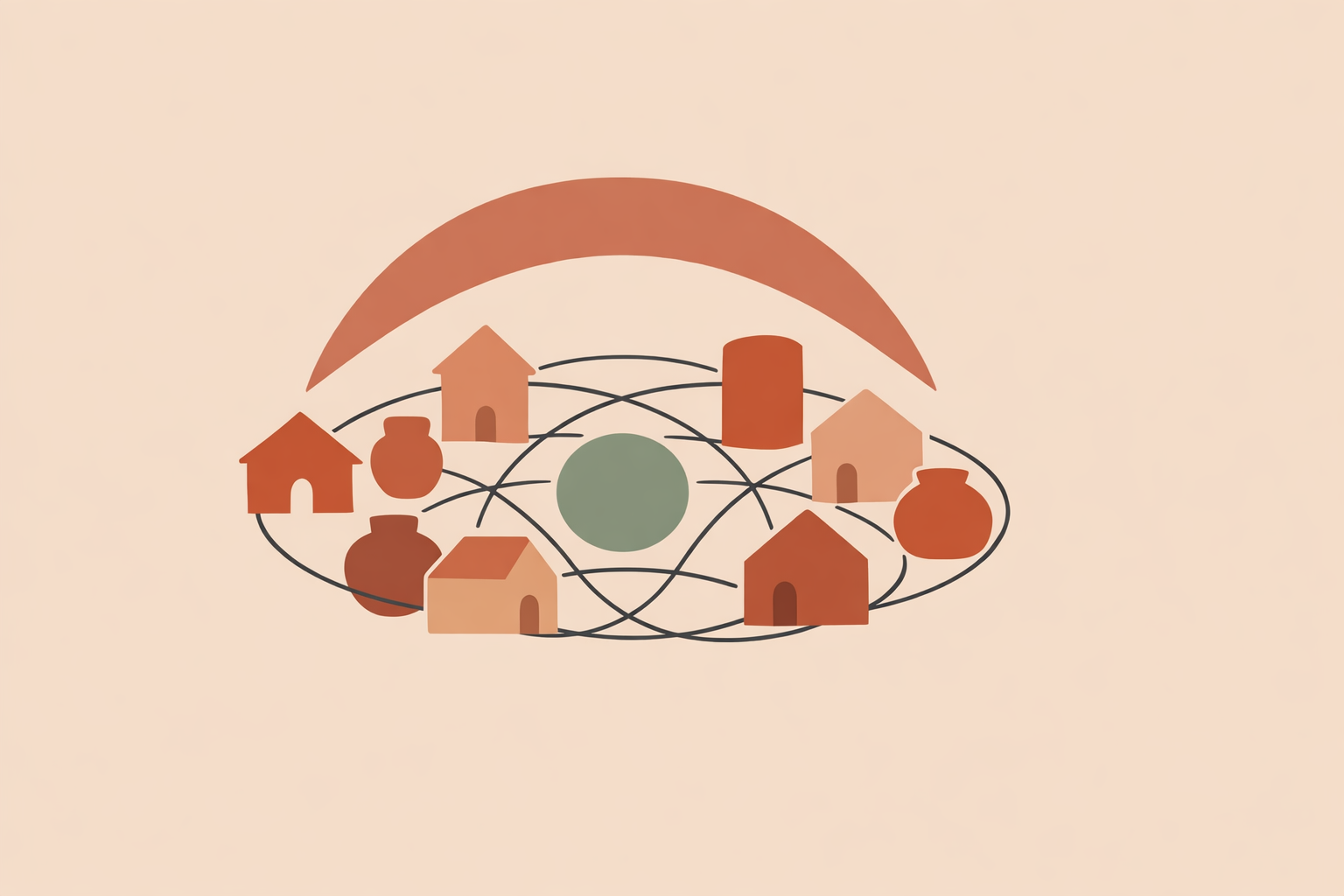
Before big plans, make the invisible web visible. A shared map of people, skills, spaces, and contact routes gives the network a spine.
Start with strengths. Asset-based approaches help people notice what’s already present—relationships, tools, languages, storage space, gardens, kitchens, vehicles, meeting places, repair skills, cooking knowledge, and informal leadership. Beginning here builds pride and ownership rather than shame.
Create a simple shared sheet or paper map with columns for:
- Name
- Preferred contact method
- Languages
- Offers
- Needs
- Neighborhood
- Availability
- Access notes, such as stairs, scent-free needs, or childcare
Then add a second list for spaces and tools: kitchens, gardens, freezers, vans, shelf-stable foods, generators, first-aid supplies, and rooms people can use.
Use both low-tech and high-tech methods together: a library table, a printed neighborhood map, sticky notes, and a shared spreadsheet. What this means is simple—more people can participate, and fewer get missed.
As you build the map, chart communication routes early: who uses messaging apps, who prefers calls, who needs translated updates, and who is likely to miss digital communication altogether. This one step prevents accidental exclusion later.
“Self-reliance and self-learning are your most dependable friends.”
Let the map become a living classroom where people learn how to help—and how to ask.
Gather a core circle and agree on boundaries early
Once the map is taking shape, gather a small core circle. Healthy networks choose clarity early, because pressure reveals what was left undefined.
Clear roles, preexisting relationships, and simple coordination structures help mutual aid efforts hold up better during crisis. In practice, this is the difference between “everyone helps” (and nobody knows what’s happening) and a network that can respond without burning people out.
In the first meeting, keep your agreements light but real:
- Purpose: one sentence you could repeat at a mailbox or market stall
- Scope: what you will do, and what you will not do
- Roles: logistics, communications, check-ins, coordination, conflict navigation, finance, or space holding
- Backups: at least one backup for each key role
- Consent: how personal information, photos, and stories are handled
- Accountability: how concerns are raised, harm is addressed, and learning is shared
Defining boundaries early protects relationships. It reduces assumptions about availability, authority, and emotional labor—and makes “yes” and “no” easier to respect.
As J. W. Jepson wrote, adulthood balances “self-discipline and self-reliance.”
In mutual aid, those qualities become culture through everyday agreements.
Build communication systems with offline fallbacks
In a crisis, clarity saves energy. The best systems are simple, layered, and inclusive enough to keep functioning during outages or overload.
Redundant systems help coordination continue when one channel fails. Think of it like having more than one path home: you don’t need all roads open, just enough to keep moving.
A practical structure looks like this:
- Real-time: one main chat app with separate channels for urgent updates, logistics, and community well-being
- Asynchronous: one shared document that acts as the source of truth for roles, notes, and current needs
- Analogue: a phone tree with 5 to 10 people per caller and a printed contact list for the core circle
- Offline hubs: bulletin boards at libraries, laundromats, places of worship, community fridges, or local shops
Practice lightly. Test the phone tree every few months, run a short urgent-message drill, and host a pop-up information table for neighbors who are rarely online. Small rehearsals reveal gaps without draining people.
Privacy matters just as much as speed. Data minimisation, consent, and clear retention rules increase trust and make people more likely to participate. Collect only what you need, explain why, and delete sensitive details once a request is complete.
Good defaults are simple:
- No public spreadsheets with full names and exact addresses
- Use first names only in group chats unless someone wants otherwise
- Share location details on a need-to-know basis
- Translate key documents into the main languages of the area
When people feel safe, they engage more fully—and the network gets stronger.
Run small pilots and let trust grow through action
Small, real actions build trust faster than perfect plans. They also show the network what’s actually sustainable.
Small pilots often create momentum more effectively than long planning phases with little visible action. A one-street check-in pod, a one-day exchange table, a weekly elders’ call hour, or a handful of food deliveries can teach more than months of discussion.
Choose one pilot and keep it modest:
- A neighborhood pantry day
- A shared meal and resource exchange
- A two-hour repair or preserving circle
- A call list for elders or isolated neighbors
Then ask a few simple questions:
- How many people were reached?
- What felt easy?
- What felt heavy?
- What should change next time?
Close gatherings with something grounding: a few breaths, a brief gratitude round, a shared meal, or a clear stop time. Traditional communities have long known that endings matter—without them, people leave carrying everyone else’s nervous system home.
Regular check-in circles, shared meals, and storytelling can also support people through prolonged uncertainty. Community-based group spaces have been associated with reduced distress and stronger coping after collective disruption. Essentially, being witnessed together helps people stay steady.
As J. Ollie Edmunds put it, our communities were built by people who relied on themselves and had the courage to act.
Your pilot is that courage in motion: quiet, practical, and enough to begin.
Sustain the network with rhythm, inclusion, and shared ownership
Once the first pulse is steady, the work becomes less about urgency and more about rhythm. This is where networks either mature—or exhaust themselves.
A seasonal approach often works better than permanent emergency mode. Spring may favor outreach and planting, summer abundance and exchange, autumn storage and workdays, winter reflection and planning. This natural expansion and contraction helps prevent burnout.
Regular check-ins help too. Weekly or biweekly core meetings and monthly wider gatherings are often enough to maintain connection without creating constant strain. Keep your signals simple: who’s participating, what exchanges are happening, where delays appear, and what barriers keep certain people away.
Inclusion becomes real when barriers are reduced in practical ways. Transportation support, childcare-friendly gatherings, and small financial supports can make participation possible for people who would otherwise be left out. Shared rides, kid-friendly meetings, and micro-grants aren’t extras—they’re part of building a network that belongs to more than the most resourced few.
And when everyone has a role, the network becomes broadly owned and more likely to last. Invite elders to teach preserving, teens to offer bike repair, multilingual neighbors to support translation, growers to share seedlings, and skilled listeners to hold story circles. Contribution becomes the norm, not the exception.
For practitioners, mutual aid can also deepen the quality of coaching and community-support work. It brings humility, local wisdom, and lived understanding. In return, structured facilitation, ethics, and continuity can help a network stay clear and kind—without turning community into a transaction.
Begin with the people already around you
Mutual aid grows from kitchen tables, stoops, gardens, notice boards, and message threads between people who decide to look out for one another. You don’t need perfect tools or a full-time coordinator to begin.
Choose one role you can hold. Map what’s already present. Gather a small core circle. Build simple communication layers. Run one tiny pilot. Then listen, simplify, and keep showing up.
That’s how mutual aid becomes durable support rather than a burst of urgency—season by season, circle by circle, until it’s simply part of how a community knows itself.
Build Self-Sufficiency Skills
Apply these mutual aid roles and rhythms with practical foundations in the Self-Sufficiency Certification.
Explore Self-Sufficiency →