Clients with ongoing back or shoulder discomfort often arrive wanting one thing: relief. When a weighted fork hums on the body and their breath drops, it’s easy to slip into a rescuer role or talk about sound as if it “fixes” what hurts. A steadier, more respectful stance works better over time: use tuning forks to support comfort, regulation, and a shift in perception, without claiming to correct an underlying cause.
Tuning-fork sessions can be deeply supportive around pain when your language, consent, and pacing stay clear. Sound and vibration can influence how discomfort is experienced through relaxation, attention, and nervous-system settling. That gives you a strong, ethical foundation for your work in energy healing.
Key Takeaway: Tuning-fork work around pain is best framed as support for regulation and comfort, not as a fix. Weighted forks are often used for local vibration, while unweighted forks create a broader field effect. In practice, sound can shift pain experience through sensory gating, autonomic settling, and changes in attention and meaning. Ethical sessions rely on clear consent, scope-safe language, gentle pacing, and the willingness to pause or decline when the situation falls outside your role.
How Sound and Vibration Can Change Pain Experience
The most useful frame is modulation. Sound work doesn’t have to change tissue to be meaningful; it can shift the pain experience through relaxation, regulation, attention, and the way the mind interprets sensation. Research suggests pain responses can shift through auditory input and related autonomic and attentional pathways.
One well-known pathway is sensory gating. When gentle vibration gives the nervous system clear, non-threatening input, that input can compete with pain signaling and make discomfort feel less prominent. In practice, vibration can engage sensory gating effects that quiet the moment-to-moment intensity.
Vibration also activates Aβ fibers, which can inhibit slower pain signals at the spinal cord. Traditional hands-on lineages have recognized a parallel truth for centuries: a clear, well-placed sensation can help settle another sensation that feels louder.
There’s often a whole-system shift as well. Steady tones from voice, bowls, or forks can encourage parasympathetic activity linked with rest and recovery. As stress settles, pain commonly feels less dominant, and sound-based approaches associated with stress reduction are also linked with reduced pain perception.
Attention and emotion shape pain too. Lived pain is influenced by anticipation, fear, memory, focus, and context. Research on music-based support shows that attention and emotion can reduce pain experience without necessarily changing tissue.
Some clients also report warmth or an “opening” feeling after localized fork work. Early lab findings suggest tuning-fork vibration may encourage nitric oxide release, which could be part of what’s felt, although this is still an emerging area.
A practical model holds up well in the session room: sound helps shift state; state shapes perception; and a change in perception can create real space around discomfort.
What You Can Honestly Say About Tuning Forks and Pain
Clear boundaries start with clear language. Promise a thoughtful process, not a guaranteed outcome. Speak in terms of support, relaxation, regulation, and body awareness.
Scope-safe phrasing includes:
- “I use tuning forks to support relaxation and nervous-system settling.”
- “Some people notice their discomfort feels quieter as they relax.”
- “We’ll explore what helps your system feel more settled and comfortable.”
- “Responses vary, and we’ll work gently with what your body gives us.”
What you avoid matters just as much. Don’t guarantee results. Don’t imply you can identify what’s structurally wrong. And don’t position sound as a replacement for other appropriate support when the overall picture is unclear or intense.
A useful standard is communicability: if you can’t explain a claim through direct experience, regulation, or a plausible mechanism, it doesn’t belong in your client-facing language.
- Say: “We’ll explore comfort and regulation.”
- Not that: “I’ll fix your back.”
- Say: “Many people feel calmer and sometimes less aware of discomfort.”
- Not that: “This will eliminate your pain.”
- Say: “If anything feels too intense, we’ll pause.”
- Not that: “Push through it.”
Set the Frame Before the First Tone
Pain-focused sessions go best when expectations are set early. From the first conversation, make it clear you’re offering support for comfort and regulation.
During intake, ask questions that guide safe, respectful choices:
- “What tends to make the discomfort louder?”
- “What helps it settle, even a little?”
- “Are you sensitive to sound, vibration, or touch?”
- “Are there any devices or implants we should avoid working over?”
- “What would feel like a meaningful outcome today: more ease, better rest, less tension, a calmer mind?”
Ask for explicit permission for on-body work each time. “Is it okay if I place this fork over your clothing for a few seconds?” keeps consent specific and the session collaborative.
It also helps to normalize the range of responses. People can experience sensory and emotional changes during or after sessions. This might look like warmth, tingling, emotional movement, changes in pain intensity, or a temporary increase in discomfort awareness. When clients know that ahead of time, they stay more oriented and speak up sooner.
For sensory-sensitive clients or anyone arriving highly braced, start with less intensity. Gentle input often creates the most ease.
Inside the Session: Start Wide, Then Go Local
A regulation-first approach usually lands better than going straight to the tender spot. Start broadly, let the system settle, then decide whether local work fits.
A simple flow might look like this:
- Begin with orienting and slow breath.
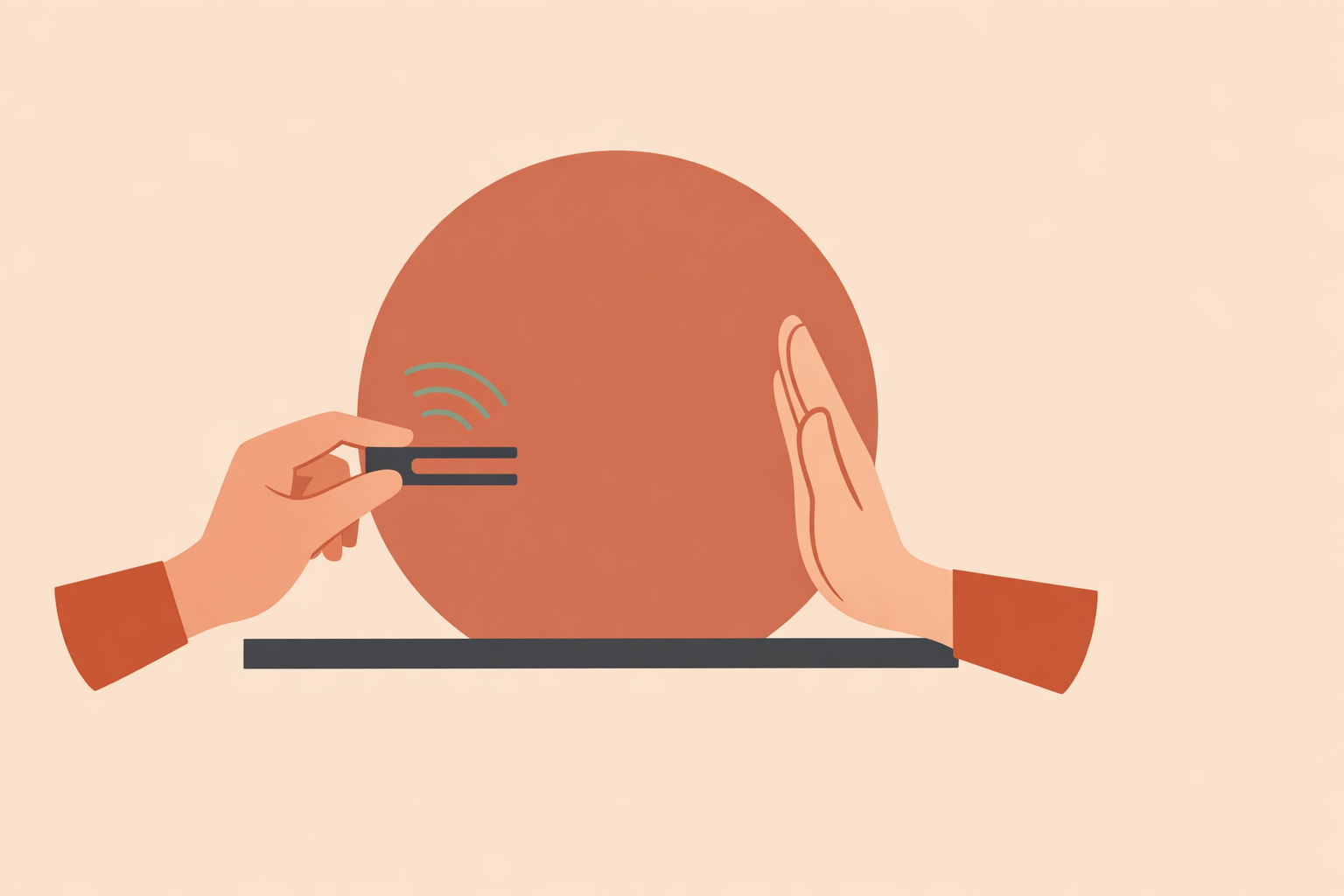
- Use an unweighted fork off-body near the ears or around the field to invite whole-system settling.
- Notice softening: slower breath, a less clenched jaw, or a fuller exhale.
- Then introduce a weighted fork briefly near the area of discomfort, with permission.
- Pause often and ask what changed.
Many practitioners find 20–45 minutes of sound exposure is enough to create meaningful change. Research suggests brief sessions can support parasympathetic activity, and session length is best guided by what you see in front of you.
If you use a 128 Hz weighted fork, short contacts often work well. Many practitioners notice that brief, well-spaced contacts sometimes shift a client’s self-rated discomfort by a small but meaningful amount. It’s helpful to track, not to promise.
Example micro-protocol:
- Minute 0–3: orienting, slower exhale, unweighted fork off-body.
- Minute 3–8: body scan; identify one area of ease and one area of tension.
- Minute 8–15: local work with a weighted fork near the tender area, 3–5 second contacts with rest between.
- Minute 15–20: return to broader sound and integration.
- Minute 20–25: silence or minimal sound; let the system settle.
Track outcomes in plain language. Ask, “How loud does the discomfort feel now compared with before?” Invite clients to notice sleep, tension, or ease later that day. Two people with similar stories can respond very differently, and context shapes outcomes.
Trauma-Informed Practice Matters in Pain Sessions
Pain often arrives with guarding, vigilance, and fear. Trauma-informed pacing belongs in every pain-focused session: go slowly, offer choices, and watch for overwhelm.
If someone goes distant, numb, agitated, or glassy-eyed, reduce input and help them orient. Bring attention to the feet, the room, the breath, or the support of the chair. In some sessions, grounding is the work.
This is also where traditional frameworks can be offered with care. If you work with meridians, chakras, or field-based maps, share them as optional lenses within energy healing. When presented respectfully, they can offer meaning and language without turning the session into a fixed belief system.
When to Pause, Decline, or Suggest Other Support
Not every pain-focused situation suits tuning-fork work, and not every session should continue once new information appears. If your instincts say slow down, listen.
Pause and suggest other support pathways when discomfort is sudden, severe, unexplained, or linked with concerning changes such as spreading numbness, marked weakness, or inability to bear weight. Tuning forks are not reliable for determining structural injuries such as fractures, so don’t present them as assessment tools for that purpose.
Keep forks off areas with pacemakers or electronic implants. And with sensory-sensitive clients, start moderate, because strong sound or vibration can be too much.
Variability is also part of honest practice. Stress and dysregulation can amplify discomfort, and elevated stress markers are associated with a more intense pain experience. Even so, individuals respond differently, and your session plans should stay flexible.
A respectful boundary script can stay simple: “Given what you’ve shared, I think it would be wise to get further support before we do local on-body work. If helpful, we can still focus today on grounding and general relaxation.”
Closing Perspective: Relief Without Overpromising
Tuning forks can be a valuable part of pain-support work when used with care, clear consent, and grounded language. Their strength is state-shifting: less bracing, steadier breath, softer attention, and sometimes a real drop in how dominant discomfort feels.
This view is backed by longstanding practice wisdom and growing research. Reviews of vibrational approaches describe parasympathetic balance and improved emotional regulation after sessions, which closely matches what many practitioners observe.
Keep your work clean and trustworthy: stay honest about scope, lead with consent, and let the session be a collaboration with the client’s nervous system rather than a performance of rescue. Save the big promises for no one; offer steady support instead.
Train in Sound Therapy
Build skillful, scope-safe sessions like these in the Sound Therapy Certification.
Explore Sound Therapy →