Most animal-massage training starts with structure and movement: muscles, joints, gait, and posture. That foundation matters. Yet with touch-sensitive animals, technique alone doesn’t always tell you where to begin, how fast to go, or when to pause. A dog might brace the moment a hand approaches the belly, while a horse may soften almost everywhere except the shoulders.
Chakra awareness offers a gentle way to organize touch, pacing, and session flow, especially when you’re working consent-led and the animal’s signals are your main guide.
Key Takeaway: Chakra awareness can be used as a practical overlay in consent-led animal massage. It helps you choose first contact, pace the session, and know when to continue, hover, widen contact, or pause. For many practitioners, beginning at the brachial chakra and moving root to crown creates a calm, repeatable structure that supports trust, regulation, and clearer communication.
How chakra awareness supports animal massage
In practice, chakras work best as a subtle map. They don’t replace hands-on skill, observation, or species knowledge. They add another way to track how an animal is receiving contact moment by moment.
Many practitioners are trained to read tissue first. Chakra-informed work adds a second lens: where the animal feels ready, where they guard, and where a hover or a broader hand is more welcome than direct touch. Sessions often become less mechanical and more like a quiet exchange.
Traditional systems use different language for vitality and flow, yet many point toward the same hands-on truth: slow, respectful contact can shift the whole animal. From a bodywork perspective, nerve networks are especially rich in regions practitioners commonly focus on, and light touch can influence deeper responses through the body’s surface-to-depth communication.
That’s where chakra awareness shines: it keeps your attention on willingness. Instead of chasing the “right” area, you follow the place the animal can meet you.
The chakra map commonly used in animals
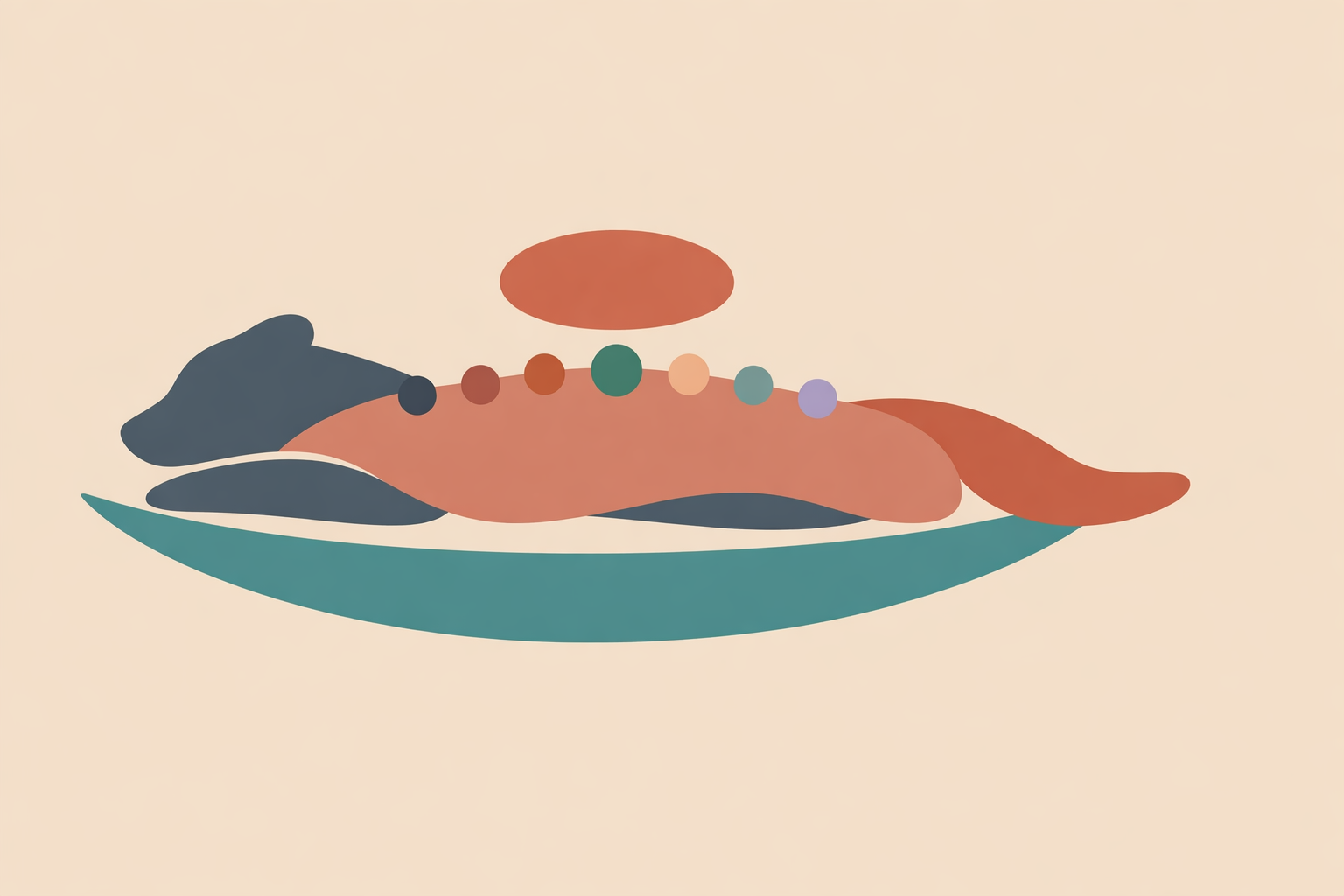
Many traditions used in animal energy work recognize seven shared chakra centers plus a brachial chakra specific to animals. In sessions, this map gives structure without locking you into a rigid routine.
- Root: base of tail; grounding, stability, bodily security
- Sacral: lower belly; fluidity, boundaries, playfulness
- Solar plexus: upper belly and ribcage; confidence, sensitivity, self-protection
- Heart: center chest; connection, softening, emotional warmth
- Throat: neck and thoracic inlet; expression, ease with handling
- Brow: between the eyes; focus, perception, inner quiet
- Crown: top of head; stillness, spacious presence
- Brachial: shoulder region; relationship, participation, access to the rest of the system
Practitioners also describe minor centers around joints and sensory structures, along with “bud” centers at paw pads and ear bases. Even without using those terms, many animals respond strongly around hocks, knees, ear bases, and the tail tip. In horses, a light glide along the topline and limbs often brings clear release responses, aligning with the broader observation that subtle contact in these areas can open up the rest of the session.
The value of the map is practical: it helps you organize attention, notice patterns, and record what changes under your hands.
Why the brachial chakra is often the best place to begin
If there’s one reliable starting point, it’s the shoulders. Beginning at the brachial chakra invites participation, builds trust, and creates an easy “entry” before moving toward more sensitive areas.
This is especially helpful with animals who are unsure, newly rehomed, highly alert, or selective about touch. The shoulder region usually feels socially safer than the belly, face, or hind end, and it gives the animal room to orient, lean in, or step away without pressure.
Keep the opening simple:
- Arrive quietly and let the animal notice you
- Hover or rest a soft hand near the shoulders
- Wait for a small sign of willingness: a blink, lean, sigh, or step closer
- Keep contact broad and light
- Let the animal leave and re-engage if needed
Once this “gateway” softens, the rest of the body often becomes more available. Not every animal stays at the shoulders long, but many offer their first clear yes there.
With dogs and cats, many practitioners stay at the brachial area briefly before making any other decision. With horses, starting at the shoulder also respects their comfort zone and makes whole-body feedback easier to read.
Using a root-to-crown flow to structure the session
A root-to-crown flow keeps sessions organized and supports a grounded pace. It also helps you avoid rushing into highly sensitive areas before the rest of the body has settled.
Starting at the hind end often steadies the system before you move forward. In horses, many bodyworkers watch for hind-leg release signs such as weight-shifting or resting a hind leg as the animal begins to let go.
A practical sequence looks like this:
- Root: begin with stillness, broad contact, and a sense of support
- Sacral: bring patience; indirect contact is often best received here
- Solar plexus: approach gradually, especially with guarded or over-alert animals
- Heart: pair contact with your own steady breathing and presence
- Throat, brow, crown: use less pressure, shorter holds, or hovering hands
Root-area contact can be especially supportive for newly rehomed animals building bodily and spatial safety. Around the sacral area, increased ease often shows up as more fluid movement and a return of playfulness or social softness.
The upper body usually calls for more restraint. Gentle solar-plexus contact often reduces guarding and invites fuller breathing. Heart-area touch paired with steady breath can help dogs soften through the shoulders and orient toward you, and around the brow many sensitive animals visibly settle their focus.
This sequence is a default, not a rule. If the animal clearly asks for a different order, follow their lead.
Blending chakra work with meridians, Reiki, TTouch, and Masterson-style bodywork
Chakra work blends smoothly with other gentle, consent-led approaches. A clean way to combine methods is to let chakras guide your structure while your hands use whichever technique best suits the animal.
With horses, following the topline with light, attentive contact is well known for inviting whole-body release. The Masterson approach teaches a feather-light scan along the back and neck that often brings subtle responses such as blinking, yawning, and softening. Chakra pauses can be woven in naturally along that line, especially around brow, heart, brachial, and root.
In dogs, acupressure traditions describe 12 meridians. If you already work with meridian pathways, chakra awareness gives you clear “re-centering points” when the animal becomes busy, uncertain, or overstimulated.
TTouch ear slides are often used to support nervous-system settling, and tail work is commonly used to support grounding through the root and sacral areas. Reiki holds can layer in easily too, hands-on or hands-off, especially when direct contact feels intrusive.
The common thread is simplicity. One anchor point, one gentle glide, and one quiet pause is often enough.
How to read responses during chakra-informed touch
Session quality depends less on how many techniques you know and more on how well you notice what the animal is communicating back. When you stay just under bracing, the system has room to unwind without feeling pushed.
Common release markers in gentle bodywork include blinking, yawning, and sighing, along with lip tremors, stretching, head drops, softer eyes, resting a leg, shaking, or snorting. These signals are often quiet, yet they carry real information.
Also watch for signs you need to adjust. Behaviors such as moving away or pinned ears, along with pawing, fidgeting, hard staring, or a defensive posture, usually mean the contact is too much, too direct, or in the wrong place right now.
A steady rhythm helps:
- Offer: place or hover your hands softly
- Observe: wait for one clear sign of softening or avoidance
- Adjust: continue, lighten, widen contact, switch areas, or pause completely
This is where the chakra map becomes a real-time guide. If the solar plexus feels too vulnerable, return to the brachial. If the head is too stimulating, drop back to the root or heart. You always have a coherent next step.
Supporting the human-animal bond over time
Respectful chakra-informed touch supports more than a single session. Over time, it strengthens co-regulation because the animal learns that your hands listen.
Trust grows through repetition: beginning gently, honoring refusal, noticing calming signals, and adjusting your pace. In dogs, paying attention to stress signals such as blinking, yawning, and lip-licking supports safety in the relationship. The same principle carries across species: animals relax more readily when they know they won’t be pushed past readiness.
Brief notes help you build that relationship intelligently. Record where the animal softened, where they withdrew, and what helped them re-engage, and your sessions will naturally become clearer and kinder.
That kind of repeatable observation also fits naturally within animal wellness work, where simple patterns and daily feedback matter as much as technique.
Closing thoughts
Chakra awareness supports a more responsive, relational style of animal massage. Begin where the animal can say yes. Let the brachial open the conversation, let the root steady the body, and let the rest unfold from there.
You do not need to prove the map for it to be useful. What matters is whether it helps you touch with more patience, clarity, and respect. Used this way, chakras become a practice of better listening.
Keep contact light and your structure simple. Over time you’ll also want to stay within your training, work in safe environments, and pause or refer on when an animal’s responses suggest discomfort or stress that’s beyond what supportive touch should address.
Train in Animal Massage Certification
Build consent-led hands-on skills and session structure with the Animal Massage Certification.
Explore Animal Massage Certification →