Most coaches can script a SMART goal in their sleep: specific target, timeline, tracker. It looks clean in the session and on the follow-up sheet—until the novelty fades. Adherence dips, the language shifts to “should,” and you’re back to resetting metrics that never quite settle.
Often, what’s missing isn’t structure. It’s meaning. When a goal reflects external expectations more than identity, follow-through becomes fragile.
Values-led goal setting takes a steadier route. Clarify what truly matters to the client first, then translate that into small, testable behaviors. Values supply the deeper reason, protect autonomy, and help goals feel like expressions of self rather than chores.
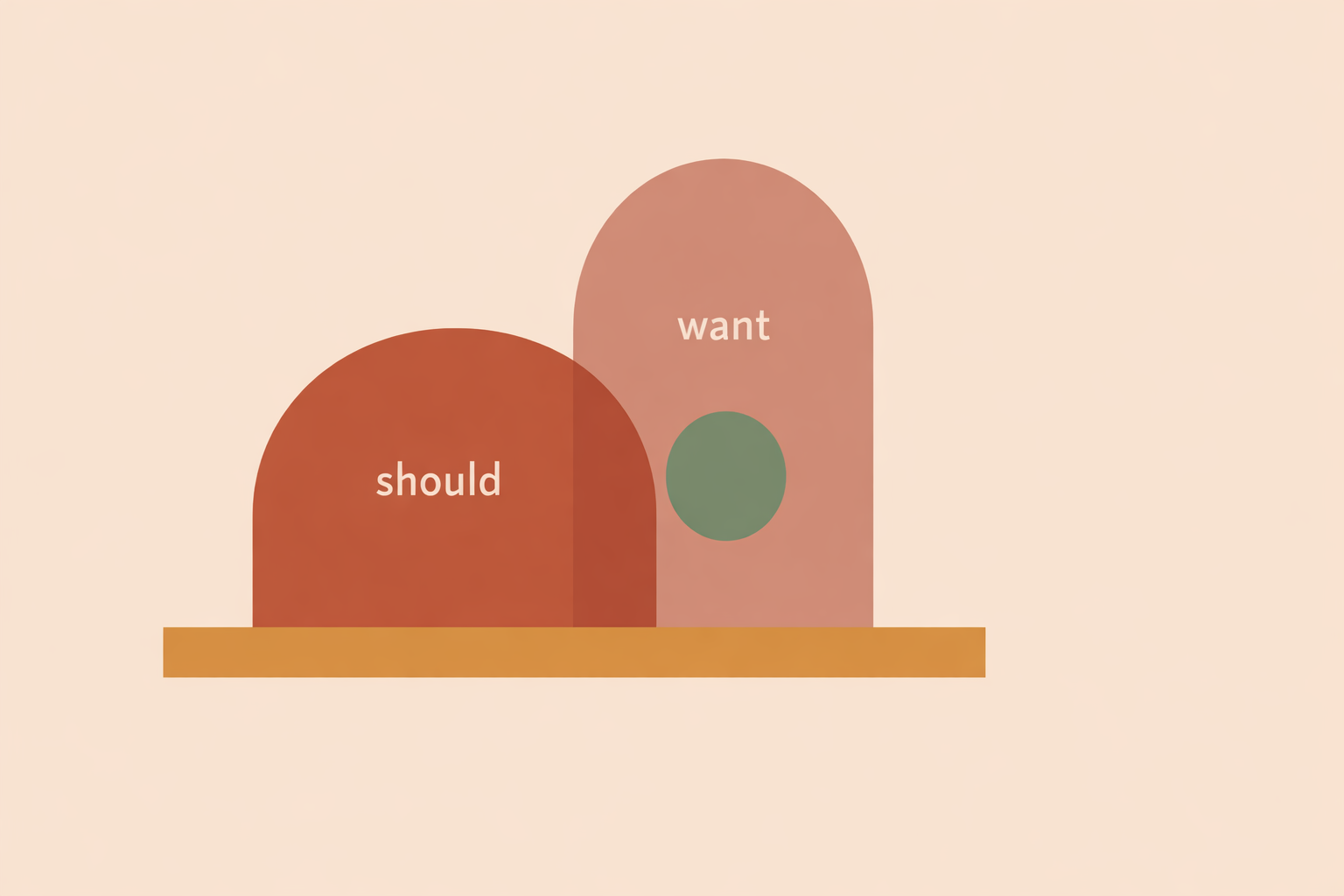
Key Takeaway: Coaching goals are more likely to hold when they express a client’s chosen values instead of external rules. Start by separating “want” from “should,” then listen for values in daily routines, emotional patterns, and cultural context. From there, turn those values into small, specific, flexible actions, review them regularly, and adjust without losing the deeper reason behind the work.
Why values make goals more sustainable
Goals last longer when they answer a deeper reason the client can actually feel. Values give that reason shape: connection, steadiness, creativity, service, dignity, devotion, freedom. A goal is an outcome; a value is a direction. When outcomes follow that direction, motivation steadies.
You can hear the difference in session. “Run 5k by June” can feel heavy and external. “Build enough energy to be present with my children” carries its own fuel. The metric still has a place, but the value tells you why the effort deserves a slot in real life.
This aligns with professional coaching expectations, too. The ICF includes exploring a client’s values within its core competencies, reinforcing that values work isn’t a “nice extra.” It changes the whole conversation.
Useful prompt: “If I erased the metric, would this still matter because it reflects who you are?” If the answer is no, you may be looking at an approval goal rather than a values-led one.
How to separate “should” from “want”
Many first-draft goals arrive dressed as pressure: “I should lose weight,” “I have to wake up at 5 a.m.,” “I need to be more disciplined.” Often these are inherited rules—picked up from family patterns, workplace culture, or online ideals—rather than chosen directions.
Before building a plan, separate three layers:
- Self-image: “I am disciplined.”
- Value: “I value reliability.”
- Behavior: “I will prepare breakfast the night before.”
This distinction gives clients room to choose. Values aren’t finish lines. They are ways of being and acting that can show up in many different behaviors.
A simple exercise often unlocks this quickly. Ask the client to complete two sentences slowly: “I should…” and “I want to…”. In many sessions, the energy shifts immediately. “Want” tends to sound warmer and more grounded, and the goal often becomes more realistic as the client comes back to their own priorities.
Try questions like these:
- “If nobody could see this, would it still matter to you?”
- “What would a satisfying life look like in everyday terms?”
- “If outside expectations went quiet for a moment, what would you make more time for?”
When clients can hear their own voice again, durable goal setting becomes much easier.
How to listen for values in real life
Once the “shoulds” soften, listen closely to the client’s lived story. Values usually show themselves in routines, relationships, and repeated choices—often faster than they do in abstract conversation.
One grounded way to explore this is to map day-to-day life across the eight dimensions of wellness: physical, emotional, social, spiritual, intellectual, vocational, financial, and environmental. This widens the lens so the client isn’t reduced to one habit or one problem.
Then track emotional markers. Moments of vitality—calm, pride, belonging, engagement, tenderness—often point to values being honored. Repeated friction—resentment, guilt, regret—often points to values being neglected.
Example: if a client lights up describing weekend cooking with an elder, you may be hearing heritage, care, creativity, reciprocity, or family devotion. If evenings feel chronically rushed and bitter, the neglected value might be spaciousness, presence, or nourishment.
Useful tools can open the conversation:
- a brief values card sort
- “best possible self” journaling
- a simple review of the week’s high-energy and low-energy moments
Culture matters here. Values are shaped by family stories, faith, land, language, ancestry, migration, and community expectations. Stay curious rather than assuming one model of success. Questions such as “What did your people teach you about caring for yourself and others?” can invite deep wisdom without flattening it.
Keep your notes plain and specific. For example: “Valued experience: unrushed family meals. Strain: evenings feel frantic. Ancestral reference: grandmother’s lentil stew as love in a bowl. Desired feeling: patient and playful.” When values sound this clear, goal design gets simpler.
How to turn values into concrete goals
Values are the compass; goals are the map. The best bridge between them is a small, specific, flexible action that fits the client’s actual life.
A simple sequence looks like this:
- Value: “Connection with family.”
- Why now: “Work has been pulling me away.”
- Desired experience: “Unhurried bedtime stories.”
- Behavior within reach: “Phone-free 20 minutes with my son at 8 p.m.”
- First step: “Place phone in the kitchen at 7:30.”
- Review point: “Check in next Wednesday after dinner.”
This is where SMART goals become genuinely useful. Specific and time-bound still matter, but relevance should mean relevance to values, not relevance to trends or pressure. Process goals often hold better than outcome demands because they stay inside the client’s control.
It also helps to attach the behavior to a clear cue. “If it is 7:30 p.m., then I put my phone in the drawer” is easier to live than a vague promise to be more present.
Start modestly. The WHO advises people to begin with small amounts of activity and build gradually over time. The coaching parallel is straightforward: minimum viable actions tend to outlast heroic starts.
Helpful prompt: “On your hardest day this week, what is the 2-minute version that still expresses this value?” If the answer comes easily, the action is probably sized well.
How to work with conflicting values
Values don’t always line up neatly. Rest can clash with ambition. Family duty can press against solitude. Service can compete with financial stability. When that happens, the work is usually to design for both values with timing, proportion, and realism.
Start with sequencing: “Which value needs protection first in this season?” A client emerging from exhaustion may protect rest first so achievement can return in a steadier form later. Another client may prioritize connection for a while, while giving personal projects a smaller but still honorable place.
Listen for ownership in the language: “I choose,” “I want,” “I’m willing.” When the tone shifts into pressure, the plan is often carrying someone else’s expectations. Keep the conversation autonomy-supportive so the client stays engaged rather than resistant.
Respect constraints without trying to “coach them away.” For clients caring for children, elders, or a whole household, small, well-timed actions often beat ambitious plans that never land. Five minutes in the right place can change a day.
Cultural humility is essential here. For some clients, values naturally center on reciprocity, spirituality, duty, and shared identity rather than individual independence. Don’t assume that self-direction must look solitary. Ask instead, “What does caring for your people look like this season, and how can your own well-being support that?”
Handled this way, value conflicts become useful design information. The goal is a rhythm the client can actually live.
Examples of values-led goals in everyday domains
Values-based coaching becomes most practical when it lands in ordinary life. Food, movement, rest, stress, and digital habits are common entry points.
Food
Start with nourishment, culture, and steadiness rather than rules. Instead of “No bread,” try “Create a breakfast that carries me calmly to 11 a.m.” That could be eggs and greens, sourdough with something sustaining, or a familiar ancestral staple prepared with care. The point is function and meaning, not punishment.
Movement
Link movement to participation and felt benefit. “Walk 10 minutes after lunch to loosen my hips and brighten my mood” often lasts longer than framing movement as payback. WHO guidance links physical activity with improved well-being, mobility, and functional independence.
Rest
Tie sleep to what the client values the next day: patience, clarity, devotion, creativity, steadiness. “Lights out by 10 so I can be the parent I want to be at breakfast” gives rest a purpose the client cares about.
Stress
Frame the goal around responsiveness and recovery. “Pause at 3 p.m. for three breaths so I return to the afternoon with patience,” or “Stretch for 10 minutes after work so I arrive home more gently.” Tiny reset practices support consistency without demanding perfection.
Risk-related habits
Stay away from shame. Focus on presence, opportunity cost, and choice. “Keep my phone off the table during dinner to protect connection” is clearer and kinder than a rule built only on restriction. The same tone applies to social habits around alcohol, late-night scrolling, or other patterns the client wants to soften.
If body size or weight enters the conversation, hold it lightly. Work with nourishment, movement, sleep, and stress in values terms. Compassion plus consistent practice often supports a more comfortable, capable relationship with the body than harsh rules ever do.
How to keep values-based goals going
Values-led work stays sustainable through regular review. Think of it as ongoing calibration: notice, adjust, continue.
A simple weekly loop works well:
- Elicit: “What value does this action serve?”
- Reflect: “Putting the phone away expresses presence with your son.”
- Test: “Would this still matter next month?”
- Shrink: “What is the 1-minute version on hard days?”
- Review: “What did we learn, and what needs adjusting?”
Support this with gentle structures:
- light tracking, such as a simple emoji check-in
- friction reduction, such as placing shoes by the door
- simple accountability, such as a weekly message to a trusted friend
Keep the data minimal and meaningful. Too much tracking can pull the client away from values and back into performance mode.
You can also work in a longer rhythm. An 11-week arc often feels long enough to build a real practice without going stale, and it fits naturally within positive psychology and wellbeing coaching:
- Week 1: map the client’s story and values
- Week 2: choose one anchor value and one process goal
- Week 3: adjust the step and add a cue
- Week 4: expand only if the first practice is holding
- Week 5: review time, tools, and support
- Week 6: notice emerging identity shifts
- Weeks 7 to 9: repeat, refine, and troubleshoot friction
- Week 10: define what a “good enough” week looks like
- Week 11: integrate what has been learned and choose one ritual to carry forward
The exact timeline matters less than the principle: consistency and humane adjustment create steadier results than intensity alone.
Closing perspective
When values lead, goals stop feeling like chores pinned to a checklist. They become small acts of alignment. That might look like reclaiming ancestral foodways, protecting bedtime rituals, walking for mood and mobility, or taking a few quiet minutes to reconnect before rejoining family life.
Begin with what matters. Translate it into actions small enough for real life. Revisit those actions with honesty and compassion.
As a final note, values-led work still benefits from common-sense care: keep actions sized to the client’s capacity, adapt to changing seasons of life, and encourage appropriate professional support when a client is struggling beyond the scope of coaching. Done well, this approach stays respectful, culturally grounded, and genuinely sustainable in health and wellness coaching.
Build Coaching Skills Further
Explore the Health and Wellness Coach Certification to turn client values into sustainable, coachable behavior change.
Explore Health and Wellness →