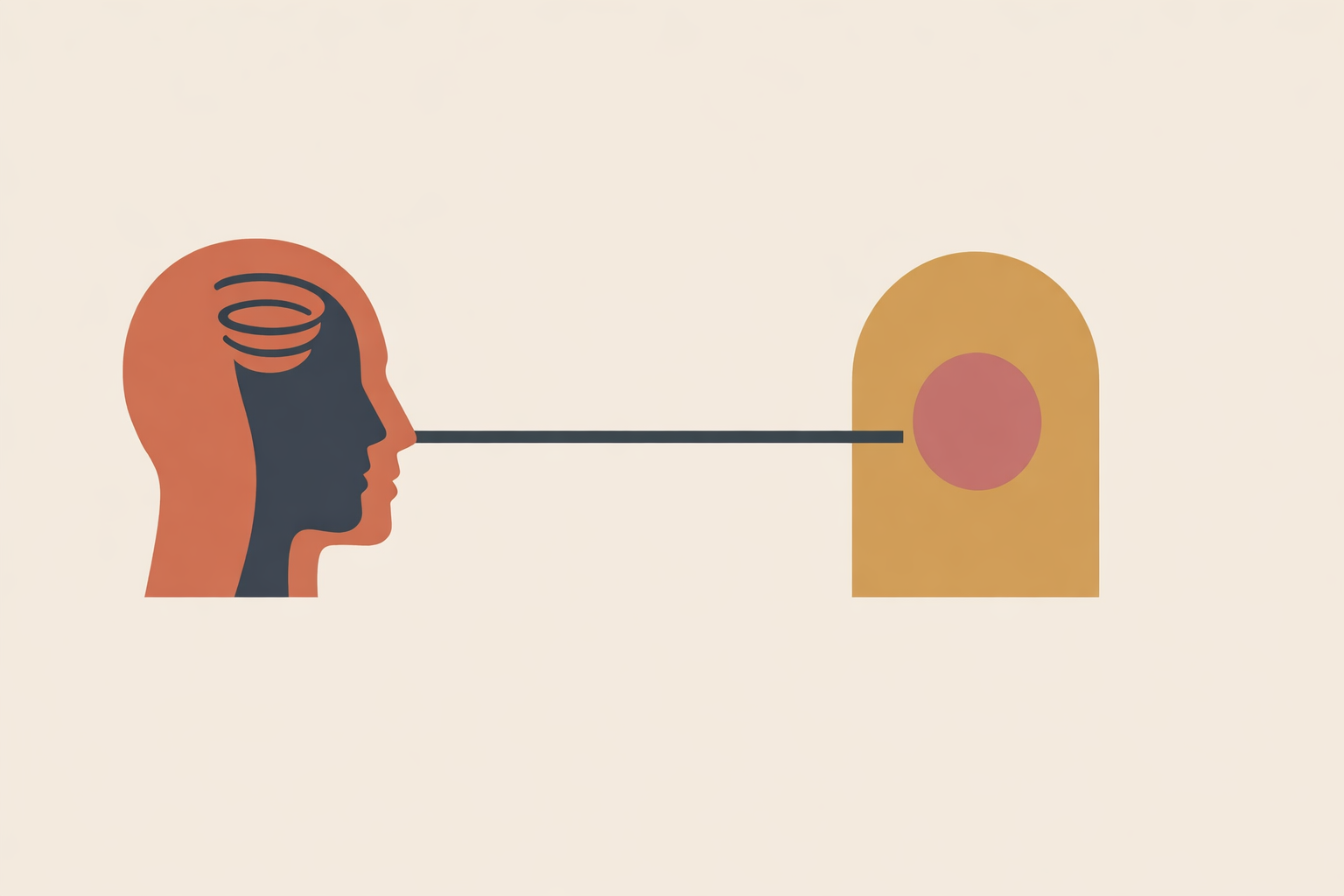
Purpose spirals often arrive wrapped in certainty: “I’m wasting time.” “If I pivot, I lose everything.” “I should have figured this out by now.” In practice, pushing for faster answers rarely helps. When someone is flooded, the most useful move is usually to slow the pace, settle the moment, and listen for the belief hidden beneath the story.
Key Takeaway: Purpose spirals soften when you ground first and then work with the belief driving the pressure. An Ikigai-informed approach helps clients move away from heroic “one true calling” thinking and toward ordinary meaning, contribution, and small, believable next steps.
What sits beneath a purpose spiral
A purpose spiral usually forms where several pressures collide: what someone loves, what they do well, how they want to contribute, and how they sustain themselves. When those currents stop feeling connected, the inner dialogue can tighten into a rigid “should.”
These moments can sound absolute because the person isn’t only questioning direction. They’re also protecting identity, belonging, security, and self-worth. In sessions, this often shows up as beliefs like “I can’t make a living doing what I love,” “I’m too old to change,” or “purpose is for other people.” Even when those statements aren’t objectively true, they can still drive decisions.
Many beliefs are protective in origin. Family and community scripts about stability, sacrifice, loyalty, age, and money can keep someone safe early on, then quietly narrow their sense of possibility later.
Ikigai offers a helpful counterweight here. It’s not only about a grand career mission. Many contemporary readings, including Ikigai coaching, emphasize ordinary daily joys, social roles, and contribution close to home. That softer lens often releases people from the burden of finding one perfect calling and turns attention toward meaning they can live now.
Instead of trying to solve the whole life plan in one sitting, start with a simpler question: what belief is making this feel so final?
Ground first: a short reset before belief work
Before exploring the story, help the person land. When intensity is high, cognitive flexibility tends to drop. Even a brief reset can create enough space to think and choose.
A simple 3–7 minute sequence works well:
- Label: Ask, “What are you feeling right now, in the simplest words possible?” Naming emotion can support reduced distress.
- Scale: Ask, “From 0 to 10, where is it right now?” The number gives you both something steady to track.
- Breathe: Invite three slow breaths, with a longer exhale. Slow breathing can help lower anxiety and bring intensity into a workable range.
- Orient: Ask them to name one thing they can see, hear, and feel. Sensory grounding brings attention back to the present moment.
- Remember: Invite recall of a time they handled uncertainty well, even in a small way.
If it fits the moment, add one quick belief check: “How true does ‘It’s too late’ feel right now, from 0 to 100?” That gives you a clear starting point and a way to notice shifts.
You can also use a gentle pattern interrupt: pause the mental scene, ask them to repeat the exact sentence they’re telling themselves, then change posture, breath, or eye focus before continuing. The aim is to loosen the loop enough for steadier conversation.
Surface the belief beneath the story
Once the intensity drops, turn the overwhelm into one clear sentence. A single belief is far easier to work with than a whole storm of commentary.
Questions like these usually help:
- What are you telling yourself about this situation?
- What feels impossible here?
- If this fear had a headline, what would it say?
- What are you assuming will happen if you follow what matters to you?
Listen for rigid language: always, never, can’t, impossible, too late, not allowed, irresponsible. Those words often point directly to the belief organizing the spiral.
Then help them separate belief from fact:
- Is that a fact, or is it a conclusion?
- Whose voice does that sound like?
- When did you first learn that?
- What would be an exception to that story?
Very often, the belief made sense when it formed. Respecting that history matters. The point is to see whether the old strategy still serves the person they are now.
For example, “If I pursue community arts, I’ll disappoint my family and end up broke” gives you something real to work with: specific, emotionally loaded, and tied to belonging and livelihood.
Match the change process to the belief
Not every limiting belief shifts in the same way. Some are image-heavy. Some are tied to time. Some are held as body tension more than words. When you match the process to the way the belief is stored, the work tends to feel cleaner.
For image-based either-or beliefs such as “meaning or money,” submodality work is often useful in practice. If the “safe” path feels huge and close while the meaningful path feels distant or faded, adjusting those inner qualities can soften the old hierarchy and allow a more balanced belief to emerge.
For beliefs organized around age or missed timing, timeline work can help. When someone experiences their story as already decided, revisiting past, present, and future often restores a sense of movement and influence.
For stuck self-images, a swish-style process can be effective. The old snapshot is repeatedly replaced with a more resourceful one: a believable version of them taking one grounded next step.
For people who process through movement, stepping processes can be especially powerful. Some clients think more clearly once the belief is placed in space: old belief here, uncertainty there, openness here, new belief ahead.
The practical question stays the same: where is the belief living most strongly right now in images, words, time, or the body? Start there.
Turn the new belief into a lived script
A belief shift holds better when it becomes part of an inhabited story rather than a nice idea from one session. The new belief needs a shape the person can live this week.
Keep the script short, warm, and believable. A brief written reflection paired with a clear if-then plan tends to support goal-directed behavior. A few grounded lines are enough.
Useful script language often sounds like:
- I’m learning to build meaningful work step by step.
- I can explore contribution without abandoning stability.
- I’m practicing sharing my craft in ways that support both me and my community.
Then pair that script with a micro-action. Repeated small actions help form habits, especially when they’re tied to a clear cue.
For example:
- If I notice “It’s too late,” then: I will read my new script once and send one message connected to the direction I care about.
- If I feel the urge to shut the idea down, then: I will take one 2-minute action that keeps the path open.
This is where Ikigai shines. The person doesn’t need to redesign their whole life at once. They can test a new belief through ordinary contribution: one message, one conversation, one hour of craft, one local act of service. Purpose and life design often become real through repetition.
Mental contrasting can also help. Noticing the gap between the old pattern and the desired direction, then linking that awareness to a specific next action, can support goal attainment.
Keep belief work ethical, believable, and culturally grounded
Belief work is not about forcing positivity. If a new script overrides lived reality, it can backfire. Incongruent positive statements can leave some people feeling worse, especially when the language clashes with their actual experience.
That’s why process-focused language is usually more supportive than grand declarations. Statements built around learning and practice tend to foster motivation more reliably than forced certainty.
It’s also important to honor culture, role, and belonging. In many traditions, meaning is rooted in relationships, kinship, reciprocity, and contribution to the wider circle. Scripts often land better when they include those realities rather than erasing them.
To make new beliefs steadier, anchor them across more than one area of well-being. The PERMA model reminds us that meaning is more stable when it’s supported by relationships, engagement, and accomplishment alongside inner conviction.
A simple ethical check before closing a session:
- Is this new belief believable for this person, at this stage?
- Does it respect their history, responsibilities, and real constraints?
- Is the language kind and non-performative?
- Is there one small action that can embody it this week?
- Does the script honor the people and communities that matter to them?
When in doubt, make the belief smaller, truer, and more relational.
Closing reflection
When someone spirals around purpose, you don’t need to chase the perfect answer. Help them settle first. Then find the sentence beneath the noise, shift it in a way that matches how they process experience, and anchor it in ordinary life.
This approach respects both the practicality of coaching and the deeper wisdom within Ikigai: meaning is not always waiting in one dramatic revelation. More often, it’s built through attention, contribution, skill, relationship, and repeated small acts that slowly become a life.
Over time, that’s what changes the spiral. Not pressure. Not performance. Just steadiness, clarity, and a new belief practiced often enough to become familiar.
Master Ikigai Coaching Skills
Deepen this belief-based approach with the Ikigai Life Coach Certification and help clients build lived meaning through steady practice.
Explore Ikigai Certification →