The first time a beginner Hatha class fills every spot, you learn how quickly a solid plan can dissolve in a tight room. Mats are close, late arrivals trickle in, props feel mysterious to some students, and your voice has to gather the group before practice has even begun.
The common instinct is to add more: more talking, more demonstrating, more movement. Crowded rooms settle faster when the container is clear, the sequence is breathable, and your presence stays calm.
Key Takeaway: Crowded beginner Hatha classes feel steadier when you simplify what students must track. Shape the room before class begins, start with breath and one clear theme, sequence in short posture families with reliable reset points, cue mostly by voice from off the mat, and guide the group with relational care. The aim is to create a room that feels organized, breathable, and supportive.
Shape the space before the first breath
In a packed beginner room, setup is part of teaching. Before anyone moves, students are already reading the space for cues about where to land, what they’ll need, and whether the room feels settled.
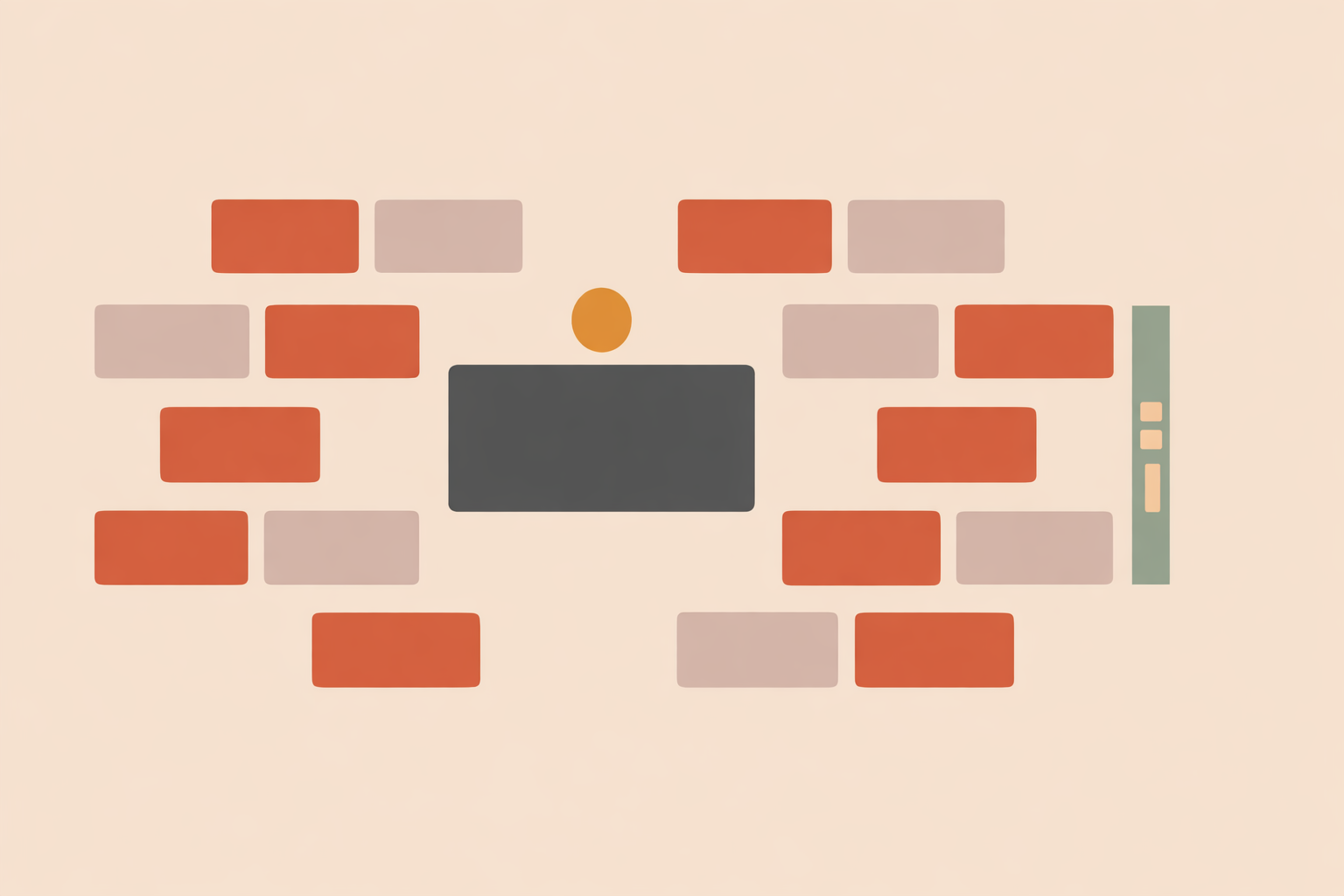
Keep the layout simple. Place mats close enough to feel unified, then stagger rows so arms and legs have a little more room. Orderly spacing naturally focuses attention and helps your voice travel without strain.
Standardize props from the start. For beginners, one consistent setup—two blocks, one strap, and one blanket—creates easy options for common sensitivities without singling anyone out. When everyone begins with the same toolkit, variations stay smooth and the room stays visually calm.
Ask students to gather everything before practice begins. Mid-sequence prop hunting breaks rhythm quickly in a full room. A clear arrival instruction like “Please bring your props to the right side of your mat and settle into a comfortable seat” reduces cross-traffic and gives people an immediate job.
A warm greeting matters here too. A calm hello and a short settling prompt can shift attention from chatter to presence, so class starts together rather than in fragments.
If students are still arriving, place early arrivals in a simple resting shape such as Sukhasana on a blanket or a supported forward fold with blocks. The atmosphere softens quickly, and you get a moment to notice who might appreciate extra options once things pick up.
Begin with breath and one clear thread
Once the room is physically organized, bring it together inwardly. In beginner Hatha, a few quiet minutes at the start often set the tone more effectively than a long introduction.
Begin with two to five minutes of breath-focused stillness. Even a short pause can reduce arousal and help the group arrive in a shared rhythm. Seated or lying down both work; what matters is giving students time to notice breath before coordinating breath with movement.
Set expectations in one or two sentences: the pace will be steady, options will be offered, and you’ll guide mostly by voice. Clear expectations can reduce uncertainty, which helps beginners relax into the process.
Then choose one philosophical thread and stay with it. In a crowded beginner class, one anchor is plenty. Ahimsa can guide pacing. Drishti can guide attention. Sthira can guide how you return to steadiness when the room gets noisy.
Keep your opening language choice-forward. In a full room, beginners can already feel exposed, so consent-forward cueing protects dignity and agency. Trauma-informed teaching guidance recommends invitational language such as “If it feels comfortable, close your eyes,” or “You might soften your gaze instead.”
A simple start is enough: notice inhale and exhale, let the breath stay natural, and hold the day’s intention lightly. That quiet clarity gives the rest of class something stable to build on.
Sequence simply and pace to the slowest steady breath
When a beginner Hatha room is full, students do best with sequencing that’s easy to read and easy to repeat. Clear structure lowers cognitive load and makes close quarters feel more manageable.
Build class in short posture families rather than long chains. Move through a few related hip shapes, then reset. A few standing shapes, then reset. A few spinal movements, then reset. These small arcs create a sense of progression without turning practice into memorization under pressure.
Use neutral reference points often. Returning to Tadasana or Samasthiti helps beginners re-orient, especially when bodies are moving around them. Familiar resets keep the whole room from drifting.
Keep transitions modest. If you’re explaining how to get into the next shape longer than students are actually staying there, the sequence is asking too much for that day’s group.
Pace to the slowest sustainable breath in the room. Slow, structured breathing is associated with lower stress, and it also creates a kinder collective rhythm. Not everyone will breathe at the same depth, but everyone benefits when the pace doesn’t rush past their capacity.
A shared count can help before movement begins: inhale for three, exhale for three. That kind of timing can support regulation without requiring more demonstration.
One standing arc might look like this:
- From Tadasana, inhale arms overhead.
- Exhale to a half fold with hands to shins or blocks.
- Inhale lengthen the spine.
- Exhale return to standing.
- Repeat, then add a short lunge with the back knee down.
- Return to Tadasana for two easy breaths before moving on.
This kind of sequencing is not flashy, but it’s reliable. In a busy room, predictability helps beginners stay present instead of bracing for what they might miss.
Cue like a guide, mostly off the mat
In a full room, your words need to be clear and well-timed. Sparse cueing often creates more steadiness than constant explanation.
Offer one action per cue. “Press through your heel.” “Soften your jaw.” “Lengthen the spine.” Beginners can follow single-step directions while they also track breath, balance, and space around them.
Demonstrate only when truly needed. In tight quarters, frequent demo pulls attention outward: people crane, turn, and search for the teacher rather than sensing themselves. Voice-led teaching supports inward focus, and clear verbal instruction can support calm behavior across a group.
Teaching from off the mat helps as well. Walking the room lets you catch confusion early, offer options in real time, and respond to the energy that’s actually there. Students also tend to feel more accompanied when you’re with them rather than fixed at the front.
Internal anchors become especially useful in crowded spaces. A steady drishti can reduce visual wandering, and light bandha awareness can help students sense midline support. Focused gaze practices are associated with improved attention, which aligns with traditional use of drishti as a simple support for steadiness.
If you use touch, keep it sparse, orienting, and fully optional. Consent comes first. Professional guidance emphasizes informed consent for hands-on adjustments, and in large groups touch should clarify rather than intensify. Often a block, a wall, or a quiet verbal suggestion does the job more cleanly.
Your tone matters, too. Speak in a natural, resonant voice instead of pushing volume. Shouting is often perceived as tension-inducing, while calm tone tends to steady the room.
A short cue set for a standing fold might sound like this:
- Inhale, lengthen through the crown.
- Exhale, soften the jaw and neck.
- If the floor feels far away, bring your hands to blocks.
- Keep the eyes steady on one spot for two easy breaths.
Lead the room with steadiness and community care
Technique matters, and atmosphere matters just as much. In a crowded beginner class, people settle more deeply when they feel acknowledged rather than managed.
That begins at the door. Greeting students by name, even briefly, can build connection and encourage a cooperative tone. A small personal exchange often lands better than a polished speech.
When it suits the group, brief partner or small-group moments can help. A quick name-share or one-line intention can strengthen group ties without changing the whole feel of class.
Keep your attention light and respectful. Some students love being seen; others prefer more space. Relational consent means offering support without making anyone the center of the room.
If redirection is needed, keep it quiet and choice-based. A soft suggestion as you pass, a block placed nearby, or a brief option offered privately usually works better than a public correction. Trauma-informed guidance encourages non-judgmental language that preserves dignity as well as agency.
When small disruptions happen—as they always do—model the quality you want the room to learn. Late arrivals, a fallen bottle, an uneven row: return to steadiness without drama, and the group follows.
Close with a predictable landing
The end of class should feel like an arrival, not an abrupt stop. In beginner Hatha, a reliable closing sequence helps students recognize that practice is downshifting.
A few familiar floor shapes followed by a genuinely spacious Savasana work well. That predictability cues the body toward rest, and classes built around slow breathing, mindful movement, and rest are widely understood to support a more settled, integrated state.
A steady landing also shapes what students remember. They leave with the felt sense that practice can organize their energy, even in a crowded room, and that experience is often what brings them back.
Over time, keep refining the craft. Notice where students get lost, where the room grows noisy, and where a simpler choice would serve better. Return often to the roots of the practice—breath, attention, steadiness, and non-harming—and let those roots guide how you hold a modern beginner room in yoga teacher training.
Train for crowded classes
Build confident sequencing and cueing for real rooms in the Yoga Teacher Training course.
Explore Yoga Teacher Training →