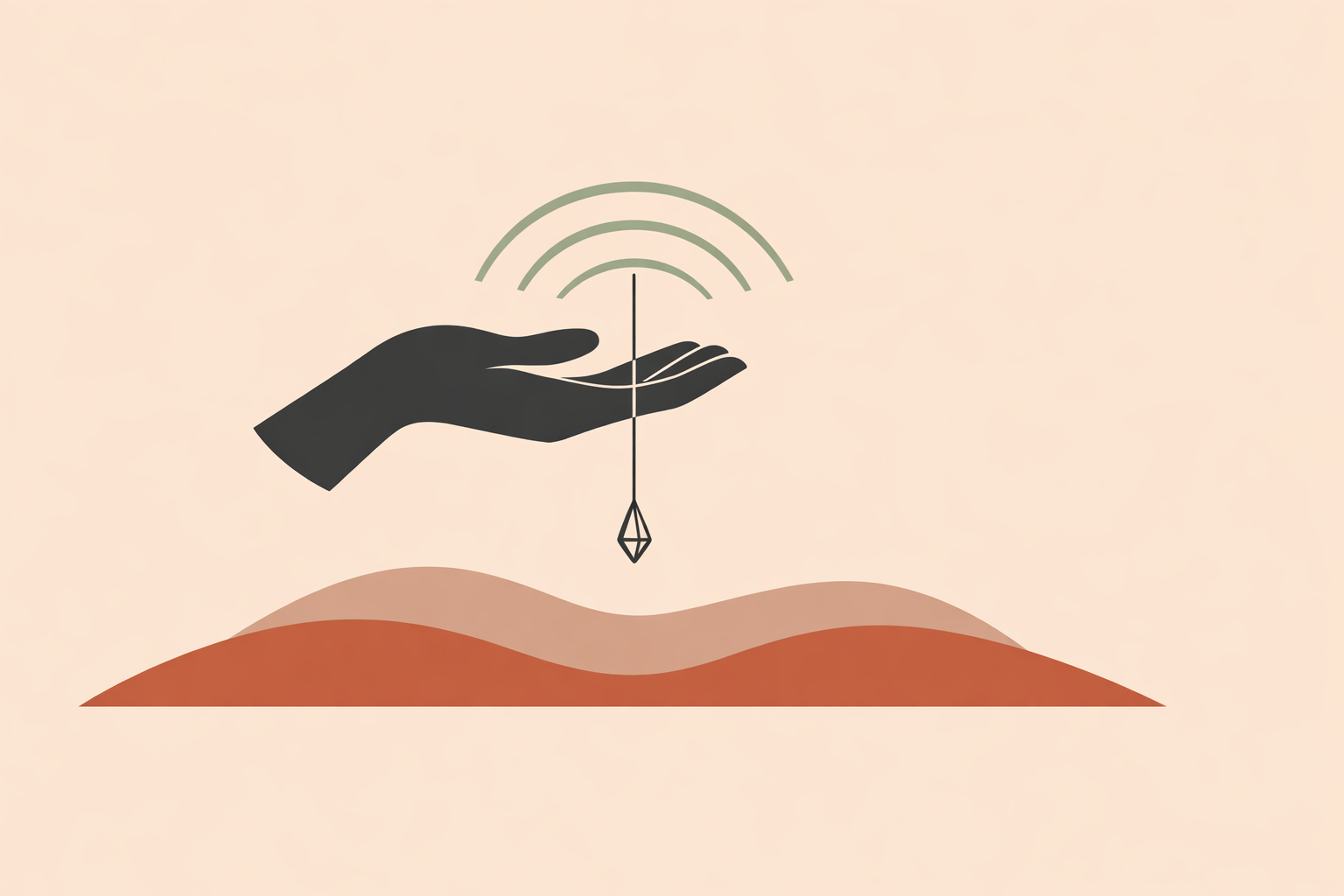
When crystal selection or placement feels stuck, it’s tempting to let a pendulum decide. It’s quick, visible, and often reassuring. The strongest pendulum work, though, keeps the client in the lead. The tool reflects what’s already being sensed, slows the moment down, and helps give it shape.
Key Takeaway: Client-led pendulum work is strongest when the tool supports choice rather than taking authority. A steady approach starts with consent, simple calibration, and clear boundaries; continues with neutral questions and body-based check-ins; and stays grounded through practical care, careful notes, and respect for the traditions that inform the work.
When to use a crystal pendulum
A crystal pendulum shines when you want a clear mirror during crystal selection, energy-center mapping, or a simple yes/no check. Used well, it’s a second lens, not a final verdict.
It also helps to know when to pause. If a client feels overwhelmed, disconnected, or eager to hand over all authority to the tool, come back to breath, sensation, and conversation. The session stays most supportive when it’s rooted in what the client can genuinely feel.
A steady rhythm is body first, pendulum second. Invite the client to hold each option and notice what shifts. If the choice still feels cloudy, bring in the pendulum to clarify what the body is already saying.
Prepare the pendulum with consistency
Consistency creates steadiness. In traditional practice, reliability often comes as much from the ritual around the tool as from the tool itself.
- Cleansing: Use what fits your approach: smoke, sound, breath, or brief water contact where appropriate. Skip water for stones like selenite or gypsum, which are water soluble.
- Calibration: Establish yes, no, and maybe using neutral statements you already know are true.
- Boundaries: Name the scope clearly. The pendulum supports reflection; it never overrules consent or makes decisions for a client.
Repeated preparation often makes sessions feel calmer and easier to trust. Subtle shifts count, especially in this kind of work.
Some practitioners prefer quartz pendulums for their crisp feel and responsiveness. In many traditions, that responsiveness is understood energetically, even when people hold different views on why it happens.
Co-create a yes-or-no language
Don’t assume the pendulum will “speak” the same way every time. Build the language together so the client understands each movement and knows they can pause at any point.
- Ask for today’s yes.
- Ask for today’s no.
- Ask what maybe or unclear looks like.
- Write the pattern on a small card and keep it visible.
This shared agreement reduces pressure for everyone. If the motion is faint, that’s information too. Slowing down tends to make signals clearer.
Ask questions that protect autonomy
The quality of the session depends heavily on the quality of the question. Neutral, present-focused, specific questions keep authority where it belongs: with the client.
- “Is smoky quartz supportive for grounding in today’s session?”
- “Is heart placement supportive right now?”
- “Is this a moment to continue, slow down, or pause?”
Avoid questions that invite dependency, especially broad “Should I…?” prompts. Those can quietly turn the pendulum into an authority figure.
If a client asks something loaded, soften and narrow it. “Will this fix my sleep?” can become “What feels supportive for rest tonight?” The work stays respectful, realistic, and useful.
If clients wonder why pendulums move at all, one commonly discussed explanation is the ideomotor effect. Many practitioners are happy to hold both frames at once: subtle body movement and subtle energetic meaning. Thoughtful work doesn’t require forcing a single theory.
Pair pendulum work with sensory crystal selection
Pendulums work best alongside direct experience. Let the client feel the stones first, then use the pendulum to clarify what already has traction.
- Invite the client to hold each stone and notice temperature, breath, mood, image, or tension.
- Narrow to two or three options.
- Ask the pendulum about each option one at a time.
- Return to the body and ask how the result lands.
This combination builds confidence because the client isn’t obeying a swing; they’re relating it to lived sensation.
Over time, patterns often emerge: certain people settle with grounding silicates, while others respond more readily to green or pink heart-centered stones. That’s craft knowledge, and it becomes much more valuable when you record it clearly.
Map energy centers gently
Pendulum mapping can offer a quick snapshot of how the session wants to unfold. The most grounded approach is descriptive rather than interpretive.
- Hover above each center.
- Observe direction, size, and quality of movement.
- Record what you notice without locking it into fixed meaning.
From there, you can connect observations to color and stone choice. Minimal throat movement may point you toward blues; a fuller heart-center response might pair naturally with green or pink tones.
When using chakra language, keep it respectful and straightforward, as you would in chakra balancing. These traditions have deep cultural roots and deserve care rather than being treated as decorative add-ons.
If color needs a visual anchor, a simple image of the visible spectrum can support the conversation without making it overly technical.
Use astrology and scent lightly
Astrology and aromatics can add texture to pendulum work, especially when they deepen presence rather than steer the session.
With astrology, timing or elemental language is often enough. With scent, keep it minimal: one quiet note can help mark the moment. A single inhale of lavender, cedarwood, or sweet orange can support settling in.
For topical aromatic use, basic safety still matters. Many practitioners use a 1% dilution as a gentle starting point for general relaxation support.
The guiding principle is simple: add only what truly serves the person in front of you.
A simple pendulum session flow
A clear structure keeps the work calm, repeatable, and easy to document.
- Arrival: Begin with breath and a brief intention.
- Calibration: Set yes, no, and maybe together.
- Exploration: Let the client handle a small group of stones and describe what they notice.
- Selection: Use clean pendulum questions to clarify the strongest option.
- Placement: Ask about location and timing with consent kept active.
- Rest: Leave space for quiet integration.
- Closure: Gather one or two words from the client about what shifted.
This flow works because it moves from sensing to reflection to integration. It also makes your notes more useful later, because each step has a clear purpose.
Troubleshooting unclear swings
Cloudy readings happen, along with fatigue, bias, and environmental interference. The skill is knowing how to simplify rather than push.
- If the swing is unclear: Pause, breathe, and recalibrate with a neutral question.
- If you feel attached to an outcome: Name the bias and step back.
- If your hand is tired: Rest, switch tools, or leave the pendulum aside for the day.
- If the room is unstable: Reduce drafts, fan movement, and surface wobble.
Even tiny movements can be amplified by unconscious micro-motions, which is why the ideomotor effect remains a helpful frame. In session terms, stillness, breath, and honesty do more than chasing a dramatic swing.
Mineral safety and stone care
Respecting stones includes respecting their physical properties. A few simple habits protect your kit and your client work.
- Avoid soaking stones such as selenite or gypsum because they are water soluble.
- Many colored stones can fade in sunlight, so prolonged windowsill exposure is best avoided.
- Take extra care with copper-rich minerals such as malachite, especially in raw or dusty forms. Avoid mouth contact and handle powders cautiously.
- Replace worn cords before they fail in session.
Labels make this easier. A small “no water” card or brief handling reminder prevents the most common mistakes.
Keep notes centered on the client
Good notes keep the client’s experience at the center. They track what the client noticed, chose, and found supportive, rather than turning the pendulum into the main character.
- Client experience: sensations, emotions, images, key words
- Choices made: stones, placement, timing, scent, boundaries
- Session observations: today’s yes/no pattern, clear or cloudy moments
This style of note-taking strengthens autonomy and helps you build a clearer long-term picture of what supports well-being within energy healing.
Home practices that stay simple
Between sessions, the most helpful practices are usually the lightest. They support reflection without creating dependence on complex rituals.
- Hold the chosen stone for three slow breaths before rest.
- Use a color card on a desk or bedside table as a visual reminder of the session’s focus.
- Journal one word after a brief check-in with the stone.
The aim is continuity, not performance. One steady practice tends to carry further than a long list.
Ethics, consent, and cultural respect
Ethics are what make pendulum work trustworthy. When the frame is clean, clients can relax into the process without feeling managed by it.
- Ask permission each time you use the pendulum.
- Keep your language within a supportive, non-overreaching scope.
- Avoid making promises or turning symbolic tools into fixed answers.
- Acknowledge the cultural lineages behind practices such as chakra work or astrology.
A boundary script can stay simple: we’ll keep questions present-focused and reflective, and we can pause at any time. That clarity keeps the client engaged and empowered.
Why pendulums come to feel reliable
For many practitioners, trust grows through repetition. Certain stones, question styles, or sequences start to show recognizable patterns. One client may consistently settle when body-based sensing comes first; another may find steadiness through a familiar mineral family.
This is where craft deepens. Some people understand reliability through subtle energy, others through body mechanics and ritual consistency, and many through both. What matters is staying observant, consistent, and client-led.
Group and distance sessions
Pendulum work can translate well to groups or distance formats when the container is clear and consent is explicit.
- In groups: explain the process openly and remind everyone that a collective reading is not a personal directive.
- At a distance: obtain written consent, restate the intention clearly, and keep the client actively included in what is being observed.
The same principle holds in every format: inclusion matters. The client should never feel that choices are being made for them off-camera.
Build a small, thoughtful kit
A strong pendulum kit doesn’t need to be large. It needs to be practical, consistent, and easy to navigate while you’re focused on the client.
- One or two pendulums with different weight or feel
- A soft mat or stable surface support
- A card for today’s yes/no language
- A few reliable stone groupings for common session intentions
- Simple care notes, including handling reminders and dilution guidance
Clear labeling keeps your attention where it belongs. When the kit is organized, the session stays spacious rather than fussy.
Conclusion
A crystal pendulum becomes most valuable when its role stays humble and clear. It can reflect, clarify, and deepen a session, but it should never take over the room. Paired with consent, body-based awareness, clean questions, and respectful structure, it becomes a steady companion to the wider practice of listening in lithotherapy.
Over time, the aim isn’t stronger swings. It’s stronger trust in the client’s inner guidance, supported by your presence, your craft, and careful use of the tools you’ve chosen.
Go Deeper with Lithotherapy
Build client-led crystal sessions with clearer methods in the Lithotherapy Certification.
Explore Lithotherapy Certification →