


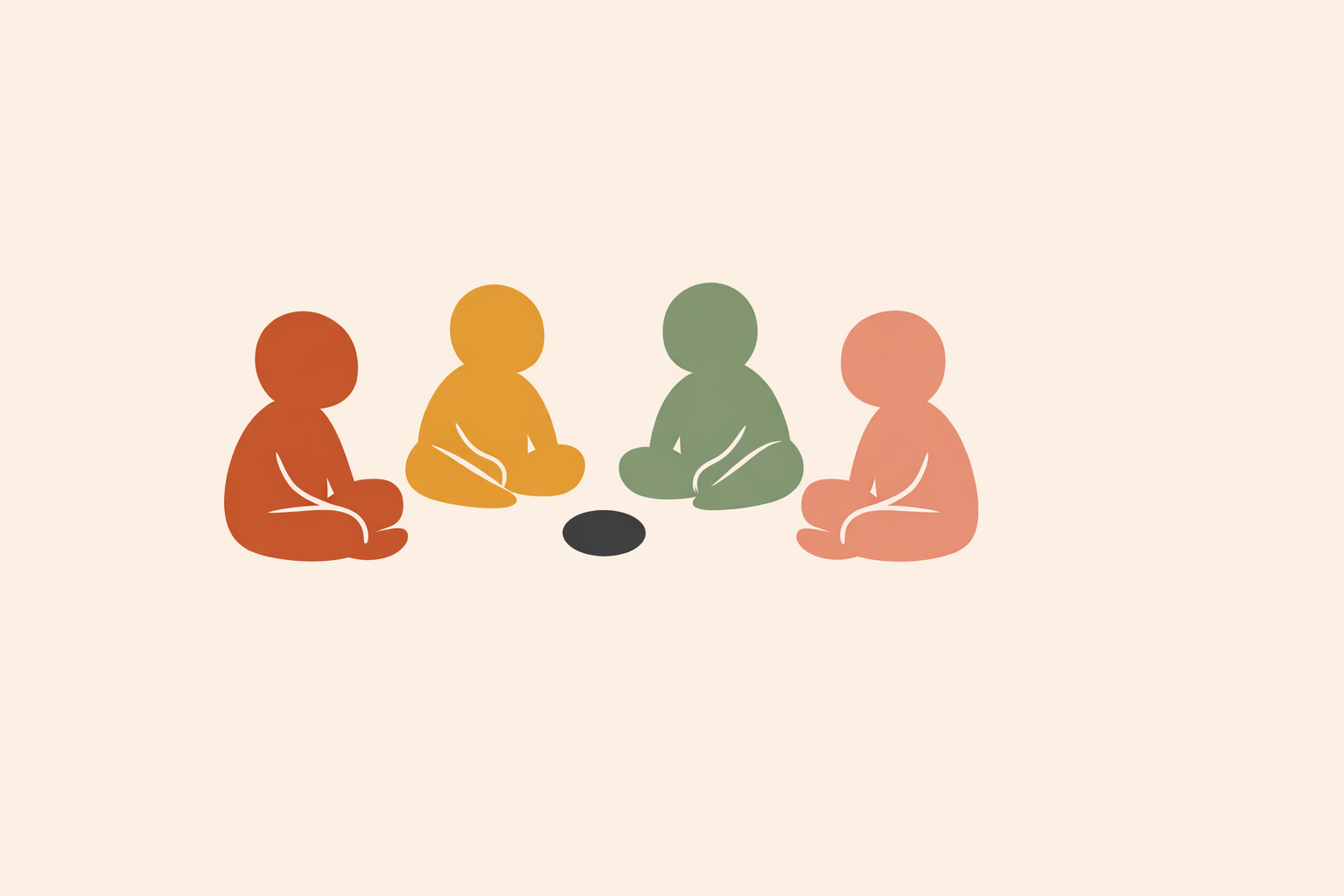
Most children don’t learn emotional regulation from a worksheet alone. They learn it in relationship: in circles, classrooms, play, transitions, and repair after things go wrong. A child might name three calming strategies in a quiet room, then forget all of them during a tense moment with a peer. Skills stick through repeated social practice.
That’s why groups matter. A steady group offers shared language, real-time modeling, and enough repetition to turn a concept into a habit. When the structure is warm, predictable, and consistent, the group itself becomes part of the support.
Key Takeaway: Emotional regulation skills are more likely to stick when children practice them together in a structured, repeating group. Groups fit how children learn emotions—socially, through observation, co-regulation, and shared routines. The strongest results tend to come from regular sessions with clear agreements, repeated tools, and reinforcement across home and school. Breathwork, storytelling, visual supports, movement, and cooperative play all translate well to group settings when they are used consistently and adapted to the children in front of you.
Do emotional regulation groups help?
Yes, especially when they’re regular, relational, and reinforced beyond the session itself. In real-world facilitation, children often improve not only in understanding tools, but in using them during ordinary moments with peers, adults, and routines.
Consistency matters more than a “big” activity. Research on routines and rituals links better psychological well-being with functional emotion regulation, which aligns with what many facilitators observe: children need repeated use of simple tools before those tools are available under stress.
One-off sessions may raise awareness, but lasting change usually comes from rhythm. Over time, familiar cues start to travel into daily life: a breath before speaking, a pause before pushing back, a shared phrase used at recess or during transitions.
Educators often describe the result as a steadier room. Not perfect behavior, and not instant transformation, but fewer escalations, faster repair, and more children reaching for the same shared tools.
How groups become a real-time practice space
The advantage of groups is rehearsal. Children watch, copy, forget, retry, and refine. The circle becomes a living practice space rather than a lesson.
Many core regulation skills are social by nature:
- naming feelings
- waiting and turn-taking
- noticing facial expression and tone
- asking for help
- recovering after frustration
- repairing small conflicts
These land more strongly in community than in isolation. A child acting out “frustrated” in charades gives the group a shared reference. Someone suggests balloon breaths. Another offers, “ask for a turn.” The learning sticks because it’s witnessed and repeated.
Groups also support co-regulation. Even beyond the earliest years, children respond to predictable structure, calm presence, and repeated interpersonal routines. The National Council on Family Relations highlights consistent structure as meaningful support for children’s development. In a group, that structure comes through rhythm, tone, clear limits, and the sense that everyone knows what happens next.
This is why peer groups can feel so powerful: children borrow steadiness from the shared container, not only from the facilitator.
What makes a children’s regulation group effective
The strongest groups are usually simple. They work because the structure is dependable, not because it’s packed with novelty. Three design choices matter most: dose, rhythm, and continuity.
Dose matters because skills need repetition to settle. A short series often works better than a one-time event. Many facilitators find that a 6- to 10-session arc gives children enough space to recognize patterns, repeat tools, and build confidence.
Rhythm matters because predictability helps children settle into participation. A familiar flow reduces uncertainty and frees up attention for the skill itself.
Continuity matters because shared signals become part of the learning. Group agreements, a talking object, the same opening check-in, the same closing phrase, and the same visual tools all make regulation more accessible.
A practical 40-minute session might look like this:
- 5 minutes: arrival and mood check-in
- 8 minutes: one skill focus
- 12 minutes: active practice through play or role-play
- 10 minutes: apply the skill to a real-life school or home moment
- 5 minutes: closing reflection and shared cue for the week
The exact activities can vary, but the shape should stay familiar. Children often do better when they know the container before they know the content, especially in child and adolescent development work where pacing and predictability matter.
Group practices that carry well
In children’s groups, the most useful practices are simple, repeatable, and easy to recognize in everyday life. Four tend to carry especially well: breath and attention practices, visual supports, storytelling, and cooperative play.
Breath and attention practices help children notice what’s happening in the body before a reaction takes over. With children, this works best when it’s brief, concrete, and embodied. A 60- to 90-second breathing pattern, a hand-on-belly pause, or a slow stretch sequence is often enough.
Guided breath and posture from yogic traditions, rhythmic clapping or drumming, and short parable-based reflection can be especially effective in community settings. They’re memorable, participatory, and regulating without demanding a lot of verbal skill.
Visual supports make an internal process easier to name. Children often respond well to shared images such as:
- traffic-light colors
- feeling faces
- a pause-plan card
- a calm corner poster
- a simple body map showing tight, buzzy, heavy, or settled states
When the same visuals appear each week, they stop being decoration and start functioning as cues.
Storytelling offers a safe, indirect route into emotional language. A short tale, folk image, or everyday scenario lets the group explore: What did this character feel? What happened in the body? What could they try next? Many children speak more freely about emotions when they discuss a story first and themselves second.
Cooperative play binds the learning together. Games, charades, matching activities, and simple role-play let children practice regulation while moving, laughing, waiting, and adjusting to others. In many groups, this is where progress becomes visible, and where social skills coaching can overlap naturally with emotional learning.
Adapting for different children without losing group cohesion
Most children’s groups include mixed temperaments, communication styles, and readiness. The aim isn’t to make everyone participate in the same way. The aim is to keep the group coherent while giving each child a workable way in.
For children who are anxious or withdrawn, predictability helps. A gentle pace, familiar structure, and opt-in participation often lead to fuller engagement. These children may prefer to point to a feeling card, choose a color, or show a gesture before speaking.
For children with high impulsivity or strong ADHD-like traits, shorter verbal stretches and more active scaffolding often help. Frequent movement breaks, hands-on materials, immediate feedback, and visible turn-taking cues can keep the group accessible while maintaining clear expectations.
For autistic children, groups can be supportive when communication is clear, sensory load is considered, and expectations are made explicit. Visual schedules, direct modeling, and enough processing time can reduce pressure and increase participation.
For children carrying high stress or difficult life experiences, the emotional tone of the group matters as much as the activities. Predictable environments with choice, dignity, and no forced sharing tend to be safer and more workable. Research in families facing trauma risk links meaningful rituals with distress regulation, reinforcing a principle many practitioners already hold: safety grows through repetition, choice, and trustworthy structure.
A few reliable adaptations include:
- using a visual schedule
- offering verbal and nonverbal ways to join
- building in movement every 8 to 10 minutes
- keeping transitions clear and short
- using the same opening and closing ritual each week
- redirecting with dignity rather than public pressure
Helping skills carry into home and school life
If the skills stay inside the circle, they fade. The goal is carryover: the child recognizes the same cue in more than one setting and uses it with increasing independence.
Caregivers are the strongest bridge. Family routines and rituals provide predictable structure through repeated interaction, and children use group skills more readily when adults share the same language and reinforce the same cue.
Keep transfer simple by sending home one shared tool for the week:
- a color check-in at pickup
- one bedtime breathing cue
- a pause-plan card on the fridge
- a short transition song
- a story prompt at dinner about a feeling and a choice
Consistency across settings matters too. If the group uses a traffic-light visual, a calm-corner poster, or a specific pause phrase, it helps when that same cue appears in the classroom and at home. Children integrate skills faster when adults aren’t using competing systems.
Embedding regulation into everyday routines is often stronger than isolating it as a separate topic. OECD reporting links regular family practices such as shared singing, reading, meals, and play with social and emotional growth, including greater self-regulation. The same principle transfers well to schools: brief repeated rituals usually carry further than occasional themed lessons.
Traditional settings reflect this pattern too. Repetition through songs, blessings, storytelling, and simple family rituals can help an emotional skill become a durable habit. One study found that more frequent rituals were associated with better well-being through more functional emotional regulation. The language may be modern, but the pattern is very old.
Closing thoughts
Children learn regulation best when it is lived, not just explained. A well-held group offers repeated practice, peer modeling, steady co-regulation, and a structure children can trust.
For groups to shape daily behavior, keep them simple and consistent. Choose a small set of tools and repeat them across weeks. Use clear agreements, warm leadership, and familiar rituals. Adapt to the children in front of you, and build bridges into home and school so the same cues meet the child in ordinary life.
As with any well-being skill-building, pacing and fit matter. Respect individual sensory needs, avoid forced sharing, and invite caregivers and educators into the same shared language where possible. When those pieces are in place, the group becomes a place where children learn, together, how to pause, feel, repair, and begin again—an approach that also sits within broader child and adolescent development practice and can deepen into child psychology coaching.
Train in Child Psychology Coaching
Build deeper emotional regulation support skills with the Child Psychology Coach Certification.
Explore the Certification →










