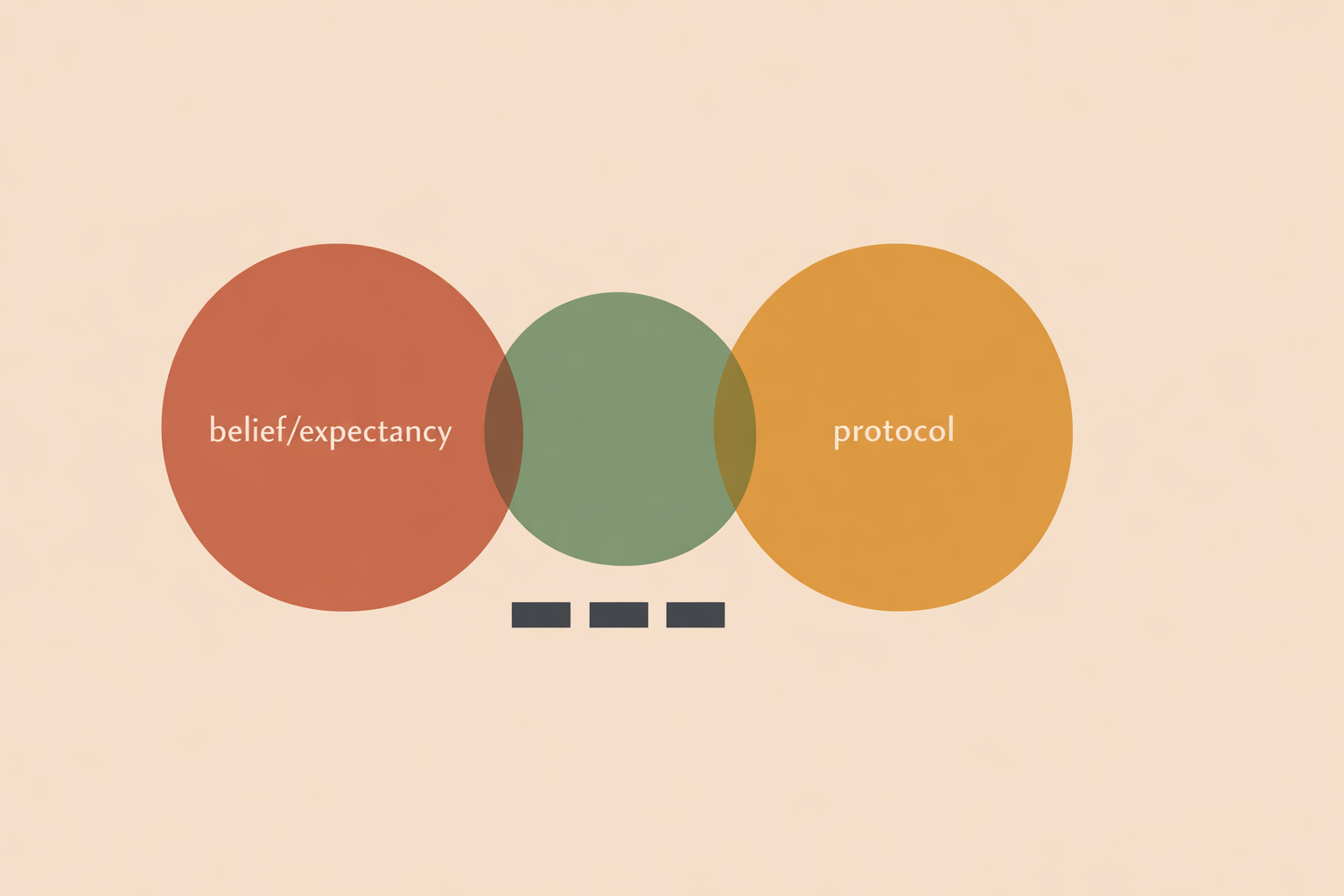
In microdosing coaching, the first sessions often come with a wave of encouraging notes: better focus, lighter mood, easier mornings. It’s natural to want to credit the protocol right away. Yet with subtle, low-dose work, belief, novelty, ritual, and attention can shape what clients notice just as strongly as the protocol itself. When those influences stay unnamed, notes can drift toward a highlight reel instead of a trustworthy record of change.
Key Takeaway: Data integrity in microdosing coaching improves when you design around expectancy instead of treating every early win as protocol-driven. The clearest approach is simple: build a baseline, keep prompts and timing consistent, use brief somatic check-ins, and help clients tag each shift as “Maybe molecule,” “Maybe meaning/behavior,” or “Maybe both.” That makes your tracking more honest, more useful, and more supportive of repeatable well-being practices.
How expectancy can skew microdosing coaching notes
Expectancy is not a flaw in the process. It is part of the process. When someone begins a new protocol with hope, focus, and strong intention, that mindset can shape what they feel, remember, and report.
In coaching, those stories become your working data. And positive expectations can systematically influence self-report. An energized client may log every good morning and smooth interaction, while neutral days barely register.
This shows up most in the first stretch of any new routine. The opening one to two weeks can feel unusually potent because novelty, supportive contact, and fresh intention create momentum. Often, early improvements reflect that wider shift, not just one variable.
Other distortions are quieter, but they matter:
- Confirmation habits: you ask more about wins than plateaus, mixed days, or reversals.
- Regression to average: unusually good or bad days often move closer to a person’s usual pattern on their own.
- Tracking artifacts: when sleep, walking, journaling, and social habits change together, it becomes hard to tell what’s driving what. These overlapping changes can confound attribution.
A practical adjustment is to widen the story. Instead of “I felt focused, so the protocol worked,” invite: “I felt focused today. Possible factors: deeper sleep, fewer distractions, stronger motivation, and the protocol. Tagging this as maybe molecule, maybe meaning/behavior, maybe both.”
This keeps your notes grounded and keeps clients connected to their own agency, where durable change often takes root.
Expectancy vs placebo in microdosing coaching
These terms get blurred, but separating them makes coaching cleaner.
Expectancy is what someone believes will happen. Placebo effects are the broader changes shaped by belief, ritual, relationship, context, and attention. Expectancy is one ingredient inside a larger experience.
That distinction helps you avoid forcing a simple story. Outcomes can be shaped by both meaning and method at the same time.
This is also where traditional practice offers strong guidance. Across many ancestral traditions, ritual and intention are understood as active carriers of transformation. In a modern coaching frame, the goal is to name these forces clearly and track them with honesty, especially in spirituality and ritual work.
A good way to do that is to pair reflection with concrete check-ins. A brief body scan can sharpen subjective reports: “On a scale from 0 to 10, how settled is your breath, jaw, and belly?” More precise self-observation improves the usefulness of subjective tracking, and body-awareness ratings can support more reliable reporting.
Then add one short reflection prompt, such as:
- Which part of you felt most active this morning: the planner, the protector, the performer, the explorer?
Parts language often helps clients describe inner patterns with respect and nuance, without reducing everything to a mood score.
A short script can keep the conversation balanced:
- Coach: “Let’s hold space for more than one cause.”
- Client: “So the shift could come from better sleep, stronger intention, and the protocol?”
- Coach: “Exactly. We do not need to force a single explanation to learn something useful.”
When belief and protocol look similar
In subtle-dose settings, belief can look powerful. That does not make the work meaningless. It makes careful tracking part of good craftsmanship.
The coaching lesson is straightforward: don’t treat every positive report as proof of a single cause. Build a process that can hold nuance.
These practices tend to help most:
- Start with a baseline. Track the same daily prompts for a week before any new protocol begins.
- Keep timing consistent. Record ratings at the same point each day, ideally before outside influence such as group chats or progress threads.
- Use a belief check. Add one item like: “Today I expect this process to help: 0–10.”
- Look for variance. Once a week, review the day that did not fit the trend and name three possible non-protocol reasons.
- Standardize the container. Consistent prompts, timing, and somatic check-ins usually create a clearer picture of subtle change. In measurement guidance, standardized conditions reduce noise over time.
This is where many coaches get sharper. Instead of chasing dramatic stories, they notice what repeats. If a client feels more resourced whenever they protect sleep, journal before screens, and begin the day with intention, that pattern matters.
If a client wants to compare different weeks in a structured way, you can support the tracking process while staying firmly within a coaching role. The aim is stable routines and clearer reflection, not substance advice, a distinction that matters in microdosing coaching.
A cleaner way to track subtle change
When effects are subtle, simplicity wins. A complicated tracker usually creates more noise than insight.
A useful daily structure might include:
- One core rating, such as clarity, steadiness, or presence
- One brief somatic scan: breath, jaw, belly
- One expectancy check: “How much did I expect today to go well?”
- One tag: “Maybe molecule,” “Maybe meaning/behavior,” or “Maybe both”
- One note on repeatable action: sleep, movement, boundaries, focus block, reflection time
This keeps the process human and makes day-to-day comparison easier. Over time, it also separates temporary enthusiasm from patterns with staying power.
Most importantly, it protects against over-attribution. When clients see that steadier days also follow stronger routines and clearer boundaries, they’re less likely to hand all the power to one element of the process.
Scope, safety, and ethical boundaries
Good microdosing coaching includes reflection, but it also rests on boundaries and care.
Start with scope. You’re supporting self-observation, intentional habit change, and integration. You are not there to promise outcomes or move beyond a coaching frame.
It also helps to standardize intake and safety steps. In psychedelic guidance, systematic screening, conservative harm-reduction practices, and pausing or referring onward when a case exceeds scope are all important for safer support.
In practice, that means:
- screening for obvious red flags before beginning
- setting clear expectations around scope and boundaries
- using consistent check-ins rather than improvising from session to session
- pausing the work when the situation becomes too complex for coaching
- referring onward when additional support is needed
Keep these cautions calm and clear. Ethical coaching relies on honesty, consistency, and respect for the limits of the role, including the boundaries of non-clinical psychedelic coaching.
Closing perspective
Expectancy is not something to remove from microdosing coaching. It is something to work with skillfully. When you name it, track it, and place it alongside behavior, ritual, and context, your notes become more trustworthy and your coaching becomes steadier.
This approach also honors both traditional wisdom and evidence-informed practice. Traditional paths have long recognized that intention, ritual, and relationship influence change. Modern process thinking asks us to observe those influences carefully and avoid oversized claims. Together, they support grounded work: humble in attribution, steady in method, and deeply respectful of the client’s capacity for growth, including in broader spirituality and ritual practice.
Train in Microdosing Coaching
Apply these tracking and ethics principles in the Microdosing Coaching Fundamentals Certification.
Explore the Certification →