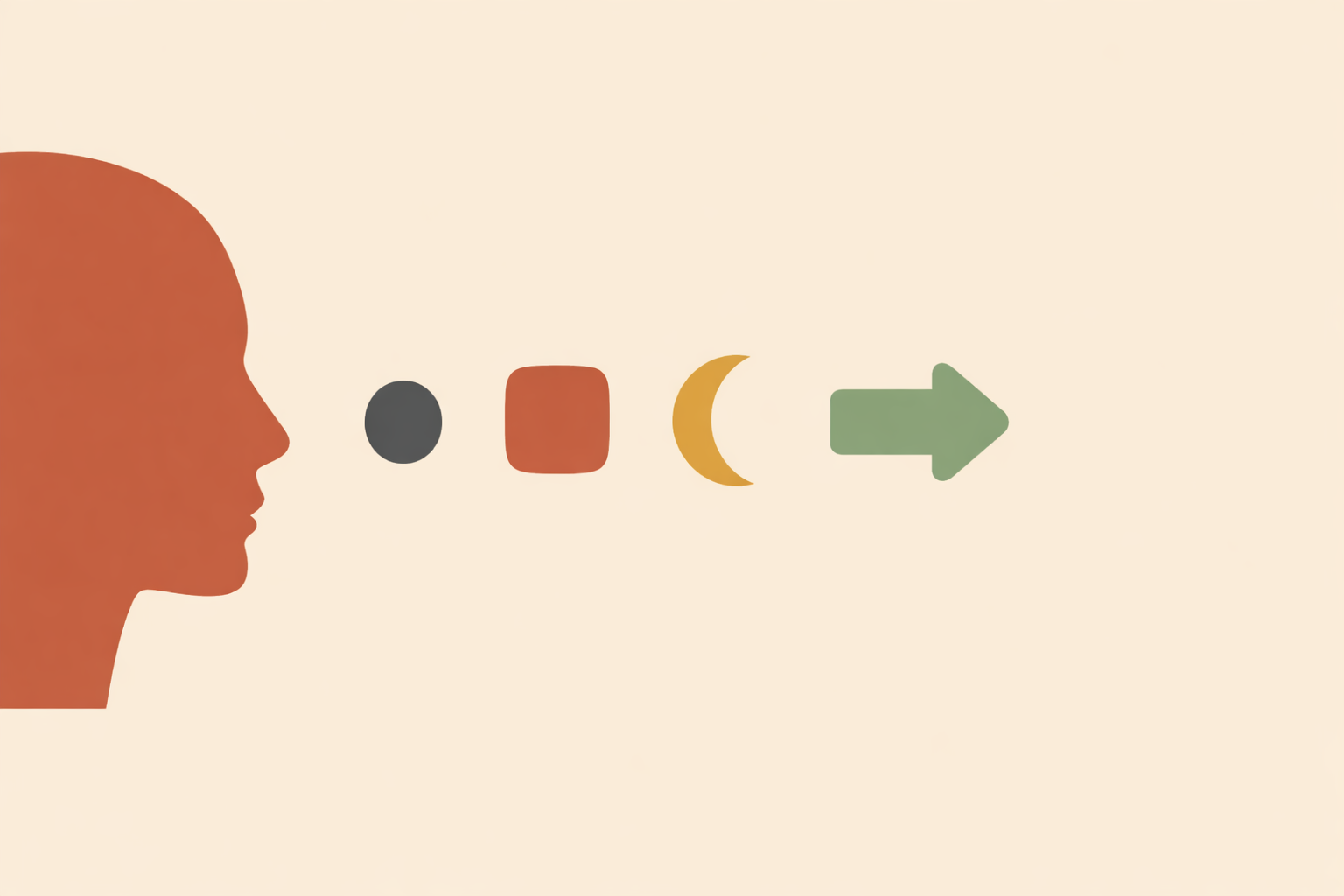
Workplace well-being often gets taught in long sessions and remembered at the wrong time. Then a tense email lands, a meeting turns sharp, or a deadline slips, and the useful idea disappears. What holds up under pressure is simpler: short, repeatable skills that fit inside real workflows and help people respond with intention.
Key Takeaway: Effective workplace emotion regulation is often built from brief ACT-informed behaviors people can use in 10 to 30 seconds. The most practical sequence starts with a short pause, moves into naming sensations and emotions, creates distance from harsh thoughts, makes room for strong urges, and turns values into one clear next step. Over time, these skills become more reliable when they are reinforced through boundaries, team rituals, and everyday ways of working.
10–30 Second Emotion Regulation Pauses People Actually Use
When someone is about to hit “send” with a tight chest and locked jaw, a tiny pause can change the next move. The aim is not to feel perfect. It is to create enough space to respond on purpose.
Across many lineages, short breaths and sensory orienting have been used to steady attention before demanding tasks. In modern work settings, the same principle fits beautifully because it’s private, fast, and easy to repeat.
Simple reset options
- Three-breath reset: “In through the nose, out through the mouth—soft belly, soft jaw.” On the third breath, ask, “What is one helpful move now?”
- Orienting: Let the eyes land on one color, one shape, and one sound. Name them quietly: “Blue folder, round mug, air vent.”
- Hand to surface: Place a palm on the desk or thigh and notice temperature, texture, and weight for 5 to 10 seconds.
A useful coaching cue is: “Notice—Name—Allow—Choose.” A short sequence is easier to recall between messages, meetings, and decisions.
Where to place micro-pauses at work
- Before replying to a charged message: notice three sensations, then ask what matters for this reply.
- As a meeting starts: take one quiet inhale and a longer exhale before speaking.
- After a high-stakes event: use a 30-second reset block to name a value and one next step.
Picture a client drafting a difficult update. They press their feet into the floor, take three breaths, and note “tight chest, heat in face, buzzing mind.” Often that’s enough to soften the edge and replace a defensive opener with something clearer and steadier.
Naming Body Cues and Emotions Before Reacting
Many professionals try to out-think strong emotion. A steadier move is to notice it more specifically. When people translate raw activation into named signals, they gain choice without having to suppress anything.
Use clear labels
- Two-part label: “Sensation + emotion.” For example, “Fluttering in stomach—anxiety” or “Shoulders lifted—irritation.”
- Intensity check: “What is this, 0 to 10 right now?”
- Coaching prompt: “If this sensation could speak in five words, what would it ask for?”
Naming sensations or emotions often reduces their intensity. The size of the shift varies, but in practice it can happen quickly.
Stay in a workable zone
- Self-check: “Am I in the workable middle, sped up, or shut down?”
- If sped up: lengthen the exhale and keep the eyes open.
- If shut down: press the feet into the floor and look at one steady object.
- If breathwork does not suit the person: use external focus, contact with surfaces, or other forms of grounding.
When someone can say psychological flexibility is closer at hand because they are noticing and making room for their experience rather than pushing it away. “My chest is tight and I’m at a 6 out of 10” is often more useful than pretending nothing is happening.
Treating bodily sensations as guidance for wise action, rather than as noise to erase, is a stance long held in traditional movement arts and land-based practices. In coaching spaces, that stance stays practical and it settles the system.
Defusing From Harsh Work Thoughts
A pause creates space, but thoughts still rush in: “You’re blowing it,” “They’ll think you’re weak,” “You need to get this perfect.” Defusion helps people relate to those thoughts differently, so they don’t have to obey each one.
Three practical defusion moves
- Label the story: “Ah, the incompetence story is here again.”
- Add distance: “I’m having the thought that I’ll fail this presentation.”
- Sort facts from predictions: facts in one column, predictions in another, then choose the next action from the facts column.
Ways to make defusion memorable
- Read the harsh thought in a cartoon voice for a few seconds.
- Write a recurring thought on a sticky note beside the monitor and tap it when it appears.
- Use simple language such as, “Let the thought ride in the back seat while values drive.”
In workplace ACT, valued goals matter more than winning an argument with every thought. The point is to loosen the grip of mental commentary so a more useful next action becomes available.
In practice, it can be very small. A person hears, “Don’t speak or you’ll expose yourself,” recognizes it as a familiar story, and asks one clarifying question anyway. That single step can change the tone of a whole meeting.
Willingness and Urge Surfing During Conflict
When emotion spikes, people often swing toward two habits: sending the sharp reply or going silent to keep the peace. Willingness offers another path. It means making room for the inner surge while still choosing action that fits the moment.
How to keep agency when emotions rise
- Willingness phrase: “This is anger in my chest, and I can carry it for 60 seconds while I choose my next step.”
- Urge surf: name the urge directly, such as “to prove,” “to punish,” or “to disappear,” and stay with it briefly without acting on it.
- Containment: if activation is high, schedule the next touchpoint and write one concrete next step.
Turn intensity into steadier action
- Ask: “What would fairness look like here?”
- Ask: “What would courage sound like in one sentence?”
- Use a boundary script: “I want to support this, and my current capacity is five hours this week. If that works, I’ll confirm by 2 p.m. Otherwise, we need to adjust scope.”
Work grounded in ACT is fundamentally about staying open to present-moment experience while moving toward valued goals. That is why willingness matters in workplace conflict: it keeps action firm and clear, even when the first impulse is loud.
Micro-Values and Choice Points Under Pressure
Pausing and making room for discomfort is powerful, but the real win is turning that into action in the next 30 seconds. Micro-values help: choose a quality of action, then choose one small step.
Turn values into immediate behavior
- Ask: “If steadiness led this email, what would the first line be?”
- Ask: “If learning guided this meeting, what one question would you ask?”
- Pick a micro-step: Collaboration → “Ask Dana what support would help most this week.”
- Use if-then plans: “If I receive criticism, then I will ask one clarifying question before replying.”
These small plans work well in pressured settings because they reduce hesitation. Instead of waiting to feel ready, the person already knows the next move.
Values-plus-mindfulness approaches also keep people oriented to what matters while navigating discomfort in real time. In everyday coaching language, the feeling can come along for the ride without steering the whole interaction.
In a tense negotiation, someone might silently ask, “What matters for the next 30 seconds?” If the answer is respect, the next move may be one clear question asked with calm attention.
Boundaries and Recovery as Everyday Regulation
Emotion regulation isn’t only about the heated moment. It also comes from how work is structured day to day. When someone is always operating at the edge of capacity, steadiness is harder to access and harder to sustain.
Why boundaries belong in this conversation
- Capacity statement: “Here’s what I can sustainably deliver this sprint: three reviews and one feature. If priorities shift, which item moves?”
- Value-based no: “To keep quality high, I can’t take that on this week. I can propose two options that protect the deadline.”
- Ethical clarity: willingness should never become a reason to tolerate harmful dynamics without naming them.
Recovery practices that fit real schedules
- No work chat on the phone after hours.
- Two focus blocks with notifications off.
- A 10-minute walk after the final meeting.
- Tea or stretching without multitasking.
- A short Friday reflection: “Where did I embody care, fairness, or steadiness this week?”
Each choice looks small on its own, but the cumulative effect is real. Over time, micro-boundaries and recovery rituals reduce reactivity and support clearer communication, especially under heavy workloads.
Embedding These Skills Into Team Culture and Workflows
Individual practice helps, but culture often determines whether the gains last. Skills land best when the environment reinforces them instead of constantly undermining them.
A review of workplace implementation found that organizational context shapes whether practices are sustained, which is why implementation matters as much as the skill itself.
Simple team norms that support regulation
- Start hard conversations with one shared breath.
- Pause before decisions to ask, “What matters most here?”
- Normalize clarification: “Can you restate the goal?”
- Use a pause-before-send norm for high-stakes channels.
Rituals that make the skills easier to remember
- Managers model naming their own internal stories without dramatizing them.
- Remote teams begin with a brief orientation to sight, sound, and posture.
- Meetings end with a quick check-out: “What mattered in how we worked today?”
Many traditional communities use simple collective practices to settle the group before important decisions. Teams can adapt that wisdom respectfully by keeping rituals straightforward, secular, and rooted in the actual needs of the workplace.
The broader principle is consistent: context shapes follow-through. When workflows, language, and expectations reinforce a skill, people use it more under pressure and keep using it over time.
How to Measure What Is Actually Changing
In workplace coaching, it’s often more useful to look at what people do than to rely only on how calm they say they feel. Self-report still matters, but behavior shows whether the skill is carrying into real work.
Look for visible shifts such as:
- Pausing before replying in a charged thread
- Asking one clarifying question instead of defending immediately
- Naming activation earlier
- Setting a sustainable boundary more clearly
- Returning to values after a difficult interaction
This behavior-first lens also keeps coaching grounded. The real question is whether someone becomes more able to act with clarity, steadiness, and alignment when it counts.
Conclusion: Start Small and Make It Repeatable
From three-breath resets to values-based boundaries, the thread running through this work is choice. People learn to notice what’s happening, soften the grip of thoughts, allow some discomfort, and take one deliberate step that reflects who they want to be at work.
Start with one skill, one situation, and one small experiment. Teach a short pause before performance reviews. Practice naming sensations before difficult conversations. Add one values question to team check-outs. Those repeatable actions are what turn into usable habits.
Keep the wider context in view. These skills support steadier action, but they are not a substitute for healthy expectations, ethical leadership, or workable workloads. Strong coaching supports inner flexibility while also helping people build broader skills in mental health frameworks and name what needs to change around them.
Above all, keep it human. The point is not perfect composure. It is staying present enough to choose the next wise move, even in the middle of pressure.
Train in ACT Coaching
Build these workplace regulation skills into your practice with the ACT Coach Certification.
Explore ACT Coach Certification →