


The default move in charged sessions is to interpret quickly or solve quickly. Yet in the very moments that feel most urgent, perception often narrows and subtle cues become harder to trust. Pace outruns presence, the room tightens, and choice shrinks. In intuitive coaching, this is usually the point where steadiness matters more than insight.
Key Takeaway: Emotional regulation scripts help intuitive coaching stay grounded when intensity rises. Short, repeatable phrases can restore orientation, breath, and choice, making it easier to hear body-based information without mistaking urgency for guidance. A simple session arc—Arrive, Resource, Explore, Integrate—gives that process structure, while self-regulation cues help the coach remain steady enough to support the work well.
Why Intense Sessions Distort Intuition
When emotions surge, attention can narrow around threat. In the room, that often feels like tunnel vision: urgency sounds convincing, speed feels necessary, and the finer body signals get harder to hear.
Grounding language matters here because it helps people return to choice. A few steady phrases can restore orientation and pacing, which gives intuition a clearer channel to come through.
Stress also taxes attention. Under pressure, working memory and sustained focus tend to drop, and rushed sessions can turn into muddled listening. A calmer pace creates room to notice tone, posture, sensation, and meaning.
This matters in intuitive work because stress can reallocate attention toward threat-related material. Inner signals may feel louder, but not necessarily clearer. Activation isn’t insight.
A script can be very plain: “Let’s pause. Look around and name three colors. Feel your feet on the floor. Let the next exhale be a little slower.” The aim is to support the nervous system so perception opens again.
A Simple Regulation Arc for Intuitive Sessions
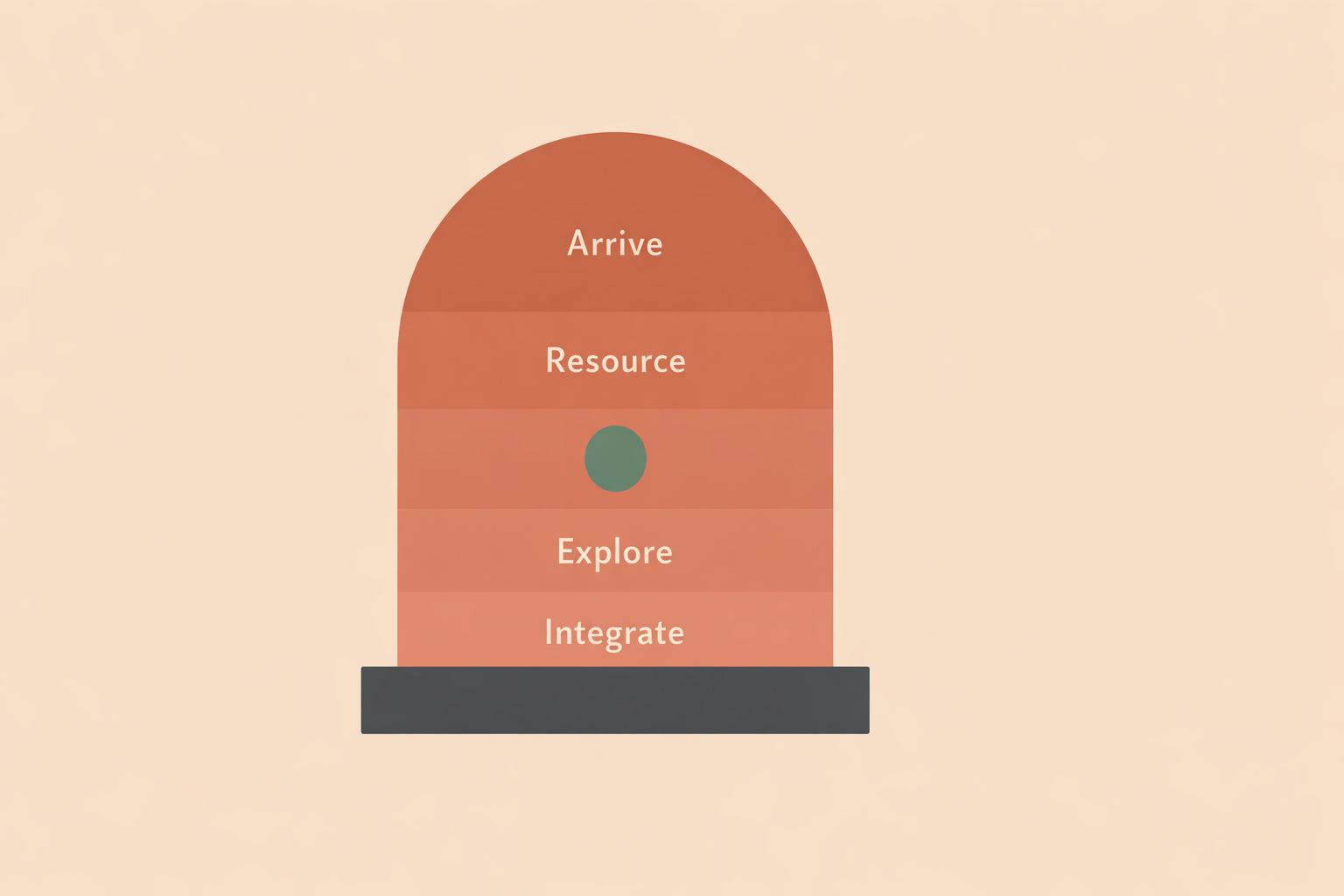
In intense sessions, it’s easy to rush toward interpretation or problem-solving. A steadier rhythm follows a simple arc: Arrive, Resource, Explore, Integrate.
This structure is widely used in practice because it reliably contains intensity and invites intuition to arise from steadiness rather than emotional momentum.
- Arrive: orient to the present moment, the room, and the body.
- Resource: add support through breath pacing, touch points, objects, or familiar grounding rituals.
- Explore: approach charged material in small doses.
- Integrate: gather what was learned and return to steadiness before closing.
Somatic work often emphasizes titration, which means working in manageable amounts instead of diving into the whole wave at once. That pacing protects clarity and respects how people naturally digest intensity in stages.
Scripts land best as invitations, not commands. Respect for autonomy and collaborative pacing sit at the heart of client-led intuition in coaching as much as phase-oriented support, and the same principle strengthens coaching.
Here is how the arc can sound in everyday language:
- Arrive: “Let’s take a moment to land here. What do you notice in the room right now?”
- Resource: “Would it help more to feel your feet, hold your mug, or slow the exhale?”
- Explore: “As you mention that decision, where do you notice it in your body?”
- Integrate: “What feels worth carrying with you from this part of the session?”
The strength of this arc is that it keeps both people oriented while leaving plenty of space for depth, intuition, and the client’s meaning-making.
Core Micro-Scripts for In-the-Moment Settling
When intensity peaks, short scripts tend to work better than long explanations. A reliable sequence is: orient, feel contact, slow the breath, offer choice.
- Orient: “Name three things you can see.”
- Contact: “Feel where your body meets the chair or floor.”
- Breath: “Let the exhale be a little longer than the inhale.”
- Choice: “Would one more round help, or is this enough?”
These steps align with established grounding guidance that uses present-time orientation, body contact, and slower breathing to reduce intensity and return to the here and now.
Sensory grounding can also interrupt spiraling thought loops. Practices like naming what you can see, feel, hear, smell, and taste are widely used to shift attention toward present-moment awareness.
Many coaches find a slower breath cadence supportive. Breathing at roughly 5–6 breaths per minute often stabilizes the system, especially when it’s offered gently as an option.
Small sensory supports can help attention settle too: a cool sip of water, fresh air at a window, or a smooth object in the hand. These sensory anchors are simple and surprisingly effective when emotion is running high.
Two brief lines worth memorizing:
- “Let your eyes land on one steady object. Feel your feet and lengthen the exhale a touch.”
- “Would it help to hold something, feel the chair more fully, or take one quiet breath?”
Ground First, Then Listen for Intuition
Many people try to read the signal in the middle of the storm. In intuitive coaching, it is usually wiser to ground first and listen second.
Once the system settles, body cues tend to come through as information rather than alarm. Calmer autonomic states are associated with greater feelings of safety, and that sense of safety supports clearer discernment.
From there, invite gentle noticing:
- “As you imagine saying yes, does your body feel rushed or more spacious?”
- “Which option brings even a little more room?”
- “What changes if we slow this down by ten percent?”
If the felt sense stays hot, urgent, or highly charged after a regulation reset, treat it carefully. It can still be meaningful, but it often reads as activation first, a distinction that also matters in trauma-aware intuition.
It also helps to name what’s happening. Research on affect labeling suggests that naming emotions can reduce intensity on its own.
A simple sequence might sound like this:
- “Let’s steady first. Look around, feel your feet, and let the exhale lengthen.”
- “Now when you picture that conversation, what do you notice in your chest or throat?”
- “If we slow it down, does anything shift?”
- “What would the steadier part of you choose as the next small step?”
This is also a good place to invite what already belongs to the client: breath, prayer, song, silence, or a small ritual gesture. When it comes from their own background and meaning, it often strengthens inner listening and can fit naturally within spirituality and ritual-informed practice. Ask rather than assume.
How the Coach’s State Shapes the Room
Your state sets the tone. People naturally attune to pace, voice, and rhythm, and relational settings can show measurable physiological synchrony.
Self-regulation is part of the craft. When the coach stays grounded, the session is easier to track and less likely to tip into fixing, rushing, or over-reading.
Internal scripts can help:
- “Slow your words. Feel your seat. Exhale longer.”
- “Soften your jaw. Unclench your hands. Stay curious.”
- “One thing at a time. They choose.”
Voice matters too. Slower speech and warmer prosody can act as cues of safety, which helps the whole room settle.
Many practitioners pair these phrases with small physical resets: feel both feet, soften the belly, relax the shoulders, sense the back against the chair. These quick adjustments help you stay in witness mode instead of getting pulled into urgency.
Two discreet in-session resets:
- Anchor and pace: feel both feet, lengthen the next two exhales, then let the next sentence follow that pace.
- Boundary reset: sense your back, soften your jaw, and silently repeat, “With, not into.”
Closing the Session Without Leaving It Open-Ended
How a session ends matters as much as how it opens. A good close helps the person leave with insight and steadiness together, instead of carrying unfinished activation into the day.
A simple rhythm works well: summarize, choose one support, ground again.
- Summarize: “Today you noticed the urgency soften when we slowed the breath.”
- Choose one: “Which support feels most realistic to keep with you this week?”
- Ground: “Before we finish, let’s take two slower breaths and look around the room once more.”
Phase-based approaches consistently emphasize safety and stabilization around deeper material. In coaching, that often looks like taking one final minute to help the body land before the conversation ends.
If older memories were stirred, use clear present-time orientation. Guidance on present-time orientation highlights how distinguishing past from present supports a return to the now.
You might say:
- “What feels most important to take with you in one sentence?”
- “Which phrase or practice will you return to if this comes up again?”
- “Let’s land here together before we close.”
Many practitioners also like to offer a small personal cue to carry out: one phrase, one grounding object, one breath pattern, or one check-in question. It doesn’t need to be elaborate to be useful.
Cultural respect matters here as well. If the person has a meaningful closing gesture from their own background, a word of thanks, a hand to the heart, or a moment of silence can be woven in gently and respectfully.
Build a Personal Script Library
Scripts become natural through repetition. Keep a small library: a few arrival phrases, a few resourcing options, a few exploration questions, and a few closings. Rehearse them when the stakes are low so they’re available when intensity rises.
Keep the spirit collaborative. These aren’t lines to impose; they support presence, well-being, and clearer listening.
Build your library for the people you actually support. Leave room for secular language, culturally rooted practices, and different preferences around touch, breath, silence, and symbolism. Ask what already works, and let the process stay theirs.
Across both modern research and long-standing traditional practice, emotional regulation is learnable. As you refine your pacing, breath cues, orientation, and choice points, intuitive sessions tend to feel steadier and easier to navigate, which is central to intuitive coach certification training.
Train in Intuitive Coach Certification
Deepen these regulation scripts and somatic pacing skills in the Intuitive Coach Certification.
Explore Intuitive Coach Certification →










