Practitioners are often trained to reach for technique first: stretch what feels tight, support what seems underpowered, and move on. Yet when discomfort spikes during deadline weeks, life changes, or emotionally charged conversations, that reflex can miss what is shaping intensity in the moment. Sessions can drift into over-interpreting one muscle test while breath shortens and the body braces.
A steadier order is usually simpler: confirm safety and scope, check recent strain and sleep, then use breath, precise language, and consent-led touch to help the client settle before interpreting patterns. In that kind of session, Touch for Health tools offer structure without being asked to carry more certainty than the moment allows. Muscle testing becomes a reflective cue, meridian maps become traditional guides, and short movement or acupressure sequences become practical choices clients can repeat for themselves.
Key Takeaway: Discomfort is often shaped by attention, expectation, and emotional load as much as by movement itself. In Touch for Health-informed sessions, a scope-safe structure can begin with observation and simple regulation, then use muscle testing, meridian language, and brief home practices to help clients notice what eases guarding and supports clearer choices.
Client Story 1: Shoulder tension and the weight of responsibility
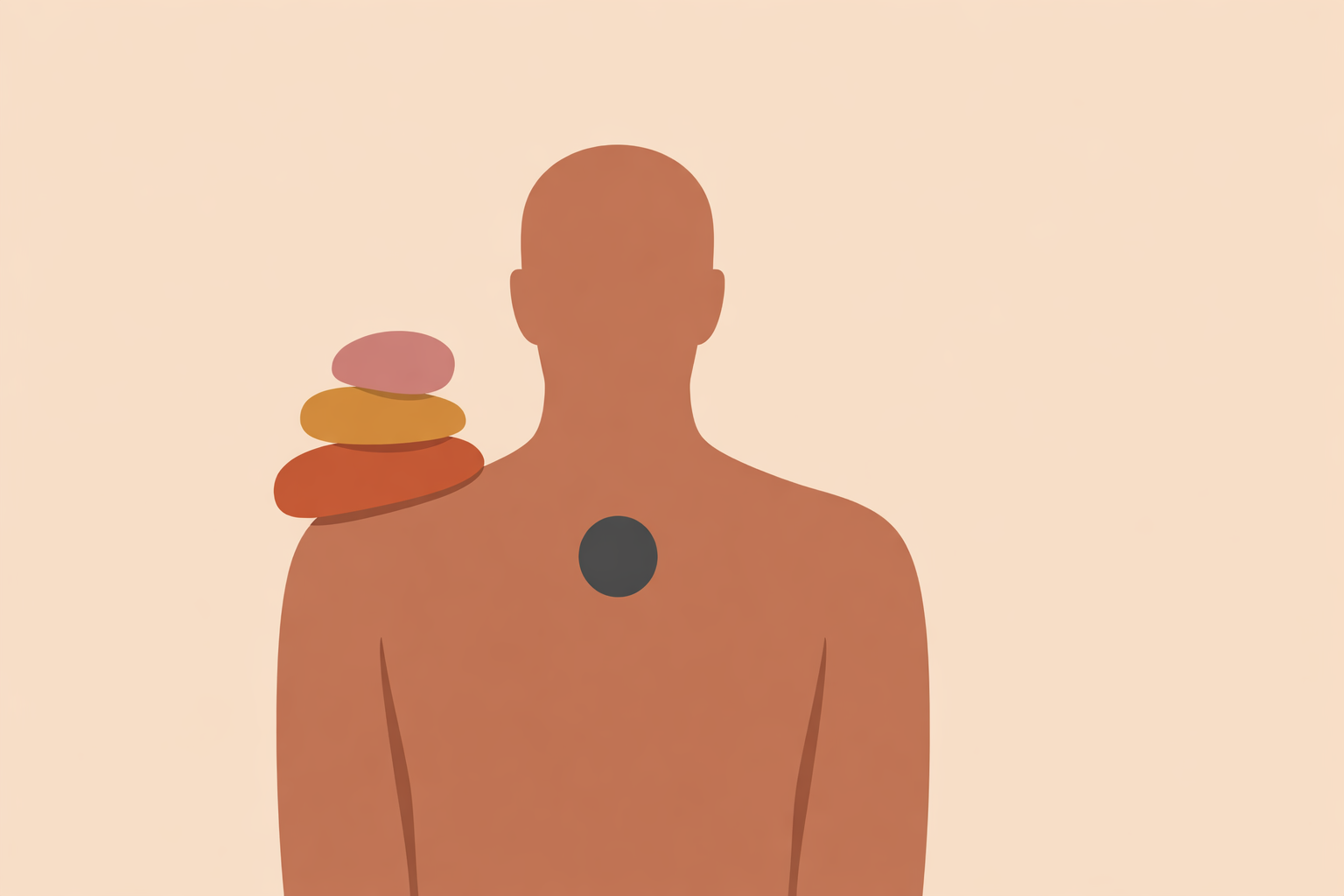
Mira arrived rubbing the place where neck meets shoulder. “It spikes during deadline weeks,” she said. “It feels like I’m literally carrying the project.” We began with basics: recent lifting, daily movement, sleep, and what made the tension better or worse. That order matters, because attention and meaning can change how strongly a sensation lands.
We set a simple frame: the discomfort was real, and our job was to listen for how body, breath, and responsibility were interacting today. When I invited her to silently say the word “responsibility,” her exhale caught and her shoulders lifted slightly. It was a small but useful clue.
From there, we moved into gentle kinesiology. A sip of water, light rubbing at K27, and tracing the central meridian served as settling rituals and helped her arrive in her body. I then used a soft anterior deltoid muscle test as a way to slow the moment down and notice change.
We paired the phrase “I’m responsible for everything” with slow breathing and repeated the deltoid check. As the phrase landed, guarding increased. Then we tried a tighter, kinder reframe: “I’m responsible for my part.” Her breathing lengthened almost immediately.
I also checked a few traditional alarm points to orient our next steps. Tenderness around the lung and large-intestine area gave us a sensible starting place, not as a declaration of cause, but as a traditional map for support.
With Mira’s consent, we tried a short recalibration:
- gentle acupressure near LU7 at the wrist
- a light hand hold over the upper chest where touch felt comfortable
- a 4-count inhale with a 6-count exhale
- the phrase: “I’m responsible for my part”
By the end, the shoulder felt a shade lighter to her. Nothing dramatic, just more space. That was enough to turn insight into action. She wrote down one practical request for the next day: share the launch checklist rather than carrying it alone.
For home practice, we kept it brief:
- one minute of cross-crawl
- three easy shoulder rolls
- one long exhale before opening her laptop
Sessions like this often shift when responsibility becomes better sized. When attention softens and breath returns, the body frequently follows.
Client Story 2: Lower-back discomfort, anticipation, and uncertainty
Jamal’s lower back had been “on and off” for months. He had recently changed roles at work and felt unsure about income for the next quarter. Instead of going straight to stretches, we began with context: activity levels, rest, recent physical strain, and when the discomfort tended to spike.
“It’s worst before I stand up from a chair,” he said. That timing was useful. Anticipation alone can increase bracing, and fear-avoidance has been linked with greater intensity and reduced ease of movement in persistent shoulder pain research. In practice, the same preparation pattern shows up throughout the body: the person braces as if the discomfort is already on its way.
We also looked at sleep. Jamal had been waking early and going to bed tense. When sleep is poor, people often feel less resourced and more reactive in their body.
To make the picture more precise, I asked him to move beyond “stressed.” Using a wheel of emotions, he landed on “apprehensive” and “irritated.” That shift in language changed his pacing right away. He stopped rushing his breath and became more observant.
Within a Touch for Health frame, I used a light indicator muscle test to organize attention while he said, “I’m safe to stand slowly.” The value was the shared rhythm it created between breath, phrase, and movement.
We then built a two-minute experiment:
- Sit tall and soften the jaw.
- Breathe in for 4 and out for 6 for three cycles.
- Say quietly, “I can pause and stand.”
- Hinge forward a little without standing yet.
- Notice the expectation level from 0 to 10.
- Stand slowly with attention on the feet and exhale.
- Compare expectation with what actually happened.
Before moving, his anticipation dropped from 7 to 4. After the slow stand, he laughed. “That was fine.”
We followed with a traditional support sequence: rubbing a few neurolymphatic reflex points on the back of the thigh, tracing the bladder line down the leg, and repeating three more slow stands. These Touch for Health-style steps work well as attention training: they reduce hurry and help the client meet movement with less guarding.
This broader pattern is well recognized: pain-related fear can sustain avoidance and stiffness, while graded exposure helps rebuild confidence in movement. In session terms, you turn a feared action into a bounded practice the client can repeat, not a test they might fail.
Jamal left with two anchors: a simple script (“I can pause and stand”) and a brief practice before breakfast and again mid-afternoon. Often that is enough to interrupt anticipation and restore trust in everyday movement.
Client Story 3: Chest tightness, breath, and unspoken feelings
Chest sensations deserve a careful, conservative frame. If the feeling is new, severe, escalating, or worrying, the right next step is appropriate conventional support. In this session, however, Ana described a clear pattern: tightness appeared during charged conversations with a family member and settled outside those moments.
We began with observation rather than interpretation. On neutral topics, her exhale was smooth. When she imagined the previous night’s argument, her shoulders rose and her breath shortened. That gave us enough to work with.
People often feel emotion in the body before they can explain it in words. Some notice heat, some pressure, some collapse, some constriction. The map matters less than helping the client notice their pattern with honesty and steadiness.
From there, I introduced the lung meridian as it’s often held in Touch for Health and related East Asian traditions: a symbolic map connected with breath, grief, boundaries, and letting go. It’s an ancestral framework that can help a client make sense of lived experience.
With clear consent, we tried a short sequence:
- inhale for 4, exhale for 8, twice
- one hand where touch felt safe over the upper chest
- the other hand near LU7 at the wrist
- a quiet boundary sentence: “I can finish my thought before we change topics.”
I used a soft indicator muscle test while she tried two phrases: “I have to stay quiet” and “I can say one honest need.” The point was to notice what happened to her posture, breath, and steadiness with each.
We also checked related alarm points lightly to orient the balancing. As in the earlier sessions, tenderness guided where to pay attention.
The real shift came through rehearsal. Ana chose a clear sentence for the next difficult conversation: “I want to finish dinner before we discuss finances.” We paired it with the longer exhale until it felt speakable rather than aspirational.
At the end, she said, “The tightness is still there a little, but it doesn’t feel like it owns me.” That change matters: the sensation can exist, and the person still has choice.
Her home anchors were simple:
- one minute of longer exhales before bed
- a brief hand hold near LU7 before difficult calls
- a reminder card with the words “one honest need”
Using emotional awareness in Touch for Health-informed sessions
Across these stories, the pattern is consistent: discomfort often shifts when clients name what they are carrying, slow their pace, and use breath or touch as anchors. That doesn’t make the experience imaginary. It respects how attention, expectation, social context, and emotional load shape what a person feels.
For practitioners, Touch for Health offers a respectful structure for that exploration. Muscle testing works well as a reflective cue. Meridian maps can hold cultural and traditional meaning without being forced into anatomical language. Acupressure, phrase work, and small movement experiments then bridge insight and daily practice.
A grounded session sequence often looks like this:
- Observe what the body is already doing with breath, posture, pace, and language.
- Confirm permission before any touch, breath pattern, or movement experiment.
- Choose one small intervention rather than stacking techniques.
- Reassess what changed: breath, tension, steadiness, or willingness.
- Translate the shift into one realistic home practice or boundary statement.
When movement itself has become loaded, it helps to turn it into a slow, bounded experiment. Graded exposure is used to reduce fear around activity and rebuild confidence. In everyday sessions, you keep the edges clear and let the client collect direct evidence that they can meet the movement differently.
It also helps to keep language clean and scope-aware:
- This work supports self-awareness and well-being; it does not establish the cause of discomfort.
- Muscle testing here is reflective: it helps us notice change, not prove a hidden issue.
When you want to bring emotional skill into session, a few tools go a long way:
- Use more precise feeling words than “stressed.”
- Favor a longer exhale when the body seems guarded.
- Keep touch light, consented, and easy to stop.
- Turn feared movements into small experiments with clear endpoints.
- Invite one written note after practice so the client can track change in their own words.
These sessions don’t rely on perfect explanations. They work because the client learns to notice, name, and make one next supportive choice. Keep safety first, stay within scope, and save the deeper debates for another day when what’s needed most is steadiness in energy healing practice.
Train in Kinesiology Certification
Apply this consent-led, scope-aware approach more confidently with Naturalistico’s Kinesiology Certification.
Explore Kinesiology Certification →