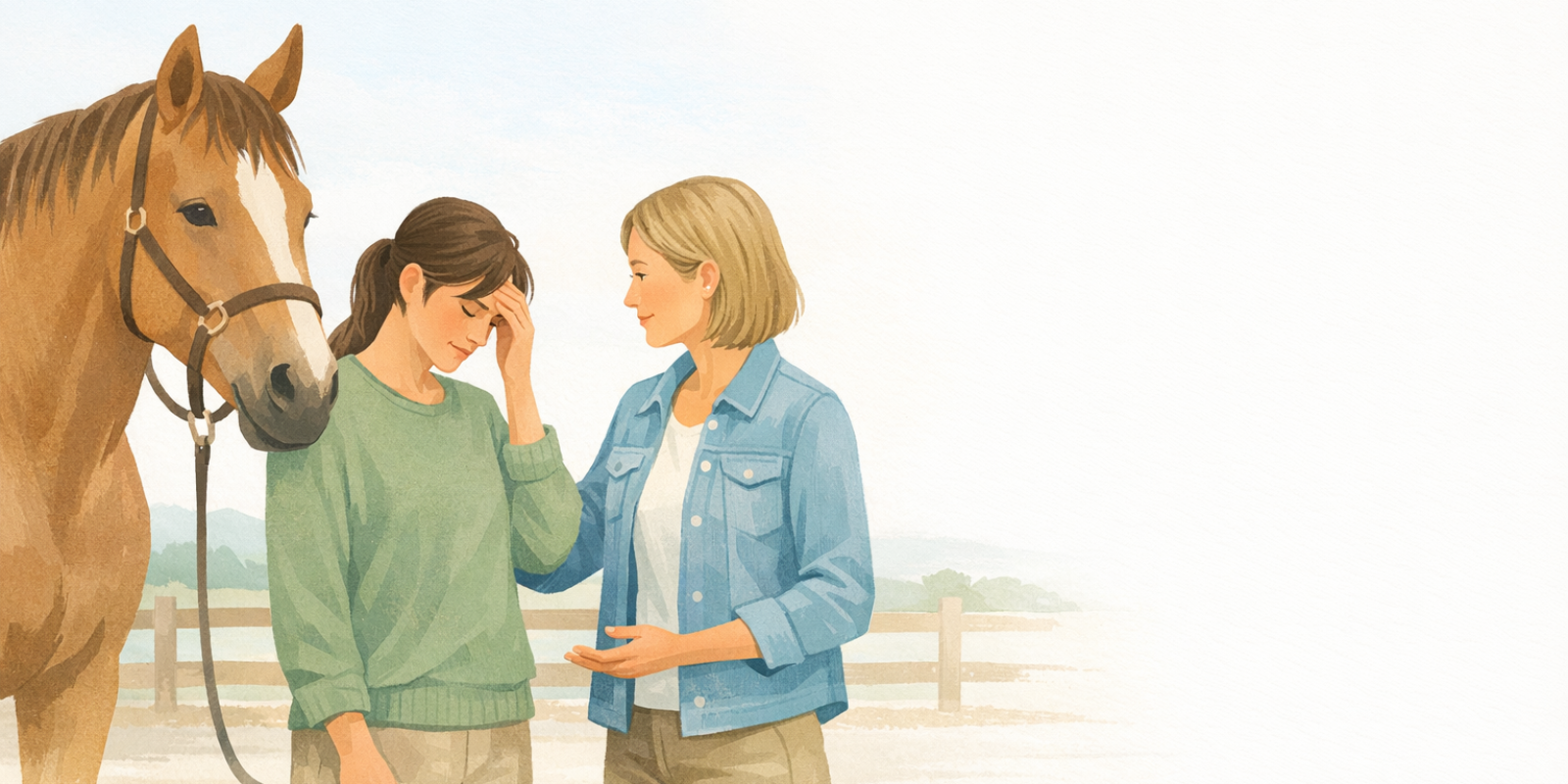
Equine work is, at its core, a language practice—two nervous systems conversing in breath, posture, and presence. Clear, compassionate scripts give facilitators a steady hand when overwhelm or shutdown appears, so the arena stays safe, relational, and growth-centered for both horse and human.
In one equine-facilitated program with veterans, participants showed reduced PTSD symptoms that were still present three months later. First-responder pilots have also shown meaningful symptom reductions with horses at the center of what helped most. Reviews of equine-assisted approaches point to calmer stress responses, shifts in mood, and a stronger ability to engage with difficult material when work is paced and relationship-centered.
From a traditional perspective, none of this is surprising. Across cultures, horses have long been approached as sensitive, relational beings who respond to subtle shifts in human energy. Thoughtful scripts help practitioners honor that lineage while staying grounded in clear, ethical facilitation.
Key Takeaway: In equine trauma work, simple, consent-led scripts keep sessions safe when overwhelm, freeze, or shutdown appear—by prioritizing breath, boundaries, pacing, and choice before meaning-making. When facilitators track both horse and client signals and respond with clarity and relief, regulation and reconnection can return without pressure or shame.
When Overwhelm Turns into Silence
In the arena, overwhelm doesn’t always roar; often it goes quiet. Freeze and shutdown are adaptive responses—equally human and equine—and reading them well is part of the craft.
Modern programs with horses are confirming what many lineages already understood: horse-guided, body-based work can support emotional regulation without forcing talk. Horses, as one provider puts it, “mirror human emotions” without judgment, offering honest feedback about pacing and pressure mirror emotions. That’s why the scripts below lean on breath, boundaries, and choice—so silence becomes information, not failure.
Script 1: Naming the Freeze — Orienting Client and Horse at the First Signs of Overwhelm
When freeze begins, name it early and gently, using the horse’s body as a shared reference point. The goal isn’t to “push through,” but to re-open options when the system is getting numb or flooded.
In some equine programs, participants are invited to observe horse body language as a live reflection of internal shifts. Think of it like catching a weather change at the first breeze, rather than waiting for the storm: those small signals often arrive before a full shutdown.
When to use this script
- You notice a client’s breath vanish, gaze narrow, or voice flatten.
- The horse goes still with a shallow breath, braces through the poll, or turns away.
- There’s a sudden hush in the arena, and “trying harder” would likely backfire.
Script language you can adapt
- “Let’s pause and look around with the horse. What do you both see? Three things near, three things far.”
- “I notice [horse’s ears flick/nostrils soften/weight shift]. My body does something similar when I’m on edge. What happens in yours as you watch?”
- “Would it help to take two slow breaths together, following the horse’s ribs as they move?”
- “If your system could speak like this horse, would it say ‘I need space,’ ‘I need closeness,’ or ‘I’m not sure yet’?”
- “Nothing to fix. Let’s simply witness. The body is telling us the pace.”
Script 2: Co‑Regulating with the Horse When a Client Feels Overwhelmed
When activation spikes, let regulation come first—through breath, rhythm, and respectful contact—before any “story.” Essentially, the horse helps set a tempo the body can trust.
In one eight-week program, participants rated horse time most helpful, often describing calmer bodies and more trust. Rhythmic grooming and leading have been associated with improved emotional awareness, and a review noted that five sessions can support meaningful shifts in some trauma-focused programs. Veteran-focused research also linked equine sessions with decreased cortisol, suggesting a softer stress response when sessions are paced with care.
“Horses invite us to be more present.” — Linda Tellington‑Jonesmore present
Grounding with the horse before the story
- “Let’s stand shoulder-to-shoulder with the horse. Feel your feet, then watch for one full rise-and-fall of their ribs.”
- “Groom in slow, even lines. Count strokes together: ‘one-two’ with the exhale. Notice when the horse blinks or licks.”
- “We’ll match pace at the walk for ten steps, then pause. What shifts in your chest? In theirs?”
- “Would a hand on the withers help? If the horse steps away, we honor that ‘no’ and breathe from where we are.”
- “We’ll stay with sensation now. Words can come later, if and when your system asks for them.”
Script 3: Naming Shutdown Through the Horse–Human Mirror
When quiet becomes numb, name it with compassion, using the horse’s behavior as a shared mirror. This invites a small step back toward connection—without pressure or shame.
Many equine professionals describe shutdown as a dorsal-vagal, energy-conserving strategy: flat, disconnected, and often mistaken for “calm.” Repeatedly ignoring signals can slide into learned helplessness. When safety returns, conflict behaviors may resurface—paradoxically, a sign of thaw rather than deterioration. Practitioners often observe that horses’ immediate responses can bring meaning and empathy to human change.
Language for noticing freeze without shame or pressure
- “I see the horse getting very still and a little distant. Sometimes that’s how ‘I’m overwhelmed’ looks in horses—and in people.”
- “If this quiet had a message, might it be ‘too much’ or ‘not yet’?”
- “We can step back together. Would one breath and three slow strokes be enough for now?”
- “Your ‘no’ is welcome. The horse’s ‘no’ is welcome. Let’s listen to both.”
Script 4: Listening to “No” — Consent‑Led Language for Shutdown Horses and Humans
Boundaries thaw shutdown. When facilitators name and honor subtle resistance—ears back, moving away, flattening tone—compliance can transform into a living conversation.
Shutdown often forms when honest signals are repeatedly ignored. In horses, confusing cues and missing release can fuel conflict behaviors until clear cues and timely relief restore safety. The parallel in humans is striking: a lifetime of overridden “no” narrows choice. As one facilitation team shares, horses’ real-time responses can bring meaning to our patterns; in Linda Parelli’s words, they help us build self-awareness and emotional intelligence. Recognizing a horse’s “no” often helps clients begin to reclaim boundaries of their own.
When to use this script
- Horse shows subtle resistance: pinched muzzle, tail swish, stepping away, bracing.
- Client agrees verbally but body flattens or eyes dull.
- Momentum feels driven by expectation rather than consent.
Script language you can adapt
- “I see a ‘no’ from the horse. Thank you for saying it. Would you like space, or a lighter ask?”
- “Let’s try an invitation: ‘Would you step with me one step?’ If the answer is ‘no,’ we listen and try something softer.”
- “Your body says ‘not yet.’ That matters. What would make this 10% safer?”
- “We can end on a ‘yes’ you both choose, even if that’s simply breathing together at the rail.”
Script 5: Rebuilding Choice and Safety after Learned Helplessness
Agency returns in tiny choices. Offer clear, low-pressure yes/no options so both horse and human relearn that their voice changes the plan.
When cues are confusing or too intense, horses can default to learned helplessness. The antidote is clarity and immediate relief: trainers emphasize simple cues with consistent release. Treating the horse as a collaborator—an equal partner with preferences—also aligns with outcomes seen in group work, where participants report greater self‑empowerment alongside reductions in distress. As one program notes, building these skills with horses reveals—and reshapes—our relationship patterns in everyday life.
Offering clear yes/no options to both horse and client
- “Here are two options: step with me one step, or we breathe together at the gate. Which do you choose?”
- “If the horse says ‘no,’ we thank them and lower the ask. Consent first, then connection.”
- “We’ll try one specific request, then instantly release—even if the try is tiny.”
- Client choice matters equally: Would you like me on your left, your right, or a few paces back?
Script 6: When Numbness Turns to Energy — Guiding Fight/Flight Safely Back Toward Connection
When a previously flat system “wakes up,” that jolt of energy is often a sign of returning capacity. Welcome it, then channel it into safe movement and clear choices.
Practitioners often see spookiness or stronger reactions as horses emerge from shutdown—a movement out of collapse, not misbehavior. Many “conflict behaviors” can reflect confusion more than defiance; clear direction and timely release help ease that confusion. In one first-responder program, participants shifted from initial reluctance to enthusiasm for the horse work across eight sessions, and broader research has reported meaningful PTSD reductions in equine-assisted programs. Reviews also describe bodies settling into calmer states when sessions blend movement, attunement, and mindful presence.
When to use this script
- The horse startles or surges; the client shifts from numb to urgent.
- You sense energy thawing—alive but unchanneled.
Script language you can adapt
- “Good. Energy is back. Let’s put it on a track: ten steps forward together, then a breath and a stop.”
- “If spook shows up, we’ll widen the arc and give space. You choose the speed; I’ll keep the rhythm.”
- “Movement first, meaning later. We’ll pendulate—move, pause, orient, repeat.”
- “Notice your feet. Notice the horse’s shoulders. Where do both of you feel 1% safer now?”
Script 7: Waking Up a Numb System with Brief, Clear Conversations
Use tiny, precise asks—never force—to interrupt shutdown gently. Reward every authentic try, so curiosity can come back online.
With shutdown horses, the aim is to interrupt the pattern with small, solvable requests and quick release. As systems thaw, spookiness may appear before balance returns; staying with clarity and immediate relief supports both species. Many facilitators notice that horses’ authentic responses also surface human incongruence, inviting honest self-checks that build emotional intelligence and real-world problem‑solving.
Using short, specific requests to interrupt shutdown patterns
- “Would you shift one hoof? Yes—then we rest. Thank you.”
- “Touch the target, release. One circle at a quiet walk, release.”
- “For the client: ‘Name one color in the arena. Now one sound. Now one sensation in your hands.’ Done.”
- “We stop while it’s working so your system links ‘effort’ with ‘relief.’”
Script 8: Integrating the Story — Closing Equine Trauma Sessions Without Re‑Triggering
Close with grounding and meaning-making so both systems leave settled, not stirred up. Integration is where insight becomes a new pattern.
In structured equine-facilitated group work, participants reported reduced depression and stronger self‑empowerment after eight sessions. A veteran-focused program found that gains were maintained three months later, suggesting that how learning is anchored matters. As one clinician reflected about equine-facilitated work, “It taught me to allow clients to use their own way” their own way toward well-being.
When horses are treated as collaborators, their feedback can consolidate trust, body-awareness, and agency—patterns participants often describe as self‑empowerment and renewed appreciation for others. Across diverse groups, equine-assisted work has been associated with increased hope and social connection—outcomes that thoughtful closings can reinforce.
When to use this script
- Any time activation or shutdown occurred.
- When consent or boundaries shifted meaningfully.
- Before crossing the threshold from arena to everyday life.
Script language you can adapt
- “Let’s mark three moments today: where your body said ‘no,’ where it softened 1%, and where a choice felt real.”
- “Name one thing the horse taught you about pacing. One thing you taught yourself.”
- “On a 0–10 scale, what is your activation now? What would bring it down one point before we leave?”
- “We’ll thank the horse and the space. Then we close with water, a snack, and two minutes of feet-on-earth.”
Script 9: Closing the Loop and Bringing Arena Wisdom into Daily Life
Translate arena insights into daily rhythms and a sustainable, ethical practice. Integration protects the gains and builds practitioner credibility.
Group work with women showed lasting self‑empowerment, and veteran programs maintained improvements at follow‑up. First responders have highlighted increased mindfulness and trust; case work also shows how grooming rhythms can translate into noticing and adjusting internal rhythms off the farm. One practitioner put it simply: let clients find their own way into meaning.
From arena insights to everyday resilience
- “What is one body cue you’ll track this week, and one consent boundary you’ll honor?”
- “Where can you add rhythm—walking, brushing your own hair, rocking in a chair—when stress rises?”
- “Who in your life can witness your ‘no’ and your ‘yes’ with respect?”
- “Let’s write one sentence you want to remember from today and one door you’ll leave closed for now.”
- “I’ll summarize any key observations for your journal. We’ll revisit and adjust next time.”
Many facilitation teams emphasize that integrating body awareness alongside reflection offers more holistic support for real-world stressors and relationships.
Bringing Equine Trauma Scripts into Your Living Practice
Scripts are scaffolding, not shackles. Adapt them to your lineage, your horses, and your scope—always with consent, cultural respect, and the horse’s welfare at the center.
Across equine-assisted fields, evidence-informed programs consistently highlight that relationship-centered approaches and personalization are linked with stronger well-being outcomes. Many practitioners also emphasize blending grounded psychological knowledge with solid horsemanship—an approach that respects both emerging research and long-standing traditional wisdom.
Bringing scripts into your own style
- Practice each script at slower speeds first; add complexity only as horse and client show capacity.
- Keep a brief “script log” to refine phrases that land well for different clients and horses.
- Co-create boundaries with your horse team: what’s a clear “no,” what’s a tentative “maybe,” and how will you respond?
- Seek community feedback; culture, language, and lineage shape what “safety” feels like in the body.
On Naturalistico, you’ll find tools and training that support this kind of modern, relationship-centered practice—so your scripts can evolve alongside you, your horses, and your community.
Equine Trauma Work as a Living, Ancestral Practice
This work has deep roots. Across cultures, horses have stood beside humans as mirrors and mentors; today we blend that ancestral wisdom with structured, collaborative approaches that honor both species. Emerging research suggests that equine communication can catalyze changes in trauma-related patterns when framed as partnership, and contemporary overviews point to steady gains—calmer nervous systems, reduced trauma-related symptoms, and more grounded connection—when relationships drive outcomes.
Keep the practice alive: read the horse in front of you, refine your language, and build in reflection. Let your scripts be responsive, humble, and lineage-aware—shaped by mentors, peers, and the horses themselves. As sessions deepen, many practitioners track what works through case notes, observational research, and community dialogue. In Linda Parelli’s words, horses keep bringing us back to what is truly important.
If you’re called to grow on this path—whether through structured practitioner training, mentorship, or guided self-study—carry these scripts as living tools. Practice them with kindness, refine them with curiosity, and let the horse–human conversation lead the way.
Deepen Your Equine Trauma Practice
If you’d like to develop these skills in a structured, ethical framework, you can explore Naturalistico’s Equine Therapy Practitioner pathway, which blends horsemanship, trauma-aware facilitation, and practice-building support.
Ready to Go Deeper?
Take the next step with a Naturalistico certification — designed for practitioners ready to deepen their expertise.
Explore the Course →