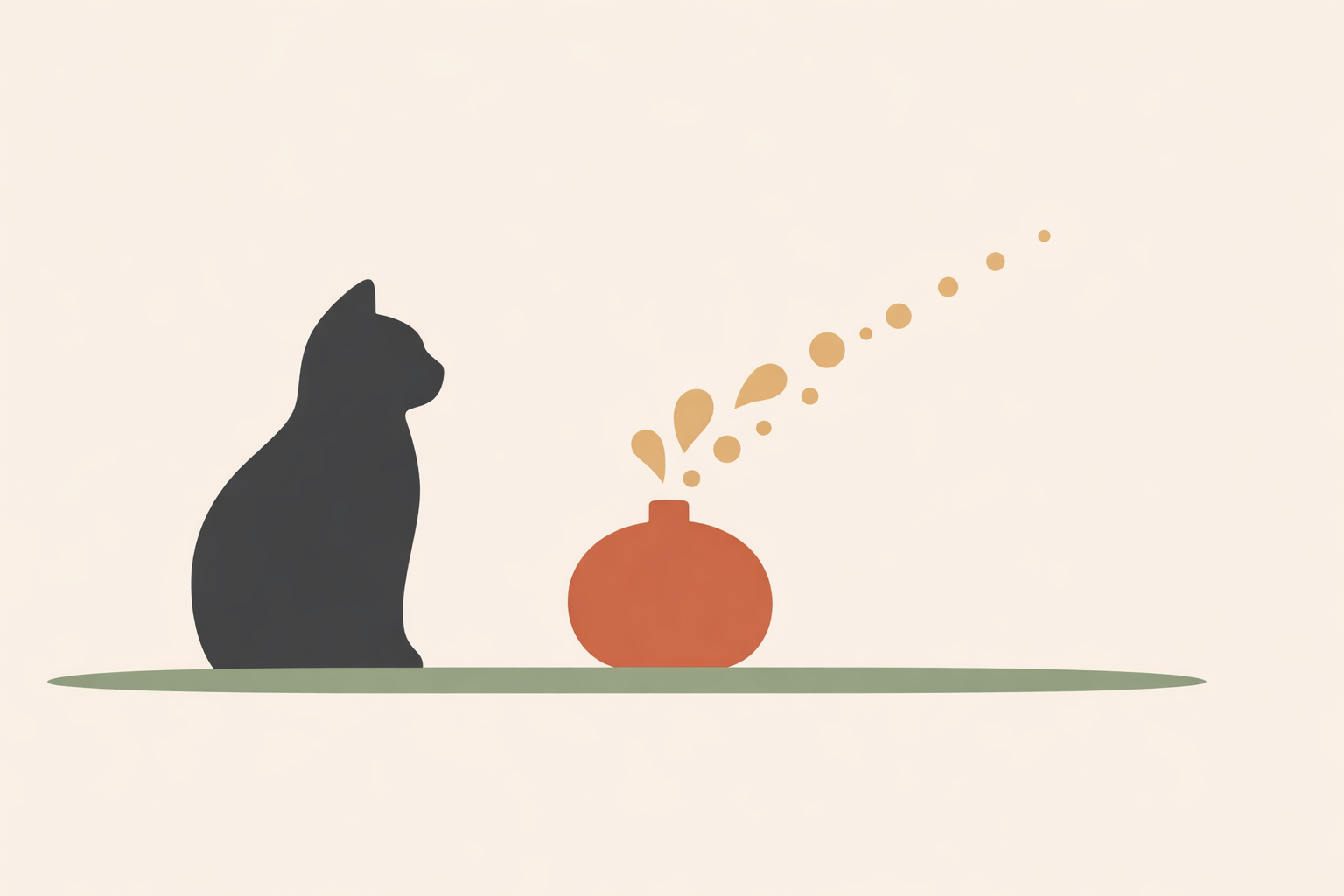
The question that matters in a cat household is “How much exposure is this cat actually getting?” With diffusers, that difference is everything. Cats groom constantly, so what starts as fragrance in the air can end up swallowed later. In real life, diffuser safety around cats comes down to understanding the route from air to fur to mouth.
Key Takeaway: Around cats, the safest baseline is to avoid active essential-oil diffusion in shared spaces. Cats can inhale aromatic particles, and oils that settle on the coat may be swallowed during grooming. If scent is used at all, keep exposure brief, separate, well ventilated, and fully optional for the cat.
Why essential-oil diffusers are difficult to use safely around cats
Cats are not small humans, and they are not small dogs. Their bodies and daily habits change the whole conversation. In feline homes, oral exposure can begin when airborne droplets land on the coat and are swallowed during grooming. Cats also handle aromatic compounds differently, so different metabolism matters when people try to apply human aromatherapy habits to cats.
This is where well-meaning advice often misses the mark. A blend that feels gentle to a person can still be unsuitable in a cat household. In cross-species practice, species differences are the foundation, not a detail.
Before bringing scent into a feline home, three questions usually tell you most of what you need to know:
- Can the cat leave the area freely at any moment?
- Could aromatic residue reach the coat, bedding, or favorite resting spots?
- Is this a particularly sensitive cat, such as a kitten, senior, or one with breathing concerns?
If any answer is unclear, it’s wise to step back. Traditional plant practice shines when it respects the animal as much as the plant.
How diffuser exposure happens in real homes
Not all diffusers behave the same way, and that shapes exposure.
Passive scenting methods release aroma more gently and don’t push an oil-containing mist into the air. They still require care around spills, curious licking, and keeping liquids fully out of reach.
Active devices are more concerning. Ultrasonic and nebulizing diffusers can release particles that travel through the room and settle over time. Veterinary guidance notes that microdroplets may reach the hair coat, turning diffusion into a grooming issue as much as an air issue.
Risk also shifts with context. It’s shaped by exposure factors such as the oil itself, concentration, device type, room size, ventilation, and whether the cat can move away. Smaller rooms, weaker airflow, and longer sessions raise the burden quickly.
Confinement makes any setup harder to justify. If a cat can’t leave, there’s no meaningful choice built in. Closed bathrooms, bedrooms, crate areas, or small offices with a running diffuser tend to be a poor match for feline well-being.
There is no universally safe oil for every cat and every home
One of the steadiest principles here is that there is no universal safe oil for cats across all situations. A safer frame is always lower exposure, not the perfect ingredient list.
For that reason, the safest baseline is to avoid diffusion in shared spaces, especially for cats with breathing concerns. Guidance for pet households also supports avoiding diffusers for animals with a history of respiratory sensitivity.
In practical terms, “safer” usually looks like this:
- No active diffusion where the cat eats, sleeps, plays, or grooms.
- No scenting in rooms the cat cannot leave freely.
- Shorter duration, more ventilation, and greater distance.
- A willingness to skip scent altogether when conditions are not ideal.
This approach may feel conservative, but it’s often the most respectful. It protects human preferences without making the cat carry the cost.
Which oils and products deserve extra caution
Some oils consistently call for more caution in feline spaces. Practitioners commonly treat tea tree, eucalyptus, peppermint, pine, cinnamon, clove, wintergreen, sweet birch, pennyroyal, citrus peel oils, and ylang-ylang as high-concern options around cats.
Not every point in that list has a strong modern source behind it, but the pattern is familiar in practice: potent, sharp, heavily aromatic oils deserve more distance and more restraint. Pennyroyal stands out in particular, with a history of toxicity that makes it an easy no for cat households.
Simple label awareness helps:
- Set aside strong minty, camphor-like, spicy, or intensely resinous blends.
- Be wary of seasonal or “cleansing” blends, which often combine several high-concern oils.
- Do not assume “pre-diluted” or “pet-safe” means appropriate for every cat or every route of exposure.
That last point matters because risk depends on concentration, combinations, and how exposure happens, not the front-label promise. Around pets, product variability is part of the picture.
If someone insists on diffusing, use a lower-exposure ladder
Some households will still want scent. When that happens, a realistic ladder supports better choices than all-or-nothing rules.
- Step 0: Do not diffuse. Use non-aromatic rituals instead: soft lighting, quiet music, warm drinks, breathwork, or evening routines that create the same mood.
- Step 1: If scent matters, keep it passive, brief, and fully out of reach in a room the cat cannot access.
- Step 2: If an active diffuser is used despite caution, keep it in a separate room, ventilate well, run it briefly, and air the space out fully before the cat returns.
Continuous or overnight diffusion is especially unhelpful because it removes the cat’s ability to avoid exposure and keeps adding to the total load. Veterinary guidance recommends short periods rather than prolonged sessions, which fits well with a lower-exposure approach.
Two house rules are worth making non-negotiable:
- Never add essential oils to a cat’s food, water, bedding, litter, or carrier.
- Never run a diffuser in a space the cat cannot leave immediately.
What to watch for if a cat seems uncomfortable around scent
Cats often show discomfort quietly at first. Early signs may include leaving the room, hiding, agitation, lip-licking, repeated swallowing, squinting, pawing at the face, coughing, or reduced interest in food.
More concerning warning signs include watery discharge, nausea, and wheezing. If those appear, stop the exposure, ventilate the space, and let the cat settle somewhere with clean air.
Some signs call for urgent outside support. These include open-mouth breathing, marked breathing effort, tremors, loss of coordination, repeated vomiting, seizures, suspected ingestion, or visible oil on the coat. In those situations, immediate contact with urgent animal support is the appropriate next step.
A practical stop-rule helps guardians act fast: if the cat looks different, breathes differently, or behaves differently after scent exposure, turn the device off and move toward fresh air first.
Hydrosols, carrier oils, and “gentler” products still need care
Hydrosols are often described as gentler than essential oils, and traditional practice often values their softer profile. Still, gentler does not equal automatically suitable for cats.
With water-based aromatic products, quality and handling matter. Preservatives, contamination, and storage conditions all shape how appropriate a product is. A poorly stored bottle isn’t made safer by being more dilute.
It also helps to stay realistic about carrier oils and oily macerates. They are not dependable antidotes for unwanted aromatic exposure, and anything oily on the coat can still be groomed off and swallowed.
For the same reason, “pre-diluted” should never be treated as a guarantee. Around pets, direct application is best avoided, especially when product composition is unclear or the cat is sensitive.
Keep the cat’s choice at the center
Many traditional practitioners value the idea that animals may show interest in certain scents. The important boundary is choice. A cat should always be able to approach, ignore, or leave without pressure and without being surrounded by lingering aroma.
That means no saturating shared rooms, no spraying around resting spaces, and no turning mild curiosity into forced exposure. If a cat moves away, that’s useful information. If a cat shows no interest, that’s information too, and ethical plant practice respects both.
A cat-centered closing principle
What is genuinely safer around cats is usually very simple: less scent, less time, more ventilation, more distance, and more choice. Active diffusers in shared feline spaces rarely meet that standard.
For kittens, seniors, underweight cats, and cats with ongoing breathing, liver, or kidney concerns, caution should be even higher. In many of these homes, avoiding diffusion altogether is the clearest and kindest option.
Traditional plant work and animal well-being do not have to compete. Keep the home cat-centered, and animal wellness practices become something used with restraint and careful attention. If there’s ever doubt, choose fresh air, keep products securely put away, and seek qualified animal aromatherapy guidance when concerning signs appear.
Study Animal Aromatherapy Certification
Build safer pet-centered scent practices with the Animal Aromatherapy Certification.
Explore Animal Aromatherapy →