Your team drops a spiral overlay on a poster and calls it “golden,” but the guide came from a Fibonacci grid. A client asks whether the curve reflects how shells grow, and you hesitate, not because the question is silly, but because precision matters. These spirals can look similar at a glance, yet they behave differently on the page and in the hand. When we blur that distinction, we also blur symbolism, composition, and trust.
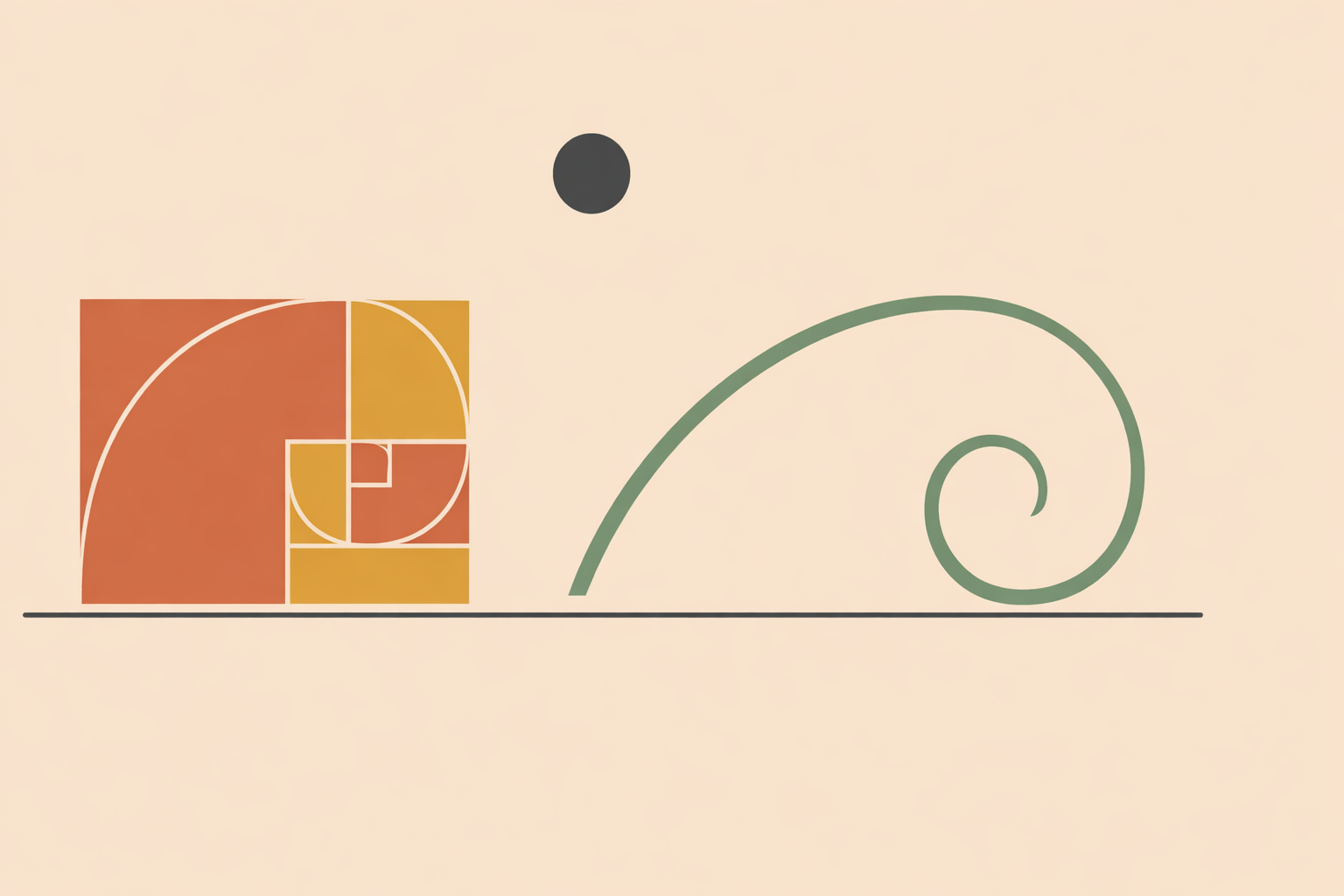
This is the useful dividing line: the golden spiral is a continuous logarithmic curve with a constant pitch, while the Fibonacci spiral is a square-built approximation made from quarter arcs. Use the golden spiral when you want uninterrupted flow. Use the Fibonacci spiral when you want staged emphasis. And if you bring in symbolism, let it remain symbolism rather than proof.
Key Takeaway: The golden spiral and the Fibonacci spiral are related, but they are not the same tool. The golden spiral offers smooth, continuous growth and is often better for visual glide; the Fibonacci spiral is a stepped construction that can help stage movement and emphasis. In practice, clear labeling, honest nature references, and consent-aware facilitation make spiral work stronger, cleaner, and more trustworthy.
Golden Spiral vs Fibonacci Spiral: The Geometric Difference
The difference is practical. You can see it while drawing, and you can feel it while tracing.
The golden spiral is a logarithmic spiral whose radius increases by the golden ratio roughly every quarter turn. That creates a steady turning quality, with a consistent arm–radius relationship and a pitch angle of about 17°.
The Fibonacci spiral is built from adjoining squares sized 1, 1, 2, 3, 5, 8 and so on, with quarter-circle arcs drawn inside them. It’s not one uninterrupted curve, and its quarter-arc construction creates curvature changes where the arcs meet.
The Fibonacci spiral does trend toward the golden spiral as it scales up; it approaches the golden spiral at larger sizes. But it never fully becomes the same curve, and because phi is irrational, the two won’t perfectly coincide.
In studio practice, that shows up fast. The golden spiral usually feels like one continuous glide. The Fibonacci spiral often feels more segmented, like a series of linked turns.
How These Spirals Feel in Composition
If you want a smooth visual journey, start with the golden spiral. If you want pacing, sequence, or staged beats, the Fibonacci spiral often serves better.
The golden spiral supports images where the eye should travel without interruption. It can carry attention from an outer edge into a focal point in one sweep, which is why it’s often chosen for continuity and a sense of unfolding.
The Fibonacci spiral naturally introduces pauses. Because it grows from squares, it lends itself to layouts with frames, nested moments, and clear checkpoints. For posters, editorial spreads, and storyboard planning, that square logic can be very usable.
A simple studio question helps: do you want glide or steps?
- If you want glide, choose the golden spiral.
- If you want steps, choose the Fibonacci spiral.
- If you are unsure, sketch both over the same composition and trace each path once by hand.
That last step is worth keeping. The hand often settles the decision quickly.
What Research Suggests About Visual Preference
Where direct comparisons have been made, viewers often prefer smoother curvature.
One study found 79.2% preferred golden over the Fibonacci spiral, and in a related comparison 81% preferred smoother spirals over piecewise ones.
That lines up with what many artists observe: continuity tends to reduce visual friction, and a curve that turns at a steady rate is easier for the eye to follow.
Preference still isn’t destiny. Some compositions need structure and deliberate rhythm, and that’s where the Fibonacci spiral’s stepped quality can become a strength.
Nature's Spirals Without Overclaiming
Nature offers beautiful references, but not a blanket endorsement of the golden spiral.
Many natural forms are better described as approximately logarithmic than exactly golden. Across species and structures, growth factors vary, so the presence of a spiral does not automatically mean phi is at work.
Plant patterns are a good example. Many species arrange leaves or seeds at angles near the golden angle of about 137.5°, but there’s substantial variation across species. Phi-related spacing appears often, yet it’s not an absolute rule.
It’s also possible for Fibonacci phyllotaxis patterns to emerge from local growth dynamics rather than assuming the golden angle from the outset. That perspective keeps living pattern spacious, instead of forcing one explanation onto every spiral we admire.
For practitioners, the cleanest language is usually the most respectful:
- “This form resembles a logarithmic spiral.”
- “This pattern is Fibonacci-related.”
- “This piece draws on spiral symbolism without claiming exact natural equivalence.”
That kind of wording protects precision while keeping wonder intact.
Using Spirals in Group Work and Guided Creative Practice
In facilitated spaces, spirals can be straightforward, effective structures for attention, pacing, and reflection.
A spiral tracing exercise gives people a path to follow without demanding a particular interpretation. Some experience an inward movement as centering. Others experience an outward movement as expansion. Others just enjoy the repetition. All of those responses belong.
Framing makes the difference. Offer symbolism as an invitation, not a requirement. Keep choice visible, and keep language spacious, especially in sacred geometry work.
Structure helps groups settle. In facilitated sessions, timed drawing intervals and clear transitions can support stable dynamics. The value here is simple: when the container is clear, participants often find it easier to engage.
Useful facilitation guardrails include:
- Offer both options: a smooth golden spiral and a stepped Fibonacci spiral.
- Set simple time boundaries such as three minutes drawing and one minute resting.
- Let participants pause, skip, or change direction at any time.
- Keep interpretation optional: notice what arose, without forcing meaning.
In many groups, the Fibonacci spiral suits people who like stages and checkpoints. The golden spiral often suits those who prefer continuous movement. Neither is inherently deeper; they simply support different experiences.
How to Construct Each Spiral Honestly
Say what you built, and build what you say.
If you call something a golden spiral, aim for a genuinely logarithmic curve or name it clearly as an approximation. The defining feature is that the radius increases by the golden ratio every quarter turn.
If you call something a Fibonacci spiral, make the construction visible: build adjoining squares in Fibonacci sizes and draw quarter arcs inside them. That classic method naturally produces a stepped result.
- Golden spiral: best when you want continuous curvature and uninterrupted flow.
- Fibonacci spiral: best when you want square-based structure and staged emphasis.
- Documentation: label the work clearly as “golden spiral (logarithmic)” or “Fibonacci spiral (quarter-arc construction).”
Accurate labeling does more than prevent confusion. It teaches by example and protects the integrity of your process when you share work with students, collaborators, or clients.
Closing Perspective
Fibonacci and golden spirals are companions, not rivals. The golden spiral brings smooth continuity and a strong sense of visual glide. The Fibonacci spiral brings an approachable structure for rhythm in stages. Both belong in a thoughtful practice.
The deeper skill is knowing how to choose them, name them, and speak about them without hype. Traditional pattern wisdom holds real value here: keep the symbol alive, keep the craft accurate, and let meaning be invited rather than imposed within broader spirituality and ritual practice.
As a final note, it’s worth being careful with claims about “nature’s rules” or guaranteed audience responses. Precision in language keeps your work grounded, and that grounding is what makes spiral practice feel like craft: rooted, usable, and clear enough to trust.
Explore Sacred Geometry Certification
Deepen your spiral practice with the Sacred Geometry Certification and learn to draw, label, and facilitate forms with precision.
Explore Sacred Geometry →