The pushback around feeding schedules rarely starts with nutrition alone. The moment you say “twice-daily meals,” many guardians hear judgment. In multi-animal homes, shift-work households, or families juggling children and changing routines, food also carries reassurance, convenience, and habit. If a pet is trending heavy or a bowl is constantly topped up, pushing harder on “free feeding vs. scheduled feeding” often creates resistance instead of clarity.
A steadier approach is to make feeding a systems conversation. Look at body condition, appetite patterns, behavior, and the realities of the household. That shift lowers defensiveness and gives you something far more useful than a debate: workable information.
Key Takeaway: Free feeding and scheduled feeding are not moral opposites. The better question is whether the current system supports stable body condition, clear appetite observation, and a calm daily rhythm in this particular household. Measured free-choice feeding can work well for some animals, especially some cats, if intake is tracked and body condition stays steady. If those markers drift, the plan should change.
Why feeding conversations feel so charged
For many guardians, feeding is emotionally loaded. It can reflect love, guilt, routine, family dynamics, and long-standing beliefs about what a “good” guardian does. Start with correction and the conversation tightens; start with observation and people usually relax.
A neutral tone helps immediately. Instead of “free feeding is the problem,” try: “Let’s look at how the current setup is working for your animal.” That keeps dignity intact while returning to what matters.
In practice, name patterns without moral language. “Food is available all day, treats happen mostly in the evening, and body condition has shifted slightly” gives you something concrete to work with.
Look at the whole feeding system
The bowl is only one part of the picture. Feeding is shaped by who offers food, when routines change, how treats are used, where animals eat, and whether multiple animals share access.
A useful review often includes:
- Body condition and weight trends
- Muscle tone and general energy
- Food type and portion size
- Feeding times or access pattern
- Treats, chews, and training food
- Elimination rhythm
- Movement, play, and enrichment
- Who feeds on weekdays, weekends, or late nights
For structure, many practitioners use assessment frameworks and then layer in the household’s real-world rhythm.
Consistency matters because it makes appetite easier to “read.” When feeding changes constantly, small shifts in interest, portion, or behavior are harder to interpret. A steadier routine usually makes appetite and feeding behavior more reliable to track.
You can frame this gently: “This isn’t a test of your care. Feeding systems evolve because they suit real life. We’re checking whether the current one still matches your animal’s needs.”
- Example: “On weekdays, a measured grazing setup may suit your mornings. On weekends, two puzzle-based feedings may work better. Let’s write both into the plan.”
- Simple log: “Tue: 6:45 a.m. food offered; 6 p.m. walk 35 min; 8:30 p.m. two training treats; stool firm.”
Move from “right way” to “what works for this animal”
There is no single feeding method that suits every animal and every home. The useful question is whether the current method supports appropriate body condition, steady appetite, enrichment, and household follow-through.
This reframing changes the tone. Instead of arguing about ideology, you help a guardian notice what is actually happening and adjust with confidence.
A clear feeding plan helps. It can include:
- Food type
- Daily portion
- Frequency and timing
- Where food is offered
- Bowls, slow feeders, or puzzle options
- Treat boundaries
- Supplements, if used
- Who feeds and how changes are recorded
Many practitioners also draw on plan structure guidance, then tailor it to temperament, life stage, and home routine.
This kind of review works best when repeated. Bodies shift with age, seasons, activity, and stress, so feeding plans should stay flexible. Regular reassessment supports smaller, calmer adjustments.
A neutral script that lowers defenses
A simple opening can change everything: “Let’s look at how your current system is working rather than assuming it is good or bad. Is your animal maintaining stable body condition, eating an appropriate amount, and showing a consistent appetite?”
Then ask practical questions:
- What feels realistic on busy days?
- Who handles morning feeding and evening feeding?
- What has changed in the last few months?
- What would make feeding feel calmer for both of you?
If you need better data, invite partnership: “Could we keep a simple 7-day food log and look for patterns together?”
That collaborative tone is especially useful when discussing free access to food. It lets you explore options without making the guardian feel corrected.
When free feeding can work
Free feeding can be a thoughtful choice when it’s measurable. The key distinction is between unmeasured access and measured free-choice feeding.
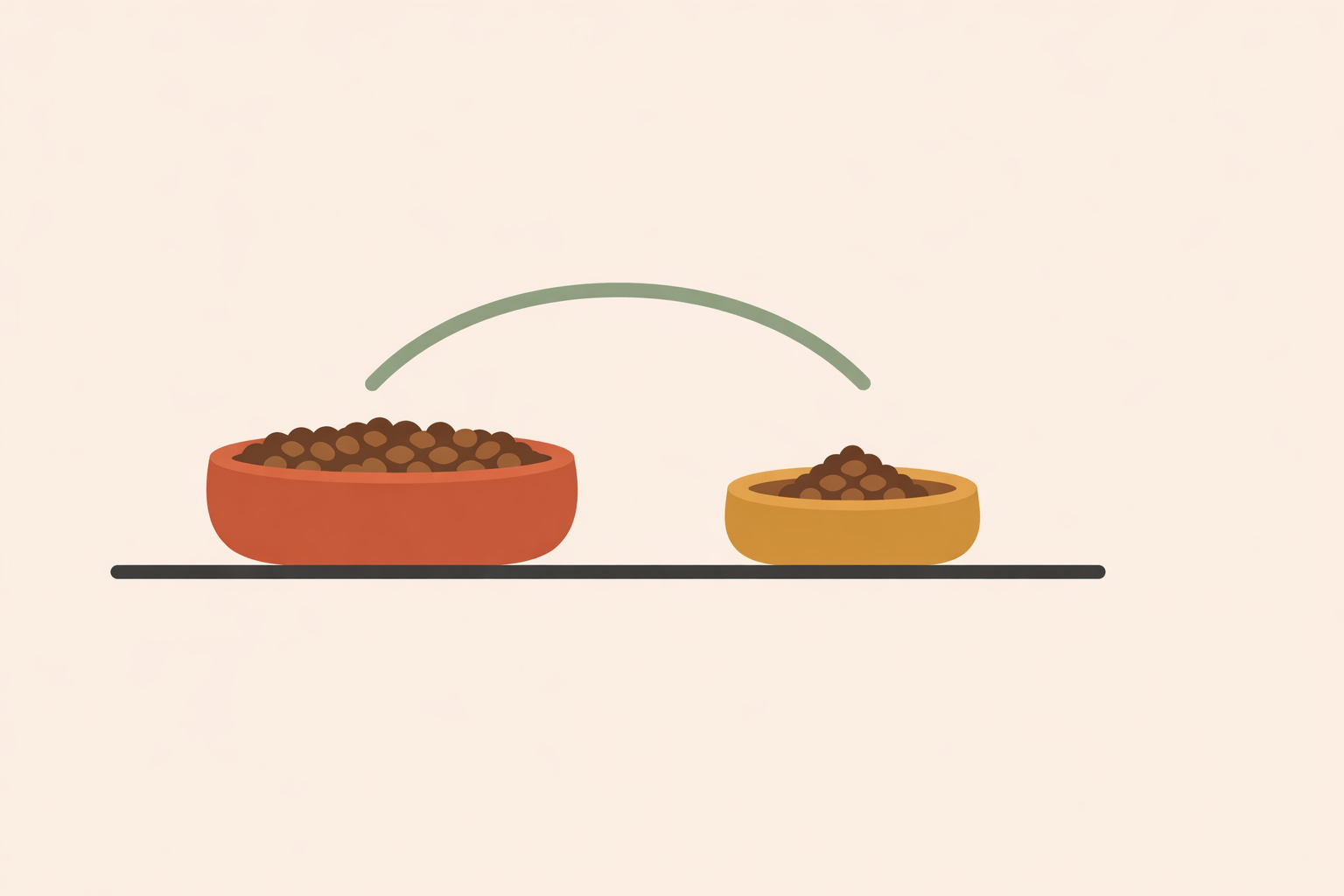
Measured free-choice means the full daily allowance is portioned once, then left available for the animal to eat across the day. Access stays flexible, while intake stays visible.
For some cats, this respects a natural rhythm. Research suggests small meals across the day and night are normal for domestic cats, and measured free-choice can align with that pattern.
It also helps that daily intake stays trackable when the full allowance is measured up front. That one habit turns “they just nibble” into something you can actually observe.
Some dogs and cats do well with this approach and maintain appropriate body condition. Others need more structure. The animal’s body and behavior make the answer clear over time.
Measured free-choice can also suit homes with variable schedules, cats who genuinely prefer grazing, or households where strict meal times create friction. In those cases, the best plan is the one people can carry out consistently.
How to shift from an always-full bowl to measured free-choice
If a guardian likes leaving food out, you don’t need an abrupt philosophical shift. Often, you only need to make the current habit measurable.
Try: “Let’s keep the easy access your animal enjoys and make it easier to track.”
- Agree on the daily portion.
- Measure the full amount once in the morning.
- Offer it in a bowl, slow feeder, or foraging setup.
- Check what remains at one or two set times.
- Review body condition and appetite pattern over the next couple of weeks.
This approach fits real life. It preserves convenience while closing the information gap.
Some guardians respond well to a short phrase like: “Open access, closed loop.” Food can stay available, but the measurement loop stays intact.
Where free feeding becomes harder
Free-choice feeding has limits, especially when food disappears without anyone clearly seeing who ate what or how much.
In multi-animal homes, it can blur individual intake. That makes subtle changes harder to spot, whether it’s a quieter animal eating less or a confident eater taking more than their share.
Weight drift is the other major issue. Guidance notes that becoming obese is common when many adult dogs have free access without limits. In cats, free feeding can also make weight management more difficult.
That doesn’t make free feeding “wrong.” It means it works best as a conditional tool, used when the household can track it and the animal stays steady.
How to explain the trade-offs to guardians
When guardians prefer free access, it helps to stay balanced and practical. The aim is conscious choice, not winning a debate.
You might say:
- “If your cat prefers to graze, we can work with that pattern.”
- “We’ll move from topping up the bowl to measuring the full day’s amount once.”
- “If body condition stays steady, that tells us the system may be working.”
- “If intake climbs or body condition drifts, we’ll switch to more structure.”
This framing keeps free feeding as a method, not an identity. It also makes future changes feel like normal follow-through rather than a reversal.
Signs it may be time to change course
Even when measured free-choice starts well, it deserves regular review. A system that once suited the animal may stop fitting later.
Early signs it may be time to adjust include:
- Body condition starting to drift
- New gorging or guarding behavior
- Noticeably higher daily consumption
- Less interest in play or movement
- Difficulty telling which animal ate what
These don’t need to be dramatic to matter. A small shift is enough reason to tighten the plan with timed meals, clearer measuring, separate feeding areas, or enrichment that slows the pace and adds engagement.
A useful rule is: free-choice feeding stays in place only while body condition remains stable and the daily amount stays measurable.
Closing perspective
Free feeding versus scheduled feeding is best approached as a living system, not a moral divide. Some animals truly do well with grazing when the daily amount is measured and body condition is watched. Others do better with structured meals, puzzle feeding, or a mixed routine that blends steadiness with flexibility.
From a traditional, animal-centered perspective, it makes sense to respect natural tendencies while staying grounded in observation. Some animals settle with ritual; others prefer several small eating sessions. What matters is choosing the method the animal’s body confirms over time.
As a final note, if appetite changes suddenly, weight shifts quickly, or guarding becomes intense, it’s wise to pause and get qualified support. Most of the time, though, when the conversation stays kind, measurable, and adaptable, guardians feel supported rather than judged. That’s usually where the best feeding decisions begin.
Advance with Animal Nutrition Certification
Build practical feeding plans and assessment skills with the Animal Nutrition Certification.
Explore Animal Nutrition →