Practitioners who work with mushrooms often see the same pattern: people chase peak experiences while the basics quietly slip. In those moments, the most helpful support usually isn’t more information. It’s language that helps someone organize behavior, pace change, and reflect in ways they can actually sustain.
Fungal biology gives unusually practical images for this kind of work. When the metaphors stay biologically grounded, they help clients strengthen foundations, make change in small steps, process what’s surfacing, separate temporary highs from deeper patterns, and shape healthier support around them. The goal is steadier practice that repeats well in real life.
Key Takeaway: Fungal metaphors can be practical coaching tools when they stay biologically grounded. Mycelium helps clients strengthen hidden foundations; hyphae reframes change as small, responsive experiments; decomposers model how to process experience before integrating it; mushrooms versus roots helps distinguish moods from habits; and mycorrhizal networks offer a clear image for consent-based support, reciprocity, and boundaries.
Mycelium: the hidden infrastructure behind visible change
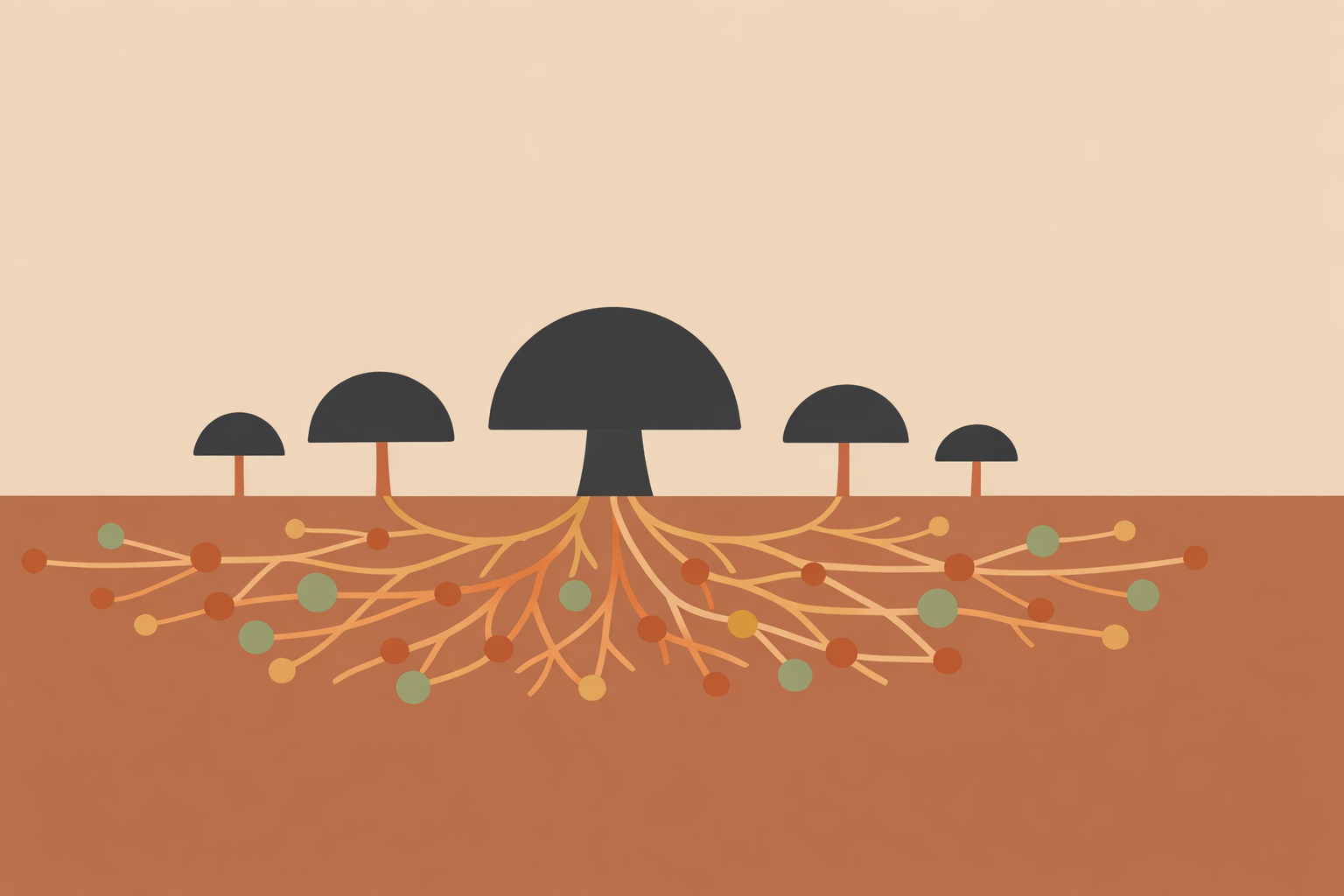
When a client wants results without structure, start with mycelium. In fungal life, the mushroom is the visible moment; the ongoing organism is the web beneath it.
That maps cleanly onto everyday foundations: sleep rhythm, nourishing meals, movement, breathing space, reflection, and consistent supportive rituals. They’re easy to dismiss because they aren’t dramatic, yet they’re often what keeps everything else alive.
In forests, fungi and plants often form exchanges where water and minerals move through the partnership while sugars flow back to the fungus. A client’s version can be beautifully ordinary: a filled water bottle by the desk, an evening wind-down, a prepped breakfast, or a weekly friend check-in. Small supports create continuity.
Healthy networks also don’t hinge on one heroic habit. Several modest habits reinforce each other, and that “quiet stacking” is often what holds under pressure.
How to use this in session: ask, “What is your mycelium right now?” Then map the hidden supports that make their week work.
- One sleep anchor
- One food anchor
- One movement anchor
- One reflection anchor
- One relational anchor
Then ask: “On a hard day, which one keeps the others from collapsing?” That usually reveals the true foundation.
Simple weekly plan:
- 10-minute evening ritual
- 8-minute morning reset
- Two brief check-ins with a supportive person
- One mushroom ritual, if appropriate, used consistently rather than sporadically
Mycelium is honest. It’s not magic; it’s infrastructure, and that’s why it works so well as a coaching frame.
Hyphae: changing through small, responsive experiments
Once foundations are visible, pacing comes next. Fungi don’t transform an environment all at once. They grow through hyphae: fine threads that extend gradually, respond to conditions, and adjust direction as they go.
This is a strong fit for clients who default to all-or-nothing change. Growth becomes one small probe into the unknown, followed by observation and adjustment.
In long-form traditional practice, this is familiar territory: consistent small steps build trust, and trust makes bigger steps possible.
Change works well when it stays exploratory. A person tries one manageable action, notices what creates openness or resistance, then decides whether to continue, pause, or redirect.
Useful script: “We’ll grow like hyphae. One small move, then we read the environment.”
Examples of hyphal experiments:
- Decline one nonessential request this week
- Delay a reactive reply by two hours
- Step outside for three minutes before a difficult conversation
- Replace one late-night scroll with tea and quiet
If a client wants a modern rationale for repetition, connect it lightly to brain change: repeated practice strengthens what gets used most, and neural circuits are shaped in part by activity-dependent signals such as BDNF.
Slow is often the speed that holds.
Decomposers: processing experience before integrating it
When old stress, grief, or identity material starts surfacing, decomposer fungi offer a grounded image. They show that transformation begins with breaking things down and sorting what’s useful.
Many fungi are primary decomposers of wood and leaf litter, returning complex material to the wider cycle of life. They do this by secreting enzymes into their surroundings and then absorbing what becomes usable.
That pattern translates neatly into reflective practice. Before someone turns an experience into a conclusion about who they are, they can externalize it: write it down, speak it aloud, walk with it. Give the body-mind space to meet the material with perspective.
In practical terms, this can look like:
- Journal before analyzing
- Move before overthinking
- Name the feeling before building a story around it
- Pause before deciding what the experience means
This is also where ritual earns its place. A warm drink, a notebook, a familiar chair, or a slow evening tea can signal that it’s time to soften and sort.
Traditions around lingzhi have long emphasized steadiness, reflection, and resilient vitality. Used respectfully, that cultural story can set a tone for practice when approached with humility rather than appropriation.
A 20-minute emotional composting ritual:
- Name the “log” you are working with
- Walk briskly for five minutes
- Write freely for ten minutes
- Sit quietly and notice what still feels true
Ecology adds one more useful image: some fungi contribute to pollutant transformation in damaged environments. As metaphor, that reminds clients that heavy material can be worked with gradually until it becomes usable wisdom rather than raw burden.
The invitation stays clear: compost the story before you keep any part of it.
Mushrooms and roots: distinguishing moods from deeper patterns
Clients often mistake a temporary state for lasting transformation. This is where the mushroom and mycelium distinction becomes especially useful.
A mushroom can appear suddenly and disappear quickly. The underlying organism takes time to build. In human terms, a surge of motivation, clarity, or emotional lightness can be real and meaningful, but it still needs roots to last.
This helps clients enjoy good days without becoming dependent on them. The visible “fruit” matters, and it also points back to deeper conditions: rest, rhythm, repetition, nourishment, and meaningful practice.
You can frame it like this:
- Mood is the mushroom
- Habit is the mycelium
- Environment is the forest floor
From there, it becomes natural to talk about tending a “brain garden,” a useful frame in plant medicine conversations. The client shifts from chasing states to cultivating conditions that support steadiness and learning.
Lion’s Mane is often paired with learning and cognitive support because its research story overlaps with neuroplasticity. Work on Hericium erinaceus has linked it with neurite outgrowth in preclinical research, and NGF is a growth factor associated with neuronal health.
More broadly, mushroom β-glucans are often discussed in relation to gut and immune balance, which can influence resilience and mood through the gut-brain axis. That gives a grounded way to talk about daily support while staying within appropriate scope.
A simple six-week brain garden plan:
- Week 1: anchor sleep and morning light
- Week 2: add a short daily learning ritual
- Week 3: include movement and hydration support
- Week 4: reduce one recurring stressor
- Week 5: revisit emotional composting
- Week 6: pause new inputs and notice what is stabilizing
Useful line: “Today’s mood is a mushroom. Let’s check the roots.”
It keeps attention on what endures.
Mycorrhizal networks: support, reciprocity, and consent
The final metaphor widens the frame from the individual to their ecosystem. In many landscapes, fungi form mycorrhizal partnerships with plants, exchanging resources in ways that support the wider web of life.
Biologically, these partnerships involve water and mineral nutrients moving toward the plant in exchange for carbohydrates. Some fungi also form host-specific relationships with particular plant partners, which is a useful reminder that not every connection fits every season of life.
As a coaching metaphor, it helps clients look at support systems with nuance. Some relationships are reciprocal. Some are neutral. Some drain energy without offering much back. Naming that clearly can bring real relief.
This metaphor is strongest when paired with consent. Healthy support relies on clear choice, clear exchange, and mutual respect.
Try this ecosystem mapping exercise:
- Place the client at the center
- Name three relationships or practices that genuinely nourish
- Name two that are functional but limited
- Name one that regularly depletes
- For each: define one ask, one offer, or one boundary
Examples:
- “Can we keep our weekly walk?”
- “I can help, but not at night.”
- “I need more notice before I commit.”
This keeps the language kind, memorable, and behavioral, so the metaphor stays grounded.
Where mushroom products are part of the conversation, keep the framing simple and scope-appropriate. In many regions, these products are positioned as foods or supplements rather than medicines, which fits best as a lifestyle support discussion.
Using fungal metaphors well
These images work best when used with precision. They should clarify practice and create steadiness, not inflate expectations.
It also helps to remember that fungal life still holds plenty of mystery. Much remains undiscovered about the fungal kingdom, and that ongoing discovery is part of what makes these patterns so rich for reflection.
If you want a simple way to choose the right metaphor, use this sequence:
- Mycelium when foundations are weak
- Hyphae when change needs to become smaller and safer
- Decomposers when something old needs processing
- Mushrooms versus roots when a client is overly attached to temporary highs
- Mycorrhizal networks when support, reciprocity, or boundaries need attention
Across traditional lineages and modern practice alike, mushrooms invite a different pace of attention: steady, relational, observant of what’s happening beneath the surface. Used with care, these metaphors help clients build foundations first, grow through small extensions, process what’s ready to shift, and choose support that stays respectful and mutual.
As a final note, keep these tools in their proper role: they support coaching conversations, not clinical care. And because people’s histories and sensitivities vary, go gently with intensity, encourage consistency over bursts, and invite clients to seek appropriately qualified help when experiences feel overwhelming or unsafe.
Explore Medicinal Mushrooms Foundations
Deepen your biologically grounded practice with the Foundations of Medicinal Mushrooms Certification.
Explore Foundations of Medicinal Mushrooms →