Owner-builders and natural design teams often face the same early decision: which arch will carry the roof? In a bermed or earth-sheltered vault house, that choice isn’t just aesthetic. Arch geometry sets wall demands and influences how backfilling stages should unfold. Choose a profile that doesn’t match your walls, materials, or site water, and you may end up chasing spreading supports, diagonal cracking, or last-minute “extra structure” to calm the thrust.
Choose well, and everything gets simpler: clearer centering, more predictable force flow, and a shell that works with the earth rather than resisting it.
Key Takeaway: Roman and pointed vaults can both succeed in small earth-sheltered homes, but they load walls differently. Round barrels often demand more lateral restraint and mass, while pointed profiles reduce outward thrust and can suit leaner supports. Regardless of form, drainage, even backfill sequencing, and stable springings decide long-term performance.
How a Roman barrel vault behaves
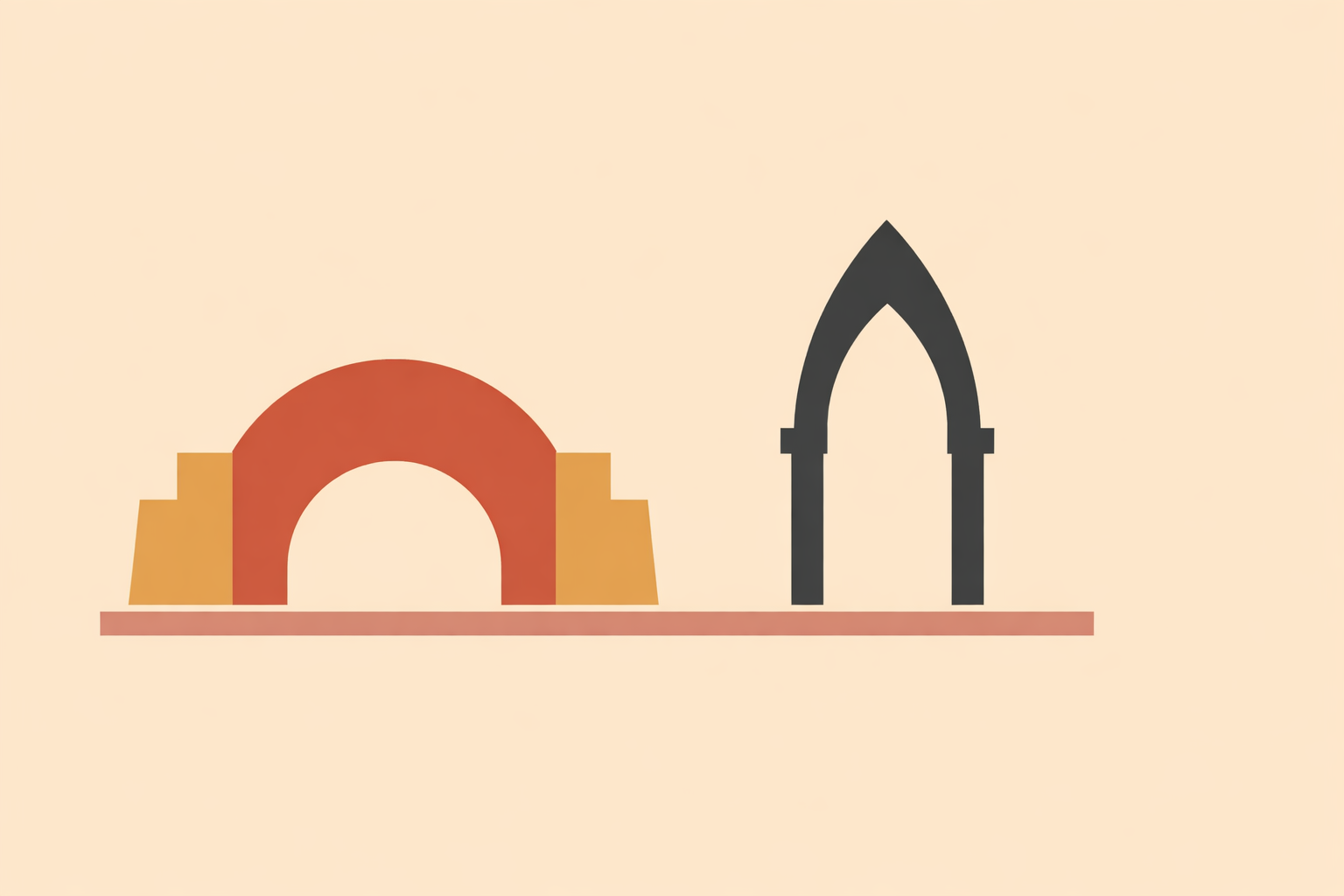
A Roman barrel vault is straightforward, familiar, and deeply rooted in traditional building. It excels in compression, and it also produces horizontal thrust at its springings—especially once earth cover is added.
Put simply: a semicircular vault wants to press outward as well as downward. That’s not a flaw; it’s the form doing what it does. Historically, builders answered with thick walls, buttresses, adjacent vaults, ties, or generous mass at the base. Earth-sheltered work follows the same logic—Roman barrels usually need berms, buttresses, ties, or thicker walls to keep that outward push settled.
“We’re thinking long and narrow… then a brick barrel vault as the roof from end to end.”
The appeal is easy to understand: a round profile is simple to set out, simple to visualize, and often more tolerant of minor imperfections. When you can commit to mass and continuous support, it’s one of the most intuitive vaults to build.
Where it shines: the Roman barrel is often the better fit when you can commit to generous walls, full berm support, and a clear, legible build sequence.
How a pointed vault changes the load path
A pointed vault follows the same compression-based logic, but it redirects more load downward. Compared with a semicircular arch of the same span, pointed arches typically create less sideways push at the supports.
Here’s why that matters: lower thrust can mean leaner walls, less dependence on heavy buttressing, and more freedom when wall mass is limited. Many pointed vaults also create more height for the same span, which changes both structure and lived-in spaciousness.
“With expert guidance… they’ve used medieval tools and techniques to create the wooden centering that would have been used to build a rib vault in the Middle Ages.”
Traditional builders leaned on pointed forms for good reason: the geometry often tracks the natural force path more closely under vertical load, keeping compression organized and reducing the risk of tension. That’s especially helpful when materials are modest, walls are slimmer, or spans begin to stretch.
Where it shines: pointed vaults often outperform round ones when you want lower thrust, more height, or a form that asks less of the supporting walls.
What actually makes a vault house strong
Whatever profile you choose, vault strength comes down to three essentials: keep the shell in compression, keep the supports from moving, and treat soil as a structural partner from day one.
First, the shell wants the thrust line in compression. Essentially, when that line stays within the body of the vault, the structure feels calm and settled. When it drifts outside the safe zone, cracking occurs—often near the crown, haunches, or springings.
Second, supports must stay put. A common failure pattern in small vaults is outward creep at the feet. Builders often say an arch “wants to walk,” and it’s a useful image: once the feet move, the shape changes, and cracks tend to follow.
Third, buried vaults must be built with soil behavior in mind. Asymmetric loading can skew the thrust path whether the arch is round or pointed. Uneven berming or rushed backfill can undo an otherwise sound form.
“Of course the vault has to stand once built although there is often movement over time,” writes structural historian Santiago Huerta.
That’s a grounded way to think about earth-sheltered vaults. Some movement and settlement can be part of the life of the structure—what matters is that the geometry stays composed and the forces remain comfortably in compression.
When a Roman barrel vault is the better choice
If your project can carry mass—berms, thick walls, and continuous lateral support—the Roman barrel is often the strongest practical choice.
It’s also an excellent fit when you want a build that’s easy to “read” on site. Semicircular barrels are simple to lay out, simple to center, and easy to judge visually, which can be a real advantage for owner-builders and small crews.
They pair naturally with earth buttressing. In earth-sheltered work, surrounding soil can become structural support once the walls are properly braced and backfill is handled with care. Many builders find round forms especially forgiving when that support is continuous and well-compacted.
There’s also a piece of practical, traditional wisdom here: round barrels often tolerate rougher workmanship better than sharper, more exacting profiles. They ask for restraint and mass more than fine precision.
Water, however, changes everything. “The moment you start burying a structure… Most failures I see come from underestimating water,” cautions a veteran advisor.
In the field, that’s often the turning point. Many structural and comfort issues begin with moisture, drainage mistakes, and saturated soil loading the shell in ways it was never meant to carry.
When water is handled well, the payoff is substantial: the surrounding earth can act as a thermal battery, smoothing indoor temperature swings as the mass settles into a seasonal rhythm.
- Choose a Roman barrel when: you have generous wall mass, continuous berming, and space for buttressing.
- It suits: straightforward layouts, owner-built work, and crews that benefit from visual simplicity.
- It asks for: restraint at the springings, careful water control, and disciplined backfill.
When a pointed vault is the stronger choice
If wall mass is limited, materials are weaker, or buttressing will be modest, a pointed vault often gives a better structural answer.
The core advantage is straightforward: higher-rise profiles generally reduce horizontal thrust at the supports. Less outward push means less burden on the walls—and less need to solve everything with thickness.
Many pointed forms sit closer to the natural funicular curve under vertical loading. Think of it like a hanging chain flipped upside down: it naturally finds a shape that carries load mainly through compression. For lower-strength masonry or lightly stabilized earth blocks, near-pure compression is a major advantage.
In living building traditions, pointed and Nubian-style vaults are often favored for longer spans when heavy buttressing isn’t available. They’re also a strong choice when you want a taller interior without needing dramatically thicker side walls.
“It’s an incredibly efficient way to roof a space with minimal timber,” as one master carpenter notes.
- Choose a pointed vault when: you need leaner walls, reduced thrust, or more height for the same span.
- It suits: lighter materials, longer spans, and sites where full buttressing is difficult.
- It asks for: careful geometry, good centering, and attention to load symmetry.
In practice, water and backfill decide more than style
When people ask which arch makes the stronger Hobbit-style vault house, the most useful answer is: geometry matters, but drainage, backfill sequencing, and restraint usually matter more.
Water is the first priority in buried construction. High water tables, trapped runoff, and poor drainage can create serious structural and comfort problems long before the arch form itself is truly tested.
Next is backfill. The shell should be loaded gradually and as evenly as possible. Uneven or rushed loading can distort the force path and trigger cracking even in a well-proportioned arch. In earth-sheltered work, soil isn’t just insulation—it’s a live, shifting partner.
Finally, supports must be restrained. If you don’t want to rely entirely on thick walls or full berming, ties or ring beams at the springings can significantly reduce outward thrust. It’s one of the simplest ways to give a traditional form more calm and margin.
Modern reinforced shells can behave very differently, with little lateral thrust by comparison. Still, for small owner-built earth-sheltered homes, the old lessons remain dependable: respect water, stage the backfill, and stop the feet from spreading.
- If you have mass and full berm support: favor the Roman barrel.
- If you need lower thrust and leaner walls: favor a pointed or catenary-leaning profile.
- In all cases: prioritize drainage, mirrored backfill lifts, and restraint at the springings.
Do that, and the choice becomes less about Roman versus Gothic and more about fit. The Roman barrel offers strength through mass and continuity. The pointed vault offers strength through geometry and reduced sideways push. Both are time-tested, deeply intelligent forms—and with good water control and disciplined backfill, either can serve as a trustworthy shell for the long term.
Build Better Vaults
Apply these geometry, restraint, and backfill principles with step-by-step guidance in the Hobbit Vault Course.
Explore the Hobbit Vault Course →