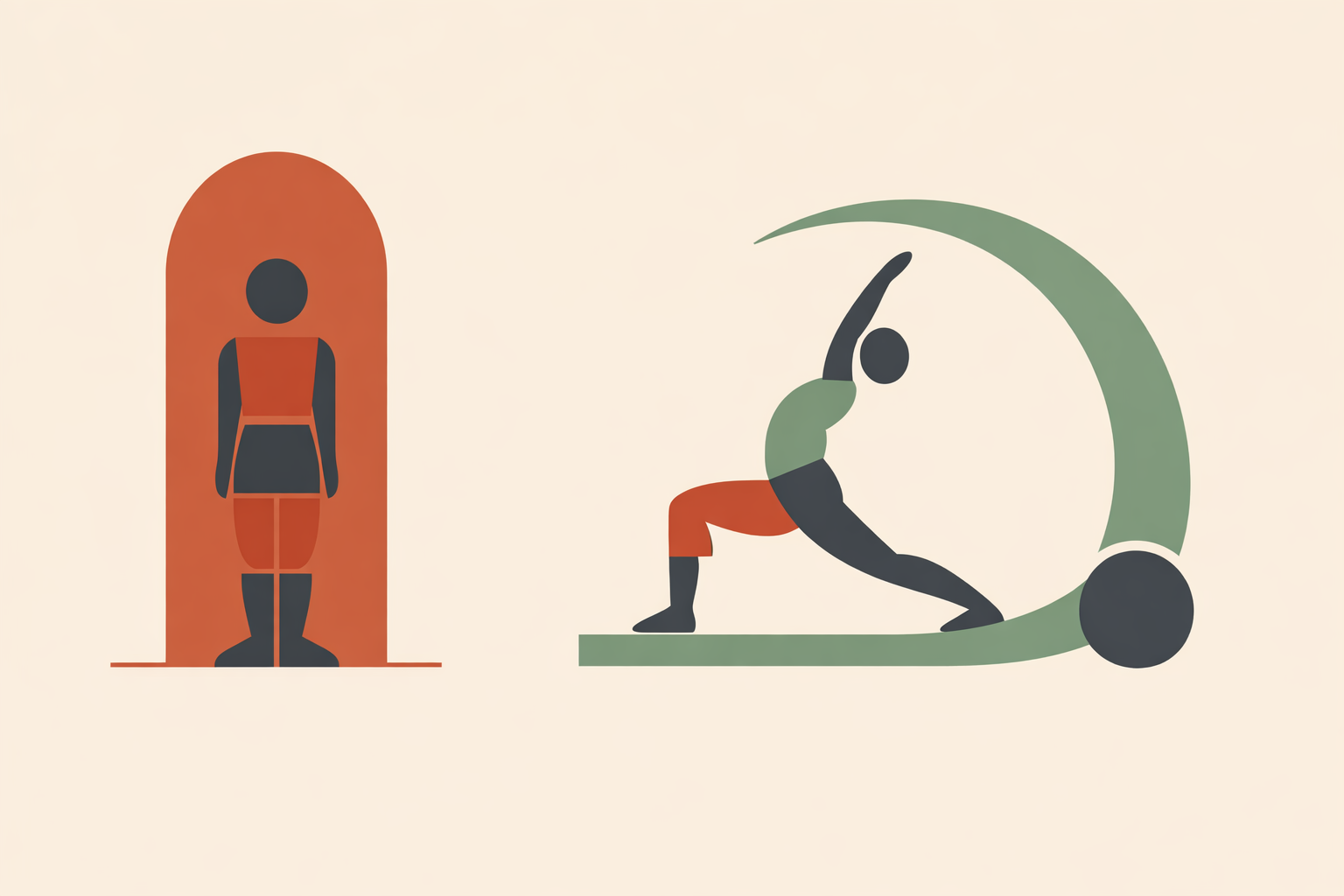
Most yoga teachers recognize the moment: you arrive with a plan, and then the room arrives with its own weather. One group is overstimulated and scattered. Another is low and heavy. Another is packed mat-to-mat and needs clarity more than creativity. In that moment, the real choice isn’t Hatha versus Vinyasa as fixed camps—it’s whether the room needs steadiness through holds or energy through linked transitions.
That decision shapes attention, pacing, accessibility, and physical load. It changes how you cue, where students reset, how easy the class is to follow, and whether newer students feel supported or swept along. Used well, both approaches belong in a thoughtful teacher’s toolkit.
Key Takeaway: Choose Hatha or Vinyasa based on what the room needs: steadiness and skill-building through slower holds, or rhythm and heat through breath-linked transitions. The right emphasis affects cue timing, reset points, accessibility, and how physical load accumulates across wrists, shoulders, and stamina.
Class structure: modular Hatha and flowing Vinyasa
Hatha often feels modular, like clear building blocks. Vinyasa often feels like a journey with fewer stops. That “architecture” matters, because structure is how students stay oriented—especially in mixed-level rooms.
Many Hatha classes move in straightforward sections: warm-up, standing work, balance, seated shapes, supine work, rest. A teacher may explore a small family of postures, then return to Tadasana (or another neutral position) before moving on. Those frequent resets make progression easier to track and easier to scale.
Vinyasa usually relies on longer movement chains. The sequencing often revolves around sun salutations, with Downward-Facing Dog as a familiar home base students return to as the choreography builds. Think of it like returning to a chorus in a song: it helps everyone rejoin the rhythm even as the verses change.
In busy rooms, predictable pathways quietly prevent confusion and collisions. Naming a clear reset point—Down Dog, Tadasana, or even a brief supine pause—can make a class feel more accessible without lowering the skillfulness of the work.
- Hatha skeleton: short posture families, neutral reset, next family, rest.
- Vinyasa skeleton: sun-salutation spine, variations and peak shapes, return to a familiar base.
- Teaching tip: name your reset points clearly and use them consistently.
Breath and attention: stillness in Hatha, rhythm in Vinyasa
Both Hatha and Vinyasa work with breath, but through different doors. Hatha often treats breath as a distinct practice. Vinyasa weaves breath into movement so completely that breath becomes the metronome.
Traditionally, Hatha uses posture and breathing techniques to prepare the body-mind for deeper contemplative work. In many modern Hatha classes, pranayama is still taught explicitly at the beginning or end, giving students a clean container to feel the breath without also managing choreography.
Vinyasa is built on breath-linked motion; when it’s coherent, it can become meditation in motion. The inhale opens or lifts, the exhale grounds or folds—attention trains itself by staying present through change.
For newer students, simpler breath patterns are usually more supportive than elaborate “breath maps,” much as in beginner cueing. What this means is: if coordination gets too complex, students stop feeling the rhythm and start chasing it.
I keep Niki’s reminder close: “Signs of an authentic yoga teacher training include equal emphasis on philosophy, pranayama, and meditation—not just physical practice,” a call to re-center breath as a living thread in our classes and in service to others.
- In Hatha, try 3 to 5 minutes of seated breath practice before standing work.
- In Vinyasa, keep one breath pattern consistent across several rounds before adding variation.
- If students look strained, simplify the breath map before simplifying the poses.
Teaching methodology and cueing style
Hatha gives you more time to teach. Vinyasa asks you to teach in time. That single difference changes everything about methodology and cueing.
In Hatha, slower pacing leaves room for demonstration, prop setup, observation, and detailed verbal guidance. You can offer one clear action, pause, and let students feel it. That makes Hatha an excellent environment for building alignment literacy—students learn what a posture is asking and how to respond.
In Vinyasa, cues must land while bodies are moving. Language often needs to be shorter, cleaner, and placed with good timing. Essentially, you’re cueing the next moment before it arrives—then stepping back so students can breathe and move.
Consistency becomes your best ally. When you repeat cue structures (name the shape, then give the key action), students learn your rhythm and feel less lost in the flow.
And it’s worth keeping Sage Rountree’s line close: “Confidence doesn’t come from a certificate—it comes from experience.” The answer is simple: consistent teaching experience.
- Hatha cue example: “Tadasana. Root through the heels. Soften the ribs. Inhale, lengthen through the crown.”
- Vinyasa cue example: “Inhale, half lift. Exhale, fold. Inhale, step back to plank. Exhale, lower with choice.”
- Teaching tip: in flow classes, repeat cue structures so students learn your rhythm.
Physical load and accessibility in real classrooms
Hatha usually spreads physical load more gradually. Vinyasa often concentrates load inside repeated transitions. In real classrooms, that’s often the difference that students feel most—especially across wrists, shoulders, and stamina.
In mixed-level groups, Hatha is often more accessible because slower pacing and longer holds allow time for props, chairs, wall support, and thoughtful adjustments. Vinyasa usually asks for more coordination and endurance, particularly when movement is continuous.
Repeated chaturanga-based transitions can stack a lot of demand on wrists, shoulders, and core—especially if students haven’t yet built the foundations. Step-throughs from Down Dog can be similar: when mobility is limited, compensation patterns appear quickly.
This doesn’t make flow “wrong.” It means flow thrives on options. Hands-free sequences, knees-down lowers, forearm variations, sphinx instead of stronger backbends, or standing-only rounds can keep continuity while respecting different bodies.
- Cap repeated high-load lowers instead of making every round identical.
- Offer a no-wrist pathway in every class.
- Teach step-throughs in parts before expecting smooth transitions.
- Rotate weekly emphasis to reduce overuse for both teachers and regular students.
What each style trains over time
Over time, Hatha and Vinyasa tend to cultivate different inner skills—even when the postures overlap.
Hatha emphasizes steadiness, introspection, and the capacity to stay with sensation without immediately changing it. Held shapes train patience and subtle listening: students learn to remain, refine, and notice what’s actually happening.
Vinyasa emphasizes adaptability, presence inside change, and resilience in motion. Students practice transitioning, recovering, reorienting, and continuing—skills that translate beautifully beyond the mat.
Traditional Hatha also carries a wider contemplative frame: posture is one strand in a larger discipline that includes breath, attention, and self-study. That bigger view remains deeply practical in modern teaching, because it keeps the practice connected to meaning.
That educational shift is well captured in Niki’s observation: “Equal emphasis on self-study (svadhyaya), ethics, and trauma-sensitive teaching is becoming a hallmark of newer yoga teacher certifications,” reflecting a move toward truly holistic formation.
- If your students need steadiness, lean toward holds, repetition, and quieter pacing.
- If they need adaptability, lean toward transitions, rhythmic sequencing, and thoughtful variation.
- If they need both, blend them deliberately rather than teaching by habit.
Professional pathways and teaching identity
For many teachers, Hatha builds the roots and Vinyasa grows the branches. It’s not a rule—but it’s a helpful way to think about skill development.
Hatha-first teaching often strengthens observation, pacing judgment, and alignment communication. With more stillness, newer teachers have more chances to truly see what students are doing and respond with care.
Vinyasa-heavy teaching often strengthens transition competence, sequencing fluency, and timing. You learn how one posture sets up the next, how effort accumulates, and how to keep momentum without sacrificing clarity.
Many lineages suggest starting with simpler structures because they teach you to see before they ask you to orchestrate. As that “seeing” matures, flow teaching tends to become cleaner, more inclusive, and less performative.
As your teaching evolves, continuing education is most helpful when it’s chosen with intention. Sage Rountree puts it plainly: “The key is to pursue further education intentionally, not just because you feel ‘not good enough’ without it.”
- Early-career strengths to build: clear pacing, simple sequences, strong observation, adaptable cueing.
- Later growth edges: theming, transition design, musicality, and sustainable programming.
- Always: self-practice, mentorship, and honest reflection on what your rooms actually need.
Bringing Hatha and Vinyasa together in one teaching toolkit
You don’t need to choose one style as your entire identity. In real teaching, the most supportive approach is often integrative—rooted in tradition, shaped by the room in front of you.
Use Hatha principles when students need steadiness, clarity, spaciousness, and time to learn. Use Vinyasa principles when they need rhythm, continuity, heat, and a stronger sense of movement. Let the group decide the emphasis, and let your sequencing serve that need.
Practically, that might look like starting with seated breath and slower standing holds, then introducing a short linked wave once the room feels organized. Or teaching a flow class with fewer chaturangas, more pauses, and clearly named reset points. You might even vary your week—one class upper-body light, another hip-focused, another balance-centered—to keep practice sustainable and alive.
In the end, pace is one of your strongest tools. Blend the steadiness of Hatha with the poetry of Vinyasa, and classes become easier to follow, more responsive to real bodies, and more nourishing over time.
As a final note: because Vinyasa can concentrate load through repeated transitions, and because slower pacing can sometimes tempt students to “hang” in joints, skilled options and clear foundations matter in both styles. When in doubt, simplify rhythm, offer pathways, and keep the focus on steady, respectful practice.
Ready to deepen your teaching foundation? Explore the Yoga Teacher Certification to strengthen your sequencing, cueing, and class-design skills in a way you can apply with real students.
Build Smarter Yoga Classes
Apply these Hatha and Vinyasa decisions with confidence in the Yoga Teacher Certification.
Explore the Certification →