Most health and well-being coaches still default to boosting motivation and setting ambitious goals. Sessions end with energy; weeks end with drift. Clients commit to 10,000 steps, batch-cooked lunches, or screens off by 9:30, then return saying the plan vanished on their busiest days.
What’s usually missing is a system that still works on low-energy Tuesdays, during travel, and when family rhythms or culture pull in a different direction. The work becomes less about bigger promises and more about designing actions that can survive real life.
Key Takeaway: Sustainable behavior change in health and wellness coaching comes from system-first design, not bigger goals or pep talks. Help clients choose a minimum viable action, anchor it to a clear cue, prepare a backup for disrupted days, and review progress without judgment. When accountability is autonomy-led and the plan fits real life, follow-through becomes far more workable.
System 1: Turn Broad Goals into Minimum Viable Actions
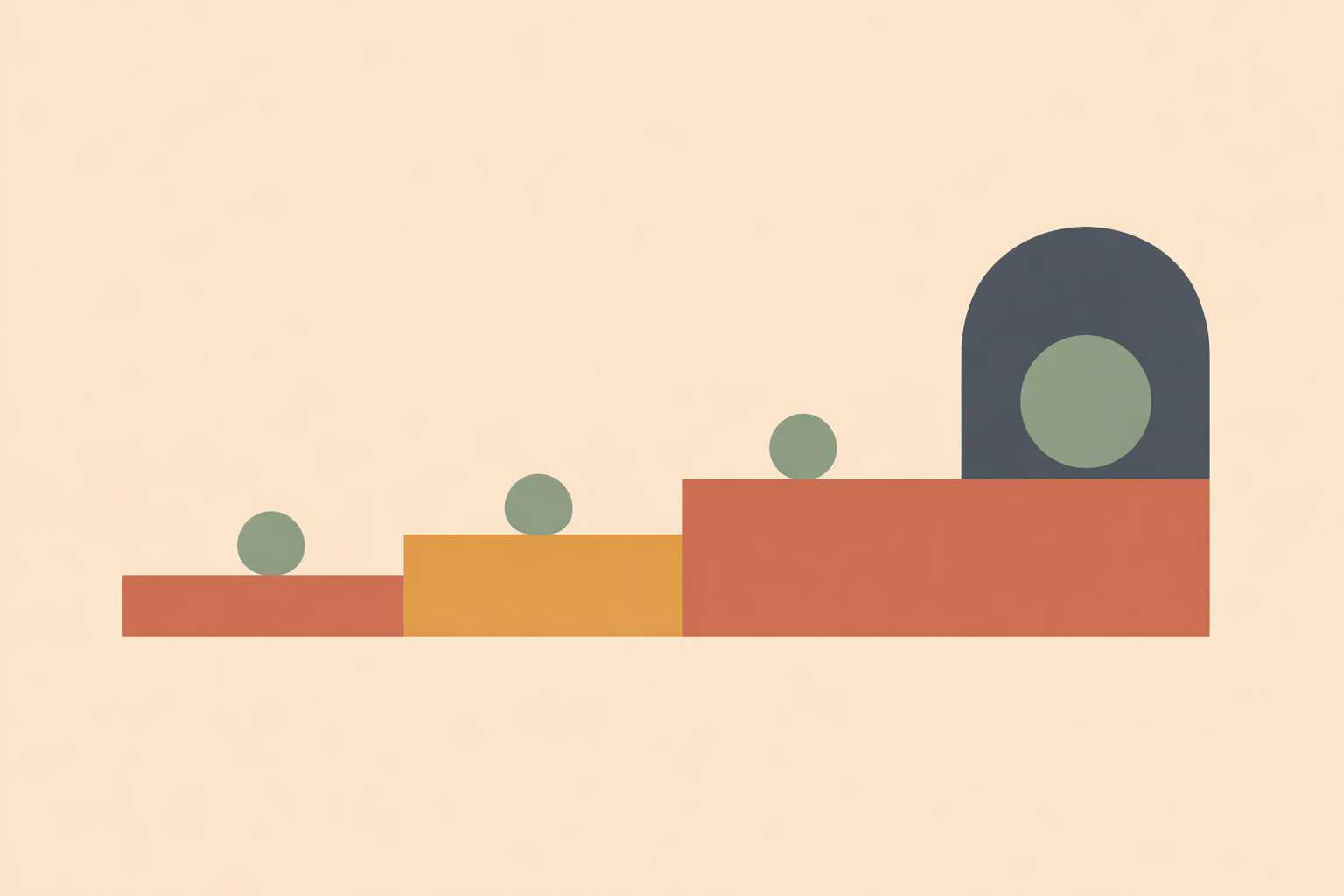
Clarity beats intensity. Follow-through improves fastest when a broad goal becomes one action the client can still do on a difficult day.
Instead of “I want to feel better,” co-create something visible and specific: “On Monday, Wednesday, and Friday, after I close my lunch container at work, I’ll walk outside for five minutes.” Now the action has a shape, a timing, and a cue.
A small action is a foothold. Many traditional practices are built on brief, repeated acts woven into everyday life: stepping outside at first light, pausing before a meal, stretching before rest. Modern habit research supports this same direction through implementation intentions that link a cue to a clear response.
How to Define the Smallest Useful Step
- Convert outcomes into behaviors: “prepare breakfast three mornings” or “turn devices off by 9:30 p.m. twice this week.”
- Make the action small enough to survive a low-energy day.
- Add a cue: after brushing teeth, after lunch, when the kettle clicks.
- Check that the plan fits the client’s real schedule and household rhythm.
A useful coaching prompt is: “On your hardest day, what is the smallest version that still counts?” It often lands as relief because it gives the client a starting point they can trust.
For example: “After dinner on Tuesday and Thursday, brew chamomile and sit without my phone for eight minutes. Cue: place the mug by the kettle after dishes.” It’s simple, visible, and realistic.
System 2: Use If-Then Plans for Disruptions
Once the action is clear, protect it. Life will interrupt, so strong plans assume disruption from the beginning.
Implementation intentions work by connecting a situation to a response ahead of time. When the cue appears, the decision is already made. Reviews of behavior change approaches support specific planning, especially when actions are concrete and tied to real situations.
Then add coping plans for predictable barriers like fatigue, travel, weather, or social pressure. A coaching study found obstacle strategies and recovery plans can help people restart more reliably after disruptions.
Plan for Obstacles Before They Happen
- Ask: When will this happen?
- Ask: What will remind you?
- Ask: Where will it happen?
- Ask: If this plan gets blocked, what is the next-best version?
A simple recovery sequence can help:
- Notice what happened.
- Name the barrier without blame.
- Choose the next available version of the action.
- Review what the moment taught.
For example, a client plans a walk after lunch while traveling. Their first if-then is: “If I’m at the airport at lunchtime, then I’ll walk the concourse for five minutes after eating.” If the gate area is crowded, they already have a backup: “If that’s not possible, then I’ll take the stairs for two minutes.”
Traditional rhythms guide this step beautifully. If a client’s family meal is late and social, the better plan may be a grounding breath practice before bed rather than forcing a routine that clashes with the household’s culture.
System 3: Keep Tracking Gentle and Useful
Tracking should support awareness, not create pressure. The aim is to make progress visible in a way the client can maintain.
Often, light self-monitoring is enough: a calendar tick, a one-line note, a brief energy rating. Reviews suggest behavior monitoring supports change best when it stays focused on actions within a person’s control.
That’s why “I walked after lunch on Monday and Wednesday” is usually more helpful than obsessing over distant outcomes that fluctuate for many reasons. It keeps review honest and kind, and it makes adjustment easier.
Simple Review Questions That Support Learning
- What did you intend to do?
- What actually happened?
- What helped?
- What got in the way?
- What will you adjust next?
This is where confidence often appears. Missed actions stop being proof of failure and start becoming design feedback. A note like “shift tracker from minutes walked to leaving the desk after lunch” can change the whole emotional tone of the plan.
System 4: Use Session Structure to End with One Doable Step
Presence matters, and structure helps presence become practical. Frameworks such as GROW or FUEL can help sessions move from reflection to a clear next action, much like a dependable session architecture.
Used well, these models create a steady rhythm: reconnect, review the last experiment, name what was learned, clarify today’s focus, explore options, choose one action, and prepare for obstacles. The structure can feel natural and conversational while still keeping things grounded.
What matters most is that the session ends with one step the client genuinely owns. Not a long list. One action, chosen with honesty.
From Insight to Action in the Session
- Ask what would make the change worthwhile now.
- Ask what is truly within the client’s influence this week.
- Ask what would make the action 10% easier.
- Listen for “I have to” versus “I choose to.”
For example, a client brings a vague wish to “sleep better.” By the end of the session, this becomes: “At 9:30 p.m., after I close my laptop, I’ll dim the lights and stretch for ten minutes.” Then it becomes even more grounded: “Tonight I’ll place the lamp by the sofa and set a 9:25 reminder.”
That is the difference between insight and follow-through.
System 5: Build Trust, Choice, and Cultural Fit into Accountability
Follow-through improves when clients feel safe enough to tell the truth about what did and didn’t happen. Honesty grows in relationships that feel respectful, steady, and non-judgmental.
Reviews of supportive behavior-change conversations highlight the importance of psychological safety for openness. In coaching practice, that means missed actions can be explored as information rather than turned into shame.
Accountability also works best when it’s chosen. People engage more steadily when action feels self-directed, and research on motivation supports autonomous motivation in sustaining health-related behaviors.
Clear agreements help too: roles, boundaries, confidentiality, scheduling, fees, and how coaching differs from other forms of support. When expectations are clear, progress becomes easier to discuss with maturity and calm.
Design Support Around Real Life
- Check household rhythms and responsibilities.
- Ask who else may be affected by the plan.
- Do not assume one family structure, routine, or income level.
- Respect cultural and traditional practices as part of the design.
If a client keeps a weekly rest day, fasts at certain times, or cooks in ways rooted in family tradition, the plan should work with those realities, not against them. A good system feels supportive inside the client’s actual life.
For one person, accountability may be a Friday text check-in. For another, it may be a private tracker or a short reflection before the next session. The best format is the one the client will genuinely use.
System 6: Bring It Together on One Page
A one-page plan reduces overwhelm by keeping the whole system visible at once. It doesn’t need to be formal; it needs to be clear.
- Desired direction and why it matters now
- One behavior for the next seven days
- Exact cue and timing
- A full version, a reduced version, and a recovery version
- The most likely obstacle
- An if-then response
- The chosen tracking method
- Any environmental or social support
- The review date
- A simple ecological check
Example One-Page Follow-Through Plans
Calmer evenings
- Why now: “I want to feel more settled at night.”
- Action: “At 9:30 p.m., after closing the laptop, I’ll start a ten-minute wind-down.”
- Full version: dim lights, stretch, mint tea.
- Reduced version: five quiet minutes with low light.
- Recovery version: two slow exhales before bed.
- Obstacle: late messages.
- If-then: “If a late message arrives, I’ll add it to tomorrow’s list and return to winding down.”
- Tracking: star on wall calendar.
Everyday movement
- Action: “After lunch on Monday, Wednesday, and Friday, I’ll walk outdoors for ten minutes.”
- Obstacle: rain.
- If-then: “If it rains, I’ll do five minutes of indoor stairs.”
- Tracking: calendar tick and a brief energy rating.
Nourishment at work
- Action: “On Sunday and Wednesday after dinner, I’ll prepare two portable lunch options.”
- Obstacle: time squeeze.
- If-then: “If I run late, I’ll assemble one option the night before.”
- Ecological check: budget, storage, schedule, and shared fridge space at home.
From Experiments to Sustainable Routines
Lasting change is often quieter than people expect. It grows from a few steady moves: make the action specific, plan for disruption, and review what happened without judgment.
Progress rarely looks like perfection. It looks like recovering faster after a lapse, noticing patterns earlier, and keeping flexible versions of the same habit for different kinds of days.
This is where traditional wisdom and modern coaching structure meet naturally. A walk after a meal, a pause before eating, morning light, an evening stretch beside a kettle: ordinary acts become anchors when they’re repeated with care. The coach’s role is to help design the next true step, refine the system with the client, and keep it aligned with real capacity and cultural fit, whether in purpose and life design work or broader life coaching practice.
As always, encourage clients to work within their scope of support, adapt plans to their circumstances, and seek appropriate professional help for anything beyond coaching. When the system is realistic and respectful, follow-through becomes something clients can build steadily over time.
Advance Your Coaching Skills
Apply system-first behavior change with deeper practice in the Life Coaching Certification.
Explore Life Coaching Certification →