Many practitioners watch clients wrestle with the same knot over and over: tighten one habit, hold it for a week or two, then life reshuffles the deck. Toddler wake-ups, team norms, a late shift, or financial pressure turns a “simple plan” into a strain. When a challenge involves roles, tools, schedules, and expectations, linear fixes often miss the pattern that’s actually running the show.
Holistic life systems mapping offers a steadier way forward. You and the client co-create a simple sketch of the people, places, routines, communities, pressures, and resources surrounding one challenge. As the system becomes visible, the conversation shifts from self-blame to context, and from vague effort to small, workable adjustments that fit real life.
Key Takeaway: Holistic life systems mapping helps clients and practitioners make sense of complex, repeating challenges by visualizing the relationships, pressures, supports, and patterns surrounding them. Used well, it shifts the conversation from self-blame to context, reveals workable leverage points, and turns insight into small, testable experiments. The map is not a final answer; it is a living tool for reflection, choice, and steady progress.
Before you draw: consent, boundaries, and respectful setup
Start by creating a clear, respectful frame. Mapping can quickly surface family dynamics, social pressure, and sensitive history, so the container matters as much as the tool.
Agree on the purpose of the map, how long you’ll spend, and how you’ll use it. Make it explicit that the client can pause, skip, revise, or remove anything at any point.
Get specific consent before recording, photographing, or storing any version. A wise baseline is simple: no recording, no automated processing, and no sharing unless the client clearly opts in and understands what it means.
It also helps to clarify ownership early:
- Who keeps the original map?
- Will a photo or copy be sent?
- Will any version live in your digital systems?
- Can the client request deletion later?
Cultural humility belongs here too. Ask what family, language, faith, migration, land ties, class, disability, gender experience, or community expectations shape the client’s world. Avoid borrowing symbols or frames that don’t belong to the client’s context, and don’t flatten identity into a neat diagram.
A simple sentence can help: “We’ll sketch only what feels useful today. You can pass on anything, and you can change or erase anything as we go.”
Choose one clear focus before mapping
The most common mistake is trying to map everything. Better traction comes from choosing one clear focus the client genuinely cares about.
Instead of “my whole life feels messy,” help them land on one workable question, such as:
- What affects my ability to protect creative time?
- What supports or disrupts my transition into this new role?
- What shapes my energy on weekday afternoons?
- What helps this relationship feel steady, and what strains it?
A focused question keeps the map usable and makes later review easier, because the client can actually tell what shifted.
From there, gather the system with a broad first pass. Let the client list influences without organizing too quickly; the most important factors often appear after the obvious ones are already on the page.
You might ask about:
- people and relationships
- places and environments
- routines and responsibilities
- beliefs and expectations
- tools and technologies
- supports and pressures
- resources, costs, and constraints
A useful minimum map can stay modest: one client-defined outcome, a manageable set of elements, arrows showing influence, a simple legend, at least one layer of context, and one likely leverage point beginning to emerge.
Build the map visually: center, layers, and flows
Once the raw material is on the table, turn it into a picture. Keep the visual language light so the map supports the conversation rather than stealing it.
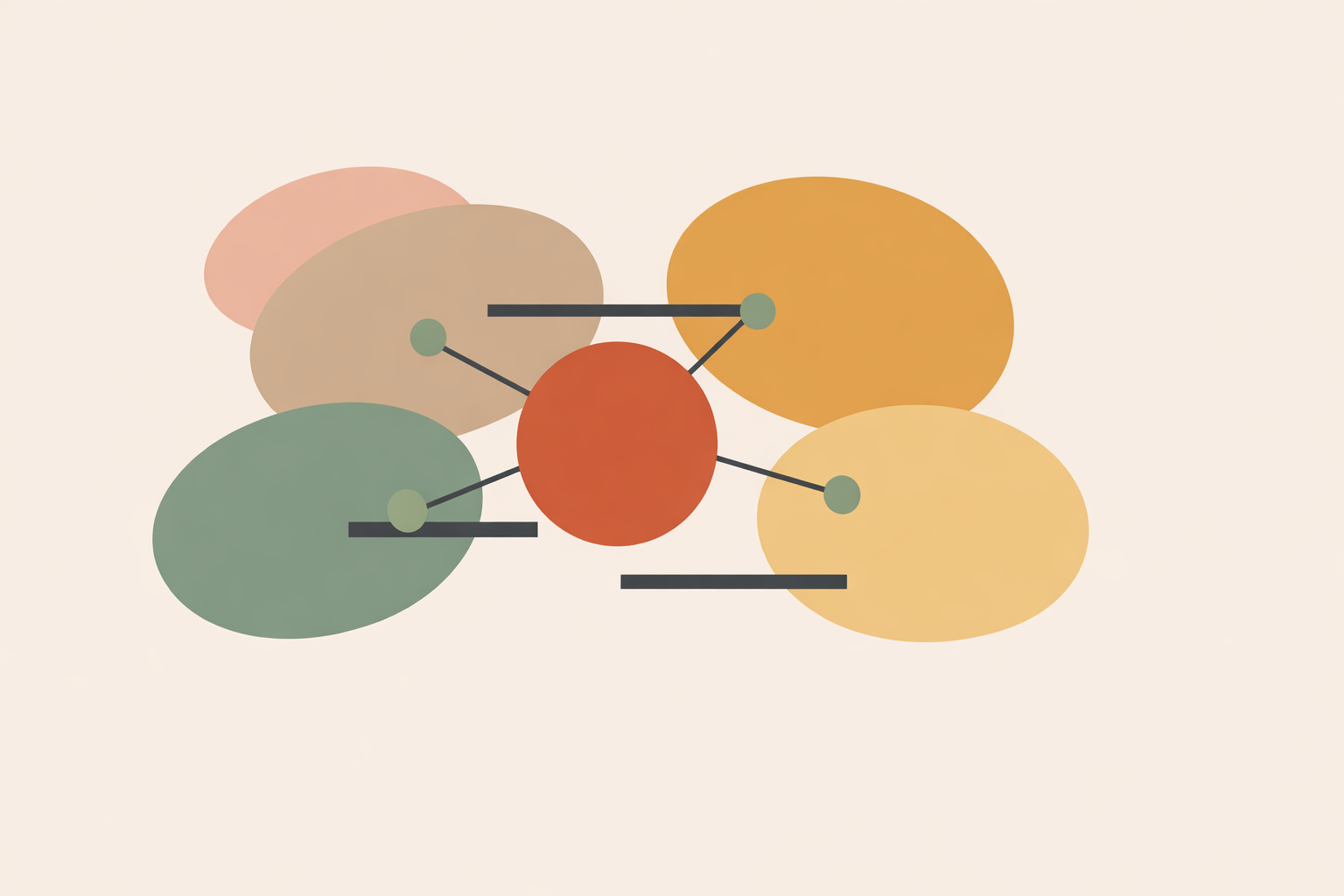
Place the client, or the chosen focus, at the center. Then organize surrounding elements in layers. Ring-based maps work well because concentric circles can show influences at different distances from the center.
A simple layered structure might look like this:
- inner layer: immediate routines, close relationships, daily spaces, key habits
- middle layer: workplace, school, peer groups, recurring commitments, local networks
- outer layer: cultural expectations, financial pressure, housing context, wider social forces, major transitions
Then draw relationships between elements. Arrows can show direction of influence, and line styles can show strain, support, uncertainty, or mutual influence. Add a small legend so the client can “read” the map at a glance.
Eco-map style visuals are useful because they can depict relationships that are easy to miss in conversation alone, including time, attention, care, information, obligations, encouragement, or energy moving between parts of the system.
A simple legend might include:
- solid line = supportive
- dashed line = draining or strained
- double arrow = mutual influence
- T = time
- E = energy
- C = care
- $ = financial pressure or support
The aim is shared visibility, not artistic perfection.
Read the map for patterns, not blame
Once the picture is visible, the tone often softens. Instead of “What is wrong with me?” the client starts asking, “What is this system doing?”
Mapping helps because the patterns that stand out can identify relationships that are more open to change. You might notice overloaded hubs, isolated supports, repeated drains, fragile connections, or one relationship affecting several other areas at once.
Next, trace likely loops:
- What happens next?
- How does that response affect the original issue?
- What keeps this pattern going?
- What softens it, even slightly?
Treat each arrow as a working hypothesis. Use language like “seems connected” or “looks like this tends to lead to that” to keep the tone curious and collaborative.
It also helps to retire deficit-heavy language. What gets labeled self-sabotage is often an understandable response to scarce rest, competing demands, social pressure, or uneven power. When context returns to the page, clients usually regain both compassion and choice.
A loop might look like this:
- extra morning emails
- fewer deep-work minutes
- afternoon spillover
- late finish
- shortened wind-down
- lighter sleep
- groggy morning
- more reactive email checking
Once that loop is visible, planning becomes practical rather than moralizing.
Turn the map into leverage points and small experiments
A good map should lead somewhere. After you’ve named the patterns, help the client choose one or two leverage points where a small change could influence the wider system.
The best leverage point is often a small repeated condition the client can realistically influence, not the “biggest problem” on the page.
One useful way to sort options is to group them into:
- within my direct influence
- influenceable through conversation or coordination
- outside my control right now
This lowers pressure while sharpening practical agency.
Then choose one experiment that’s specific, proportionate, and easy to observe. Systems-oriented work tends to move best through small experiments rather than grand redesigns.
A grounded experiment includes:
- what will change
- when it will happen
- which part of the system it is meant to affect
- what support is needed
- how the client will know whether it helped
For example: “For the next two weeks, I’ll move the mentor huddle to 10:30 a.m. on Tuesdays and Thursdays, protect 1–3 p.m. for focused work, and batch messages later in the afternoon. I’ll ask for the change today and review whether I got two strong focus blocks each week.”
Small enough to try, meaningful enough to teach the client something real about their system.
Review and revise the map over time
A useful map is meant to evolve. As life changes, the map should change too.
That’s also how ecomaps have been used to compare patterns over time: revisiting what’s shifted, what’s stable, and what’s newly influencing the system.
When you return to the map, ask:
- What changed?
- What stayed the same?
- What surprised you?
- What became easier?
- What new pressure entered the picture?
You can add a simple timeline when it serves the work. This can help the client notice when a pattern strengthened and which transitions shaped it, without pushing them into deeper exploration than they want.
Mark strengths clearly as well. Ecomap-informed work can identify strengths alongside stressors, including skills, values, belonging, restorative places, supportive relationships, and successful adaptations already in play.
This balance matters. Many clients focus on what’s missing and overlook what’s already supportive, and the map is a natural place to make both visible.
When to use mapping, and when not to
Holistic life systems mapping shines when a challenge is spread across relationships, routines, expectations, and context. It’s less useful when the issue is already clear and no wider pattern needs exploration.
You may choose to skip mapping when:
- the client already knows the next step and primarily wants follow-through support
- the issue is narrow enough that a full map would add clutter
- the person feels too overloaded for reflective diagramming in that moment
- the conversation needs immediate stabilization and simple support, not complexity
Good judgment matters. The map should serve the person, not the other way around.
Bringing holistic life systems mapping into practice
At its best, holistic life systems mapping expands compassion and practical choice. It helps clients see that many struggles are expressions of relationship, rhythm, pressure, and environment.
For practitioners, it’s a grounded way to work with complexity without drifting into abstraction, especially in purpose and life design work. You name the system, notice the pattern, find a leverage point, and support one small shift that can be tested in real life.
In closing, the essentials are straightforward: map with consent, keep identity and culture treated with respect, and let the client set the pace. Like any reflective tool, mapping isn’t the right fit for every moment, and some topics call for extra care around privacy and boundaries. Used well, though, it becomes a living reference point that supports steadier decisions and clearer priorities over time.
Train in systems-based coaching
Apply holistic mapping in practice with the Systems Based Life Coaching Certification.
Explore Systems Based Life Coaching →