Every coach hears it early: “How long until this sticks?” A neat number sounds comforting, but real change follows a more human rhythm. You often see early shifts within weeks, stronger reliability across months, and deeper settling with continued practice. That arc matches lived experience: early wins, a wobble under stress, then steadier returns.
Key Takeaway: Brain rewiring in coaching works best as a phased process rather than a 21-day finish line. Early shifts can show up quickly, but durability usually takes months of repetition in real-life conditions. A practical three-horizon map is: early change in days to weeks, consolidation across 2-3 months, and deeper stabilization over 6 months and beyond. Coaches serve clients best by setting flexible timelines, designing tiny repeatable actions, and checking whether a change holds under stress and across different settings.
What Actually Changes During Brain Rewiring
At the start, new behavior is usually deliberate. The client notices a cue, pauses, and chooses the new response on purpose. Early learning can reorganize quickly, with changes showing up within about 48 hours of focused practice.
Then repetition does the deeper work. With consistent use, helpful pathways strengthen, while less-used ones gradually fade through a use-it-or-lose-it pattern. This is why small daily reps tend to outperform occasional bursts.
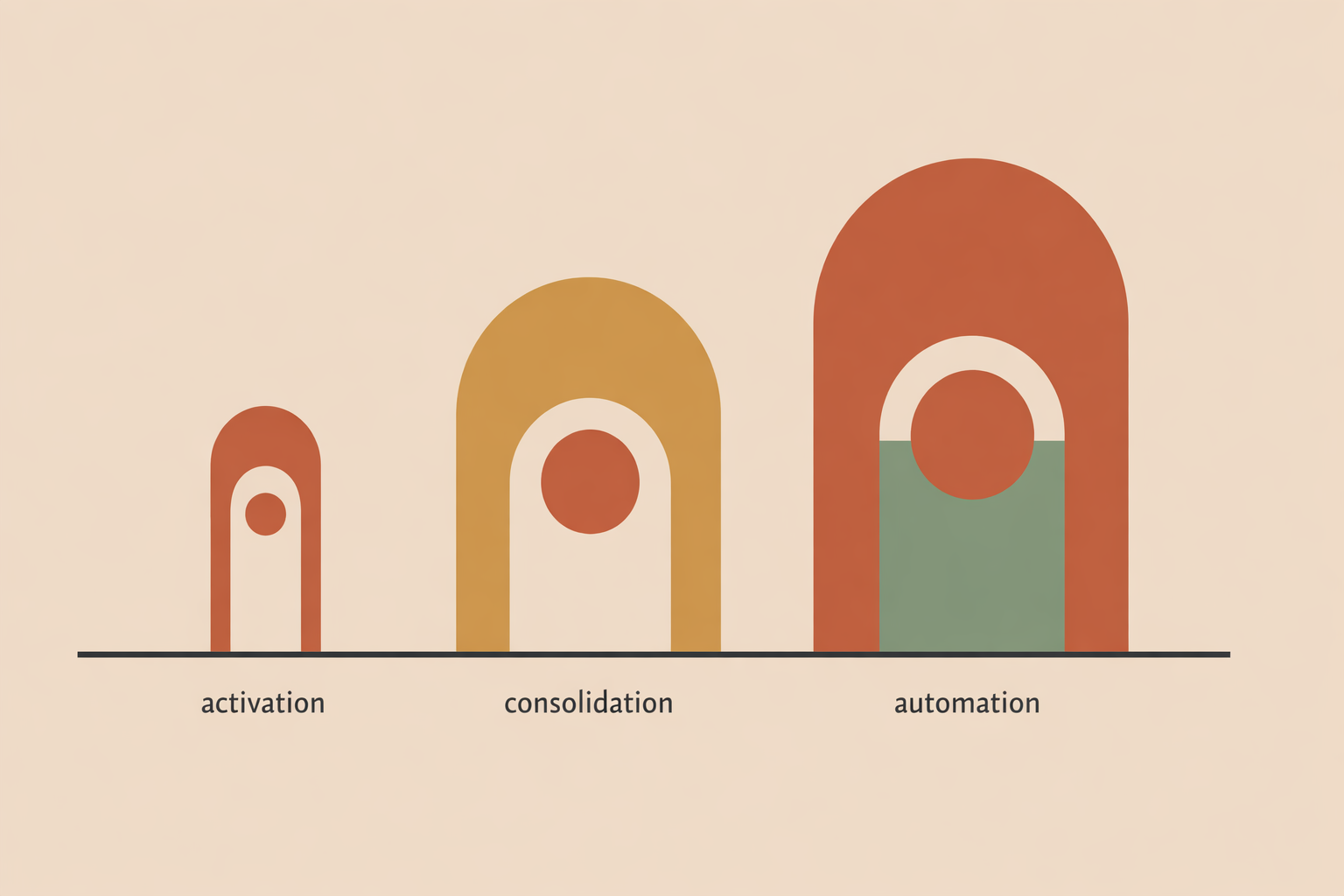
In coaching terms, the process often unfolds in three recognizable stages:
- Activation: the client can do the new behavior intentionally.
- Consolidation: the behavior shows up more often, with some wobble under pressure.
- Automation: the behavior happens with less inner negotiation.
Take a simple pre-email pause: a hand on the belly, inhale for four counts, exhale for six, repeat twice, then open the inbox. By week two, many clients report a calmer tone. By around week eight, the pause can start to happen almost automatically. It is not a rule; it is a common rhythm that helps clients stay patient and consistent.
Three Timelines Coaches Can Use With Confidence
A three-horizon model gives clients something more useful than a countdown. It sets steady expectations while leaving room for real life.
- Days to weeks: early awareness, first relief, and fragile wins.
- 2-3 months: consolidation, stronger automaticity, and fewer missed days.
- 6 months and beyond: greater stability under pressure and deeper identity-level alignment.
The middle horizon is often where motivation is won or lost. Automaticity tends to climb quickly, then plateaus around two months for many simple daily behaviors. Longer-term steadiness commonly takes more time. In the stages-of-change framework, more stable maintenance is associated with around six months of sustained action.
So a grounded message sounds like this: change often becomes visible within weeks, reliability tends to build over the first few months, and the version that holds on tough days typically asks for longer.
Why Some Clients Change Faster Than Others
Not all changes ask the same thing of a person. A single, clearly cued action usually settles faster than a broader shift that involves emotions, relationships, or long-standing stress patterns. Research also suggests simple actions form faster than more elaborate routines.
The client’s internal and external “terrain” matters too. Chronic stress and early adversity can shape self-regulation, making change feel less linear. Research finds early stress hinders adaptation, which is why experienced practitioners often choose smaller steps and longer runways when life is heavy.
Daily life can be the biggest variable. A client with predictable evenings and strong support might stabilize a routine in about eight weeks. Someone managing rotating shifts or intense family demands may need twelve to sixteen weeks for similar steadiness. That difference reflects load, not character.
For coaches, a practical planning lens is:
- Make the action smaller when stress is high.
- Give more runway for complex emotional or lifestyle shifts.
- Build support into the plan rather than treating it as a bonus.
A Realistic 90-Day Coaching Arc
Ninety days is a useful container. It is long enough for repetition to reshape behavior, and short enough to stay motivating. Many daily actions start to feel easier through steady practice, then become more self-running across the second and third month.
A simple structure looks like this:
- Weeks 1-2: choose one cue, one tiny action, and one immediate reward.
- Weeks 3-4: protect the context and add a backup version for difficult days.
- Weeks 5-8: continue daily reps and gently expand the behavior.
- Weeks 9-12: practice in varied settings so the pattern travels beyond one ideal moment.
Examples:
- After brushing teeth, floss one tooth.
- Before opening email, take two slow breaths.
- After dinner, stand by the window with tea for three minutes instead of reaching for the phone.
By around day 45, many clients say the behavior feels easier than skipping it. By day 90, it often feels like it has its own momentum. That is not a universal benchmark, but it is a workable expectation for ordinary habits when the plan stays small and consistent.
Why Daily Ritual Often Beats Intensity
Traditional practice has long favored repetition over heroic bursts, and modern learning science tends to agree. Spaced practice supports stronger retention than cramming.
That is why daily ritual remains such a strong container for change. A short morning breath practice, a nightly unwinding sequence, or a 40-day reflection cycle creates repetition inside real life. In practitioner terms, these rhythms build steadiness and meaning because they return you to the same touchpoint again and again, much like meditation for focus trains a steady return through brief, repeatable practice.
Mental rehearsal also has a place when it is paired with real action. Research suggests mental imagery enhances performance, especially when someone also practices the behavior in the situations where they want it to live.
A respectful way to bring this into coaching is to invite a culturally appropriate practice cycle: for example, 40 days of a sunrise breathing ritual, followed by a seasonal review of what feels stronger and what still needs simplifying.
How to Recognize When Change Is Starting to Stick
Early relief matters, but durability is the stronger sign. A pattern is starting to stick when the client returns more quickly after disruption, uses the behavior in more than one setting, and notices that it takes less effort over time.
Automaticity is associated with consistency across contexts. A behavior that only happens in one perfect setting is still fragile. When it shows up at home, on a commute, or after a difficult conversation, it is becoming reliable.
In practice, durability signs include:
- faster recovery after a stressful interruption
- the behavior showing up across several contexts
- steadier self-ratings of “this feels automatic now”
If you use a 0–100 self-rating, keep it as a coaching tool rather than a strict rule. Research uses validated scales for measuring automaticity, but there is no universal “70/100” threshold. A consistently high rating over a couple of weeks is often a practical sign the pattern is settling.
Relapse also needs careful framing. A lapse rarely means nothing changed. It usually means the old route is still familiar, and the new route needs more reps. The useful question is how quickly the client returned.
Speaking Honestly About Brain Rewiring Timelines
The most grounded answer to “How long will this take?” holds two truths at once: change is often noticeable within weeks, and stability tends to take months. Deeper identity-level change commonly takes longer, which is why neuroscience and brain health coaching often works best with phased expectations rather than fixed deadlines.
That timeline is freeing. It helps clients stop measuring themselves against miracle numbers and start building the kind of consistency real life can support.
In practice:
- Replace fixed-day promises with phased horizons.
- Design around one cue, one tiny action, and one reward.
- Plan for longer timelines when stress is high or the shift is complex.
- Use daily rhythm and repetition instead of intensity.
- Measure durability by return speed, context range, and ease.
When expectations are set this way, clients trust repetition, respect their own pace, and build patterns that can stay with them, a practical foundation for neuroplasticity coaching.
Master Neuroplasticity Coaching
Deepen these habit-timeline skills with the Neuroplasticity Coaching Certification.
Explore Neuroplasticity Coaching →