Clients often ask for “something for focus.” Most of the time, they’re asking for something more concrete: starting tasks with less resistance, staying with them longer, and feeling less scattered across the day. A useful response begins by defining what “better focus” would change in real life, not by jumping straight to product options.
Key Takeaway: Effective focus coaching starts by translating vague requests into observable daily outcomes and staying firmly within scope. Before discussing any supplement, map sleep, meals, movement, daylight, workload, and digital habits. If a product is considered, keep it as a conservative, single-variable experiment inside a broader focus plan, with clear tracking, stopping points, and referral boundaries.
Why clients ask for focus support
When someone says, “I need a brain booster,” they can mean several different things: difficulty starting, drifting attention, mental fatigue, weaker working memory, or trouble staying engaged with boring (but necessary) tasks. Naming the real problem matters, because feeling more “activated” doesn’t always translate into better output.
A reliable coaching question is: “What will be different in your day if this works?” That turns a vague wish into something you can see and measure, like starting a report within ten minutes, completing two focused work blocks, or reading without checking the phone.
- Clarify the target task.
- Define what success looks like in real life.
- Name what tends to interrupt follow-through.
- Track whether the change shows up in output, not just in feeling.
This keeps the work grounded, client-centered, and protected from overpromising.
Map attention before discussing nootropics
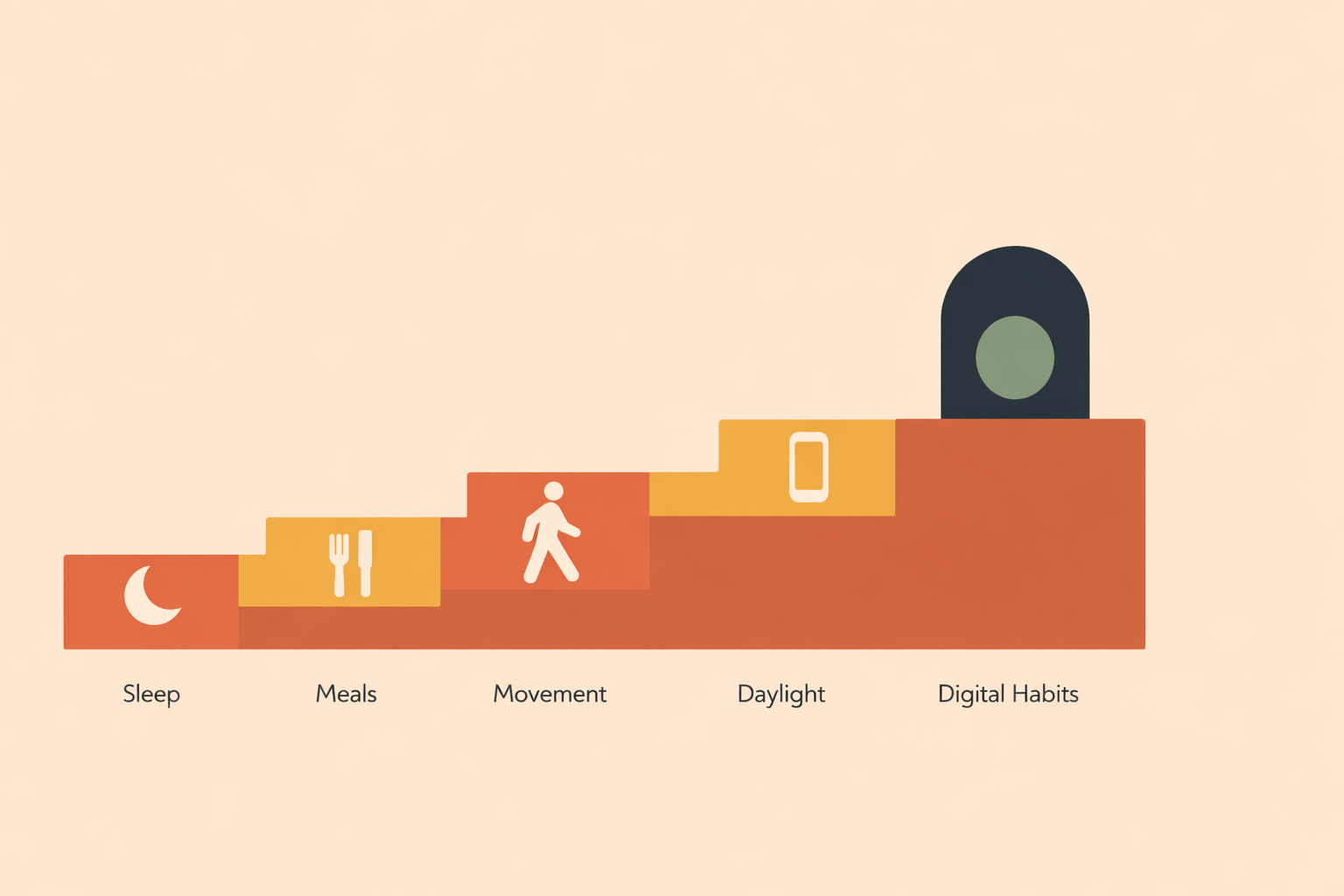
The steadier move is to map before modifying. Attention isn’t one switch; it’s shaped by sleep, nourishment, movement, daylight, workload, digital context, stress, and meaning.
In sessions, this often explains more than any label ever will. “Poor focus” commonly turns out to be late-night stimulation, skipped meals, low morning light, too many open loops, or a day with no protected deep-work window.
Many clients improve when they rebuild a stable middle ground: steady energy without fogginess, and alertness without feeling jittery. Consistent sleep-wake timing, regular meals, gentle movement, and time outdoors support that baseline, and sleep supports focus, learning, memory, and problem-solving.
Day-to-day focus also responds to structure. Reducing simultaneous demands, using written prompts, and chunking tasks often creates faster wins than adding another capsule. One clear note like “Open the document. Write one sentence. Set a 25-minute timer.” can be surprisingly powerful.
- Look for best and worst focus windows in the day.
- Notice what happens before a slump.
- Track caffeine, screens, meals, and outdoor time.
- Protect one medium-energy hour before chasing peak performance.
When to pause experimentation and refer out
Coaching can strongly support routines, awareness, and decision-making. When attention concerns are persistent, worsening, or significantly disruptive, it’s more appropriate to pause supplement experimentation and encourage outside qualified support.
High-caution situations call for extra care, including pregnancy or breastfeeding, cardiovascular concerns, seizure history, severe sleep disruption, strong anxiety, substance-use vulnerability, and complex multi-substance stacks. Reported risks around some nootropic-style supplements include seizures, blood-pressure changes, insomnia, agitation, dependence, and hospitalization.
It also helps to set expectations in a grounded way. Stimulant-like “smart drug” products can affect healthy people unpredictably, and intensity doesn’t guarantee better thinking or better work. A strong plan keeps routines and careful observation in the lead.
- Pause if a client reports chest discomfort, fainting, severe agitation, rash, unusual bleeding, or marked sleep or mood changes.
- Pause if use is escalating or becoming emotionally charged.
- Pause if the product identity, dose, or source is unclear.
- Document what was taken, when, and any lot number if available.
How to explain nootropics with balance and perspective
Nootropics are a broad category in everyday language. The term can include nutrients, botanicals, caffeine-containing products, and more aggressive cognitive-enhancement products that sit well outside conservative wellness practice.
Traditional practice offers a valuable starting point here. Across cultures, ginseng, bacopa, rhodiola, and gotu kola have long been used to support mental clarity and stamina, and that lived knowledge deserves respect. Modern products, though, vary widely: species, plant part, growing conditions, extraction, and standardization can all change what ends up in the bottle.
A balanced explanation usually lands well: traditional use helps shape expectations and good questions; modern evidence helps you think about quality and safety; personal experience still needs careful tracking rather than assumptions.
- Honor traditional use without turning it into certainty.
- Explain that product quality varies greatly.
- Keep claims modest and outcome-based.
- Bring the conversation back to sleep, mood, and daily function.
Safety first: label literacy and harm reduction
If a client is already taking something, start with curiosity. Ask what drew them to it, how much they take, how often, what else they combine it with, and what they’ve noticed.
Then widen the lens to total stimulant and “boost” load. Coffee, tea, energy drinks, pre-workouts, chocolate, and “wellness” blends all count. Multi-ingredient products are especially hard to assess because dosing is often unclear, and in one analysis of cognitive-enhancement supplements, 75% of declared drug quantities were inaccurate.
Purity matters as well. Supplements marketed for cognitive enhancement are sometimes adulterated with undeclared active substances, so easy online access should never be mistaken for quality assurance.
This is also why large stacks deserve caution. When several things change at once, it becomes difficult to tell what helped, what harmed, and what interacted. One change at a time gives cleaner information and a calmer process.
- Check the full ingredient list and serving size.
- Note whether exact amounts are disclosed.
- Record the brand, lot number, and timing used.
- Be cautious with proprietary blends and stacked stimulants.
Design a conservative focus-support trial
If a client chooses to experiment, frame it as a short, bounded test rather than a sweeping solution. The goal is a modest, observable shift in one clearly defined area of daily functioning.
The single-variable principle is key. Big stacks muddy results; one change paired with a brief review window and a simple log usually gives enough insight to decide what to do next.
Track practical measures:
- date and timing
- product and amount per label
- other stimulants that day
- sleep duration and ease of winding down
- task completion
- focus rating
- mood and body signals
It also helps to normalize expectation effects. Placebo and nocebo dynamics can shape how benefits and side effects feel, so subjective impressions alone aren’t enough. Observable outcomes matter more than feeling “more on.”
A simple coaching frame might sound like this: the aim is one-task support without disrupting sleep, mood, or overall steadiness.
A repeatable conversation flow for sessions
A consistent process makes sessions calmer and more useful. It also helps practitioners stay within scope while still offering thoughtful, practical support.
A clear flow looks like this:
- Clarify the client’s real goal.
- Map routines and daily rhythms.
- List all relevant exposures, not just supplements.
- Screen for red flags and high-caution contexts.
- Offer balanced education on categories, traditions, and uncertainty.
- Agree on one observable outcome.
- Create a short tracking plan.
- Set stopping points, referral thresholds, and a review date.
This structure leaves room for motivational interviewing: open questions, reflective listening, and permission-based education help clients think clearly without feeling pushed. When stacking comes up, it’s usually enough to explain that combinations are rarely well understood and that simpler trials produce better feedback.
From hype to honest partnership
Focus support works best when it stays practical, respectful, and conservative. Translate product requests into clear daily outcomes, map the rhythms shaping attention, and let foundations do most of the heavy lifting within longevity and biohacking work.
If a product is explored, keep the experiment small, track real-world results, and protect sleep and mood along the way. This approach makes room for both ancestral knowledge and modern evidence without overstating either, while keeping the work anchored in steady well-being rather than hype.
Train in nootropics integration
Build safer, outcome-based client trials with the Nootropics Integration Certification.
Explore Nootropics Integration →