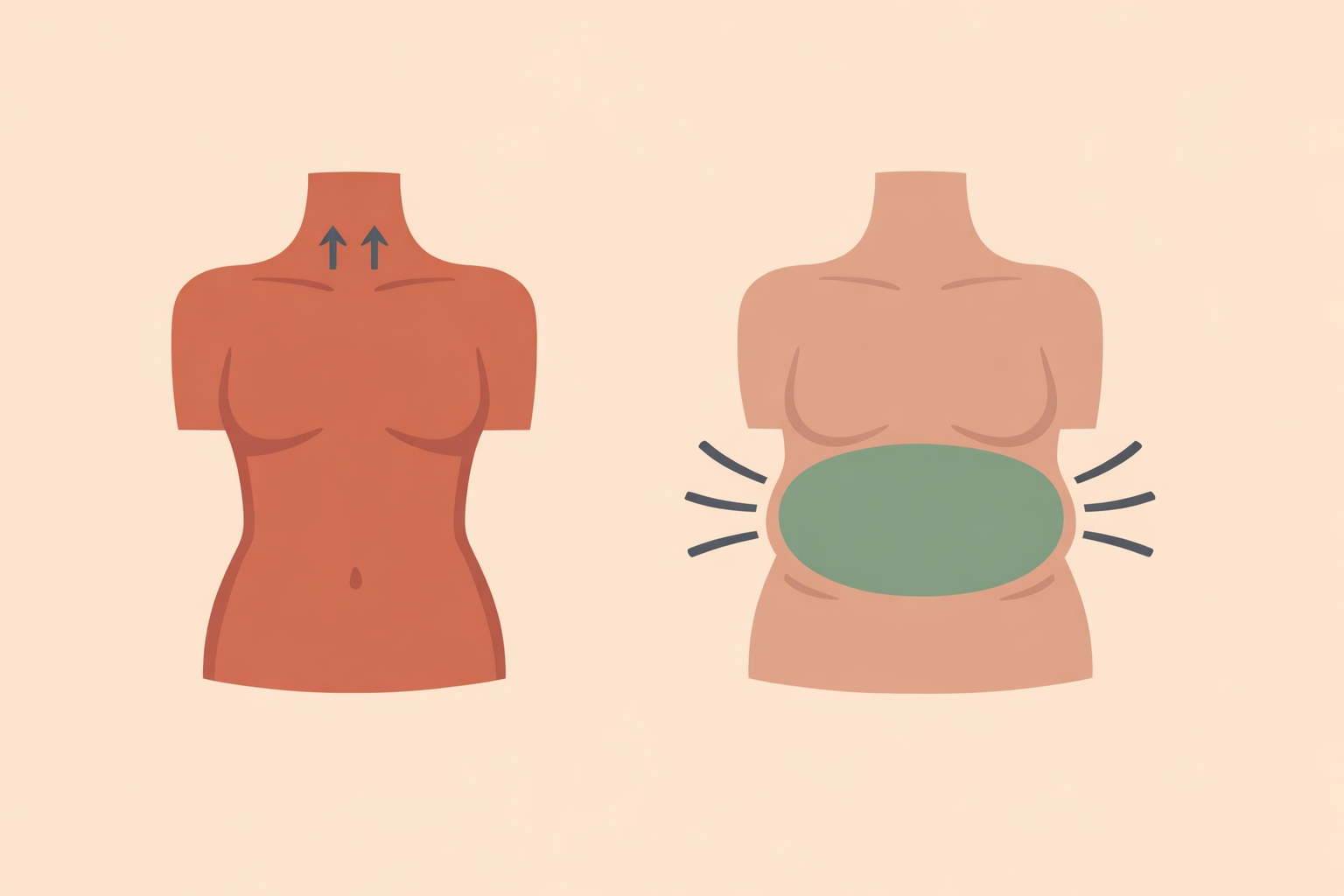
Most practitioners meet the same sticking point: a client arrives breathing high and fast, shoulders doing the work, and your well-meant anatomy lesson doesn’t land. They nod, but they can’t feel the difference—and the room tilts toward performance (“Am I doing it right?”) instead of curiosity. In that moment, trust depends less on technical accuracy than on whether your explanation gives them a sensation they can verify.
When clients can distinguish “this is my belly and lower ribs” from “this is my chest and neck” with their own hands, they relax, self-correct, and practice between sessions. Confidence follows the first felt contrast, not a lecture.
Key Takeaway: Clients trust breath coaching when they can feel an immediate contrast between “high and tight” and “low and wide.” Use simple sensory language, hand placements, and a quick A/B comparison so the body can verify the pattern, making it easier to repeat between sessions.
How to explain diaphragmatic vs chest breathing in client language
The simplest contrast is this: diaphragmatic breathing feels low and wide, while chest breathing feels high and tight.
When the breath drops lower, the belly and lower ribs have room to respond. Many coaches describe it as a soft widening around the base of the ribcage—think of it like an umbrella opening. For most clients, that image is enough to find the movement.
By contrast, chest-dominant breathing often pulls extra effort from the neck and upper chest. Shoulders may want to lift, and the breath can get shallower and quicker. Clients will often say it feels like “breathing into my throat” or “breathing from up here.”
Lower-rib expansion paired with a slower rhythm can support a more balanced state. Rather than presenting low breathing as a rule, it usually lands better as a practical option—one pattern that often supports steadiness, ease, and clearer self-awareness.
A direct A/B comparison works well:
- Chest style: “Let the breath stay high, let the shoulders help, and keep the belly still. Notice the pace and what happens in your neck.”
- Low-and-wide style: “Let the shoulders stay quiet and invite the lower ribs to widen as you inhale. Notice the pace and what changes in your belly, sides, and back.”
This way, clients discover the difference instead of trying to perform the “right” answer.
Helping clients feel the difference quickly
Clients usually understand breathing patterns fastest through touch and sensation.
Start with a simple hand test: one hand on the upper chest, one on the belly or low ribs. Ask them to breathe normally for a few rounds and notice which hand moves first. Then invite the upper hand to become quieter while the lower hand “receives” the breath. This tactile cueing can help people feel belly rise and recognize a new pattern quickly.
Position matters, too. Many people find it easier to notice low breathing when lying on their back with knees bent, because the body can soften and the shoulders don’t need to help. Supported positions can support deep breathing and make subtle movement easier to sense.
Here is a short mini-lesson that often creates the first “aha” moment:
- “Place one hand on your chest and one on your low ribs or belly.”
- “Let your jaw soften.”
- “Breathe in gently through the nose and let the lower hand move first.”
- “Breathe out slowly and feel the ribs soften.”
- “Repeat for a few rounds, noticing whether the shoulders can stay quiet.”
Most people notice something within a few minutes—warmth, heaviness, softening, or simply less effort. Here’s why that matters: once a client feels a contrast, the practice becomes real, repeatable, and far easier to use between sessions.
If someone becomes self-conscious, imagery can do more than correction. Traditional teaching has long used metaphors because the body understands them quickly: an umbrella opening, a wave rolling in and out, or a soft inner balloon can invite the breath to organize itself without strain.
“The beauty of breathwork is that it can be practiced any time… a moment to breathe deeply can provide instant stress relief.”
That practicality is exactly why breath practice is so teachable: it doesn’t need to be long to be useful. Even a brief pause can lower stress.
Explaining breath, stress, and emotions without overwhelming clients
Keep the explanation simple: fast, chesty breathing tends to signal “on alert,” while slower lower-rib breathing tends to signal “safe enough.”
Clients don’t need a long lecture—they need a usable map. One friendly frame is to describe the body as having upshifted and downshifted modes, and breathing patterns can nudge which direction we lean.
Modern findings support this broader picture. Slow breathing can increase parasympathetic activity, and diaphragmatic breathing may reduce negative affect. That fits what many traditions have taught for a long time: breath influences the whole person, not just the lungs.
Breath-focused work also feels immediate because people can sense the shift quickly—shoulders soften, the face changes, and the tempo of thought often changes too. Essentially, rhythm gives the nervous system something steady to follow.
At a slightly slower pace—often around six breaths per minute—breathing practice may increase HRV, which is commonly used as a sign of improved stress regulation. This doesn’t mean everyone must count breaths or match one “perfect” rhythm; it simply points to the value of steadier pacing for many people.
“When people practice slow breathing at about six breaths per minute… indicators of stress resilience improve.”
To keep things empowering, avoid telling clients their breathing is wrong. A better frame is: “You learned a pattern that helped you get through demanding moments. Now you’re learning another pattern for different moments.” That preserves dignity and creates choice.
Adapting your explanation for different bodies and contexts
The principles stay the same, but the doorway should change with the person in front of you.
Begin with orientation and permission. Invite clients to notice the room, the chair beneath them, and the ground under their feet. Then ask whether they’d like to try a short breath exploration, making it clear they can pause or stop at any point. Consent- and choice-based language creates steadiness and supports genuine participation.
Then adapt your cues:
- For clients who struggle to feel the belly: begin in supported lying or seated rest, and emphasize side and back rib movement rather than “push the belly out.”
- For pelvic floor considerations: avoid exaggerated belly pushing; gentler rib expansion is usually a better cue.
- During pregnancy or postpartum: side and back rib expansion, plus seated or side-lying positions, often feel more natural than strong front-body expansion.
- For sensitive or easily overwhelmed systems: keep rounds short, allow open eyes, and include outward anchors such as feet on the floor, contact with the chair, or sounds in the room.
Some clients get edgy when attention goes straight to the breath. That’s not a failure—it’s information. Shorter rounds, tactile grounding, and an outward focus often make the practice far more approachable, and trauma-aware safeguards can help you keep that pacing steady.
Context matters, too. Some people want steadier energy for work, parenting, or daily transitions; others want more choice under pressure. In athletics and other high-demand roles, breath training is often used to support focus, arousal, and moment-to-moment decision-making. The goal isn’t one ideal pattern at all times—it’s the ability to notice your default, choose deliberately, and shift when needed.
Across all contexts, the throughline is simple: kind pacing, simple words, and one unmistakable success experience. Help clients feel the contrast between “high and tight” and “low and wide.” Keep it short enough to repeat. Trust direct experience as much as explanation—this is where traditional wisdom and modern insight meet in a very practical way, especially when you’re using breathwork for nervous system regulation.
Master Breathwork Practitioner Skills
Build clearer client cueing with the Breathwork Practitioner certification and deepen your diaphragmatic breathing coaching.
Explore Breathwork Practitioner →