Clients rarely ask you to referee the mushroom industry’s favorite argument. They arrive with a tub labeled “Full Spectrum” or “Polysaccharides 50%,” wonder whether mycelium is “just filler,” and want to know if the product is honest, well made, and relevant to their goals.
A more helpful starting point is: what is this, exactly? When you shift from “Which is better?” to “What am I actually taking?”, the conversation gets calmer and far more practical. You can look at the species, the fungal part used, how it was prepared, what was measured, and whether any published evidence matches that exact material.
Key Takeaway: The useful question isn’t whether mycelium or fruiting body is universally “better.” It’s whether the material is clearly identified, appropriately prepared, and matched to the person’s aims. In practice, that means reading labels carefully, understanding compound families without hype, and choosing products with transparent testing and language you can explain plainly.
Mycelium, fruiting body, and spores in plain language
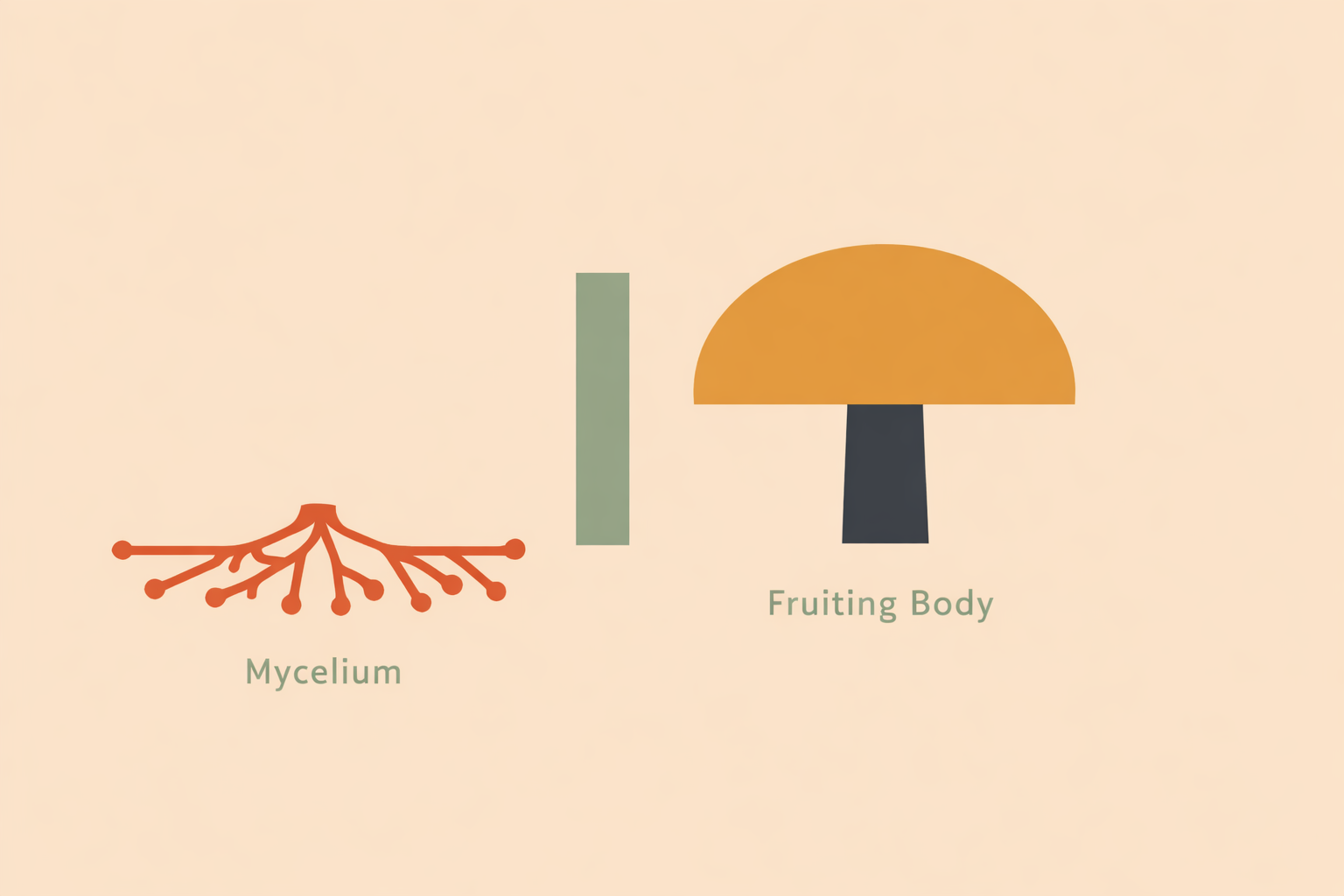
Mycelium is the thread-like network that grows through a food source. Fruiting body is the visible mushroom structure that emerges later and releases spores. Both belong to the same organism, but they are different materials.
Different parts can emphasize different compounds. Mycelium and fruiting bodies often share broad families—polysaccharides, proteins, sterols, phenolics, and terpenes—but not always in the same proportions. Species, growth conditions, and development stage all shape the final profile.
For clients, a straightforward explanation usually lands best: “The fruiting body is the part you can see and cook. The mycelium is the hidden network that grows through what feeds it. Both can be useful. They’re just different, so we read the label to see which one we’re working with.”
How traditional lineages approached the whole mushroom
Traditional lineages generally related to mushrooms as whole organisms rather than as isolated marketing categories.
In East Asian kitchens and apothecaries, Reishi, Turkey Tail, and similar mushrooms were commonly prepared as broths, teas, or additions to daily dishes. In northern forest traditions, Chaga was often shaved and brewed as a dark beverage. These were practical, food-like preparations rooted in season, place, and habit.
Written traditional records rarely single out mycelium by name. That doesn’t make mycelium “lesser”; it reflects a different orientation. People worked with mushrooms as they appeared in ecology and cuisine, rather than dividing them by modern label language.
That viewpoint still guides good practice today. It helps keep cultural histories specific and respected, and it discourages lifting practices out of context just because they read well in marketing copy.
It’s also why many people do well starting with the kitchen. A broth, tea, or culinary powder can restore rhythm and relationship before moving into more concentrated products, including in broader herbalism and plant medicine practice.
Key compounds without the jargon
When clients ask what’s “inside” a mushroom product, four compound conversations come up most often.
β-glucans are structural fibers in fungal cell walls. They’re often a more helpful marker than a broad “polysaccharides” claim when you want reassurance that a product reflects meaningful fungal material rather than generic carbohydrates.
Glucans are not all the same. A high total-polysaccharide number can include starch-like α-glucans from grain or storage carbohydrates within the fungus. That’s why separate reporting for β-glucans is usually more informative than one large “polysaccharides” figure.
Triterpenes are central in many Reishi discussions. They’re commonly associated with Reishi’s bitter taste and are often discussed for their antioxidant effects in lab settings. Because many triterpenes are less water-soluble, alcohol or dual extraction is often used when the goal is to access more of them.
Then there is Lion’s Mane. In this species, hericenones are commonly linked with fruiting bodies, while erinacines are commonly linked with mycelium. These compounds have been studied for NGF pathways, which is useful when comparing product types, but it still doesn’t translate into a guaranteed experience.
The most helpful phrasing is calm and clear: markers tell you what’s likely present, not what will definitely happen.
Species first, then part
One common mistake in mushroom education is acting as if one rule applies across every species. It doesn’t.
A steadier approach is to choose the species first, then decide whether the part used matters for that specific mushroom.
With Lion’s Mane, the difference between fruiting body and mycelium is especially relevant because different compounds are associated with each. Human research has included both fruiting-body and mycelial preparations, so results from one form should not automatically be applied to the other.
With Reishi, conversations often center on triterpenes and polysaccharides, especially in fruiting-body extracts. In traditional and culinary contexts, fruiting body preparations remain a familiar and time-honored choice, particularly for teas and broths.
With Cordyceps, identity becomes especially important. Products sold as Cordyceps may contain cultivated mycelium, fruiting bodies, or a different species used as a stand-in. That’s exactly why species naming, extraction details, and testing matter so much.
This species-first habit prevents blanket slogans from steering the whole decision.
How to read labels without fear-mongering
Many mushroom labels sound impressive while saying very little. “Mushroom Complex,” “50% Polysaccharides,” and “Full Spectrum” can be meaningful, but only when the details are clear.
Start with basics that change the material in your hands. If a product is mycelium grown on rice, oats, or similar substrates, some carbohydrate content can reflect grain starch rather than fungal cell-wall fibers. This is why mycelium-on-grain products deserve extra label scrutiny.
Glucan language can be slippery. A big total-polysaccharide number does not necessarily mean strong β-glucan content. Separate β-glucan reporting is typically the clearer signal.
None of this needs to turn into a new hard rule. Not every mycelial product is poor quality, and not every fruiting-body product is automatically superior. Clear identity and clear testing matter more than slogans.
A short checklist keeps things grounded:
- Is the species clearly named?
- Does the label state fruiting body, mycelium, or both?
- If it is mycelium, does the maker explain whether grain substrate remains in the final material?
- Is the extraction method listed: hot water, alcohol, or dual extraction?
- Are β-glucans reported separately?
- Is there a batch-specific certificate of analysis?
A useful client line is: “Let’s not chase the biggest number. Let’s chase the clearest one.”
Mycelium on grain and “full spectrum” claims
This is where many clients get stuck: the language sounds technical, but the label often avoids plain specifics.
Mycelium grown on grain can still be a meaningful material, but it’s not the same as a purified fungal extract. If the final product includes the growth substrate, carbohydrate levels may partly reflect grain starch rather than fungal structure. A label can look “strong” on paper while staying vague about actual fungal content.
This is also why “full spectrum” doesn’t help much on its own. Full spectrum of what: the whole fungus, the fungus plus grain, a blend of extracted and unextracted material, or just a marketing concept? Without details, there’s nothing solid to evaluate.
When a label is fuzzy, bring it back to three questions:
- What exact material is in here?
- What was measured?
- Can the maker show it clearly?
If those answers aren’t available, there’s no need to argue. You can calmly conclude that the product isn’t transparent enough for confident use.
How to speak about benefits ethically
Once you understand the material, the next step is choosing language that stays respectful and accurate.
The cleanest approach is to frame mushrooms as optional supports rather than promises. It’s fair to say a mushroom is being explored for focus, energy, resilience, digestion, or general well-being, without turning that into certainty.
Keep mechanism and outcome separate. A compound can be studied for a pathway or biological effect, while real-world experience still depends on preparation, absorption, consistency, and individual response. Extraction can improve access to compounds, and results still vary.
It also helps to keep categories clear. Lion’s Mane, Reishi, Cordyceps, Turkey Tail, and Chaga are generally discussed as non-psychoactive supports, which makes them a different conversation from psilocybin-containing species and the distinct legal and ethical considerations around those.
Useful phrasing includes:
- “May support” instead of “will fix.”
- “Would you like to explore this?” instead of “You need this.”
- “We can track your experience and adjust” instead of “This works for everyone.”
This keeps autonomy front and center while still giving clients practical guidance.
Choosing fruiting body, mycelium, or blends in practice
Once the label is clear, the choice usually becomes straightforward.
Choose fruiting body when you want a familiar, food-like material for teas, broths, powders, and traditional daily use. This often suits people who enjoy culinary ritual and a whole-food orientation.
Choose mycelium when you’re specifically looking for compounds more commonly associated with mycelial material, as in some Lion’s Mane preparations. In those cases, the quality questions matter even more: what exactly is the material, how was it cultivated, and what testing supports the label?
Choose blends when the formula is transparent and purposeful, rather than used to blur weak sourcing. A well-built blend can broaden the compound profile when the parts and proportions are clearly stated.
Match the extraction to the intention. Hot-water extraction is commonly used for water-soluble β-glucans, while alcohol or dual extraction is often chosen when triterpenes are part of the focus.
For cleaner feedback, change one variable at a time. If someone is curious about Lion’s Mane, start with one clearly labeled form, keep notes for a few weeks, and compare only if there’s a good reason, much like a simple lion’s mane plan. It saves time and reduces confusion.
Beyond the debate: tell the whole mushroom story
The more fluently you can read species, parts, preparations, and labels, the less you need a universal winner.
Neither mycelium nor fruiting body is automatically better. The best choice is the one that’s clearly identified, honestly presented, and matched to the person and purpose. Sometimes that will be a fruiting-body tea. Sometimes it will be a carefully verified mycelial extract. Sometimes it will be no product at all, just a return to broth, kitchen rhythm, and observation.
When clients ask, “Which is better?” a grounded answer is often: “Neither by default. Let’s choose the material that makes sense for your goals, and let’s make sure we can explain what it is.”
That gives people something more valuable than hype: literacy and choice. As with any supportive tool, it’s wise to review sourcing, start modestly, and pause or get qualified guidance if someone has complex health considerations, uses medications, is pregnant, or has a history of sensitivities. For a deeper foundation in plant medicine and product literacy, or more focused study in the medicinal mushrooms certification, staying grounded matters more than hype.
Explore Mushroom Foundations
Build confident label literacy and product selection skills in the Foundations of Medicinal Mushrooms Certification.
Explore Foundations →