Many practitioners first meet insulin resistance through lab work: broad panels, borderline numbers, and a wait for HbA1c to “catch up” to what a client has been feeling for months. Yet plenty of women arrive with afternoon crashes, strong cravings, acne, irregular cycles, or new midsection weight while standard markers still look “fine.” The difference-maker is usually not more testing at the start, but smarter sequencing.
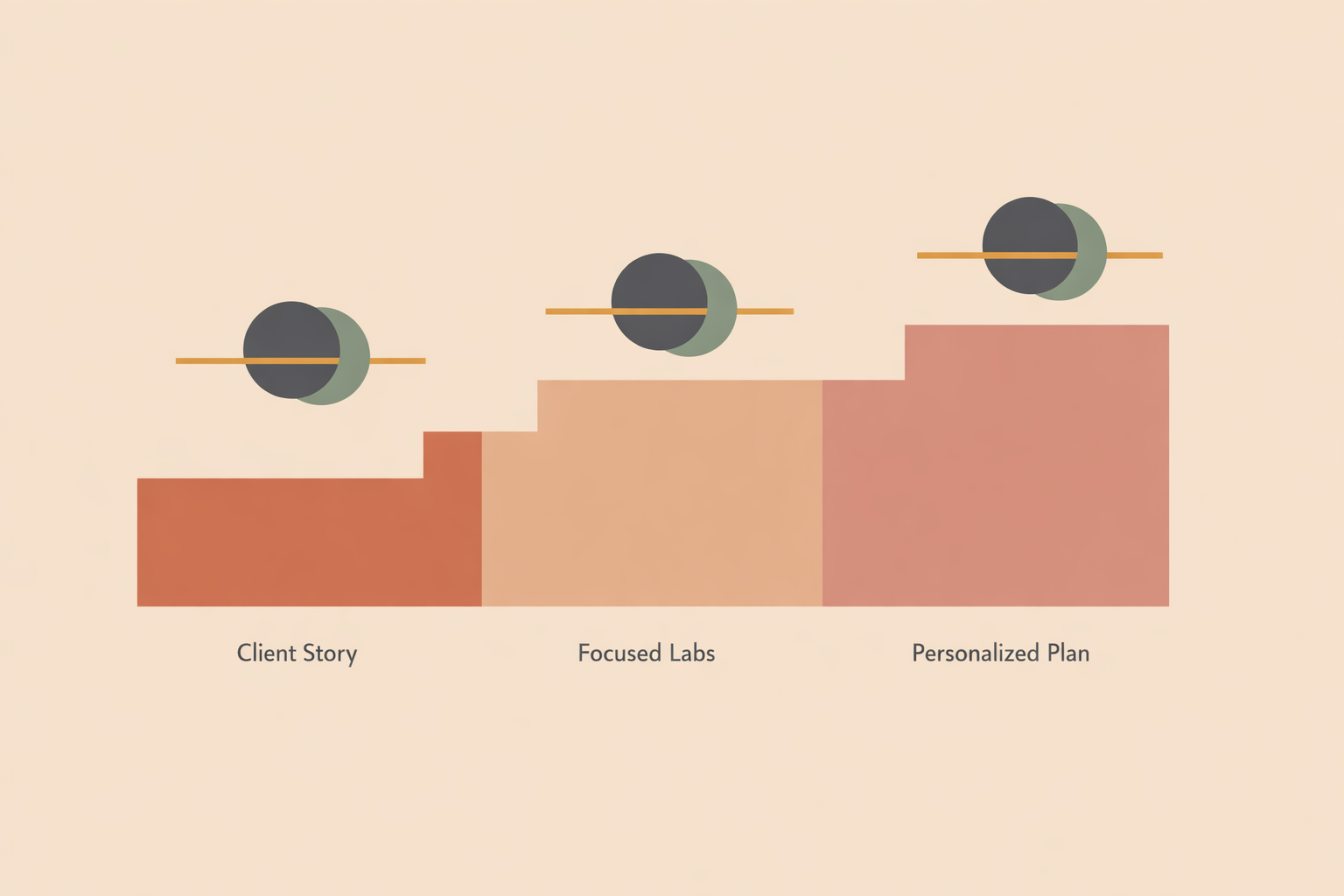
Key Takeaway: A useful insulin-sensitivity workflow starts with the client’s story, then moves to a focused panel: fasting glucose, fasting insulin, HbA1c, and lipids, with selective add-ons only when the picture calls for them. Reading fasting glucose, insulin, HOMA‑IR, and HbA1c together can reveal early shifts that a single marker may miss. From there, lipids, waist measures, liver markers, and life-stage context—especially PCOS, contraception, and menopause—help shape a personalized plan rooted in food, movement, rhythm, and culturally grounded habits. Retesting then becomes a way to follow direction and reinforce what is working.
Step 1: Start with the client’s story
The earliest clues usually show up in daily life. Ask about energy after meals, morning appetite, cravings that feel urgent, sleep quality, skin changes, and where weight seems to be settling.
With women, cycle patterns add essential context: regularity, ovulation signs, PMS, and changes linked to postpartum, perimenopause, or coming off contraception.
A strong intake prompt is: Walk me through a typical day of eating, movement, and energy—where are the steady parts, and where are the dips? That answer often tells you what needs attention before any numbers come back.
Insulin resistance shapes many women’s metabolic patterns. In PCOS, insulin resistance is a major feature in many cases. Around menopause, central adiposity and a more insulin-resistant backdrop become more common, which changes how cravings, energy dips, and weight redistribution are interpreted.
Traditional frameworks can deepen this kind of intake. Ayurveda and East Asian medicine have long connected patterns like intense sweet cravings after noon, abdominal heaviness, and erratic bleeding with disrupted metabolic balance. That language can help clients feel understood while you map their experience onto modern markers.
Consider a client with late-afternoon crashes, increased chin breakouts, cycles stretching to 38–45 days, low morning appetite, and new midsection weight. Even before testing, that story points toward insulin signaling, rhythm, and androgen context as likely priorities.
Step 2: Build a focused insulin-sensitivity lab panel
A lean panel is usually more helpful than an expansive one. Start with:
- Fasting glucose
- Fasting insulin
- HbA1c
- Standard lipid panel
Together, fasting glucose and fasting insulin allow calculation of HOMA‑IR, a practical surrogate for insulin resistance.
Then add context only when the story calls for it. If you see irregular cycles, clear central weight gain, a strong family history, previous gestational diabetes, or a stronger PCOS picture, it can be reasonable to widen the view with an OGTT, SHBG, ALT, or hs‑CRP.
In women with higher metabolic risk, guideline summaries recommend OGTT screening rather than relying only on fasting glucose or HbA1c. Lipids are also more than a cardiovascular snapshot: triglycerides and HDL often mirror metabolic strain in a way that is highly useful for coaching.
Some newer surrogate markers, such as adiponectin, ferritin, IGFBP‑1, or hs‑CRP, can add nuance. In most real-world workflows, they work best as “supporting actors,” not the foundation.
Step 3: Read glucose, insulin, HOMA‑IR, and HbA1c together
Early insulin resistance often hides behind acceptable fasting glucose. Glucose can look typical while fasting insulin is already climbing and HOMA‑IR is starting to rise, so these markers are strongest when read as a set.
HOMA‑IR cutoffs vary by population and assay, so use them as pattern clues rather than a rigid verdict. Many practitioners use a teaching threshold around 2.0 or above as a sign that insulin sensitivity may be declining, and then confirm with the client’s symptoms, history, and trends.
This is where interpretation gets practical. A client might show fasting glucose of 88 mg/dL, fasting insulin of 12 μIU/mL, and HbA1c of 5.3%, with a HOMA‑IR around 2.6. Glucose and HbA1c may not raise concern, yet insulin is clearly working hard to keep that stability in place.
In younger women, especially those with irregular cycles, HbA1c can miss early shifts. Guideline summaries note reduced accuracy for HbA1c compared with OGTT in this context. When fasting insulin and HOMA‑IR align with the story, it makes sense to act on that coherent pattern rather than waiting for later markers to drift.
Step 4: Add metabolic context with lipids, waist measures, liver markers, and inflammation
Once the core pattern is visible, widen the lens. Insulin resistance rarely shows up in only one place; it often travels with shifts in lipids, body composition, liver strain, and low-grade inflammation.
Triglycerides and HDL are especially practical. The TG/HDL ratio is commonly used as a surrogate marker of insulin resistance and can highlight metabolic strain even when single values look “not too bad.”
Some coaches also calculate the TyG index from fasting triglycerides and glucose. It is a simple, cost-effective proxy that can add another layer of pattern recognition.
Body shape matters too. Waist circumference and fat distribution are often more informative than BMI alone when you are thinking about insulin sensitivity. A gradually increasing waist can be meaningful even when total weight is fairly stable.
ALT can also contribute to the broader picture, especially when central adiposity and triglycerides are trending upward. Likewise, hs‑CRP can sometimes help you spot a more inflammatory pattern, best read as supportive context rather than a stand-alone answer.
For example, a client may show fasting insulin of 10 μIU/mL and HOMA‑IR of 2.1, with triglycerides of 180 mg/dL, HDL of 42 mg/dL, and a waist measurement that has gradually increased over the past year. The combined pattern is the message.
Step 5: Interpret insulin patterns by life stage
Insulin-related markers do not land the same way at every life stage. The same pattern can mean something different in a woman with irregular cycles at 28 than in a woman navigating postmenopause.
In PCOS, insulin resistance is one of the central metabolic features. It often sits alongside cycle disruption and signs of androgen excess. Low SHBG is also a familiar clue in practice, often suggesting that insulin signaling and androgen patterns are linked.
When fuller glycaemic assessment is needed in PCOS, guidelines favor the most accurate glycaemic test over fasting glucose or HbA1c alone. That matters because younger women can look normal on simpler markers while early dysregulation is already unfolding.
Contraception can also shift the landscape. Different formulations affect appetite, fluid retention, mood, and metabolic patterns differently. Coaches do not direct medication decisions, but they can help clients track timing: when cravings, energy changes, or lab shifts began, and whether those changes line up with contraceptive use.
At midlife, the picture changes again. Postmenopausal status is associated with higher central adiposity and a more insulin-resistant metabolic profile. That helps explain why women who once felt steady may notice sudden changes in waistline, appetite rhythm, or post-meal energy.
Seen this way, labs become part of a life-stage story, and that story guides what support is most realistic and effective.
Step 6: Turn patterns into a personalized support plan
Once the pattern is clear, the work becomes practical. The aim is a set of repeatable habits that improves insulin sensitivity steadily over time.
For women with PCOS, guideline-based lifestyle support is recommended to improve metabolic health, including body composition and lipid patterns. In practice, three areas do much of the heavy lifting: meals, movement, and daily rhythm.
- Meals: build plates around protein, fiber, and colorful plants; pair starches with protein or fat; and create steadier meal timing where possible.
- Movement: resistance training is a strong anchor for many women, especially when paired with regular walking and enough weekly activity to support energy rather than deplete it.
- Rhythm: earlier dinners, consistent sleep, morning light, and gentler evenings often support steadier appetite and energy.
Traditional foodways fit naturally here. Many ancestral eating patterns center legumes, vegetables, fermented foods, seafood, whole grains, herbs, and consistent meal rhythms. Rather than forcing a generic plan, it often works better to help clients reclaim familiar foods prepared in steadier, more supportive ways, especially in women's health coaching.
A simple starting week might include:
- A savory, protein-anchored breakfast
- Lunch built from leftovers, legumes, vegetables, and healthy fats
- A 10–15 minute walk after one or two larger meals
- Two resistance sessions each week
- A calmer evening rhythm with earlier sleep
This approach tends to feel sustainable because each habit reinforces the others. Clients often notice steadier energy and fewer cravings before slower-moving markers shift.
Step 7: Retest for direction, not perfection
Retesting works best when it has a clear purpose. In active coaching, many practitioners revisit fasting insulin and HOMA‑IR after about 8–12 weeks to see whether the pattern is moving in the right direction.
HOMA‑IR is a well-validated surrogate for tracking changes in insulin resistance, which makes it especially useful for follow-up. Lipids, liver markers, and waist measures can also be revisited over a similar window when they were part of the original picture.
Often, fasting insulin and HOMA‑IR improve before HbA1c changes much, especially when HbA1c started in a fairly typical range. Naming that upfront helps clients recognize progress instead of doubting it.
A useful coaching stance sounds like this:
- Here is what is shifting already.
- Your daily habits are showing up in the numbers.
- We do not need instant perfection; we need steady direction.
This keeps lab work in its proper place: as feedback, not judgment.
Conclusion: Use labs with clarity, humility, and strong scope
A clear insulin-sensitivity workflow is simple at heart: listen first, test selectively, interpret markers together, widen the context only when needed, and translate the pattern into practical daily support.
This approach respects both modern evidence and lived reality. Lab markers can reveal early shifts that are easy to miss, while traditional frameworks often describe the same patterns in language that feels human, grounded, and motivating. When both point in the same direction, clients often feel more understood and more ready to follow through.
It also keeps scope clean. Questions about medications, hormone therapy, or formal assessment belong with the appropriate licensed professionals. The coaching role is to support awareness, build sustainable habits, and help clients notice how food, movement, rhythm, and life stage shape their well-being, including through women’s hormonal health coaching.
Finally, keep expectations realistic. Insulin sensitivity responds best to steady repetition and patient follow-through, and progress can look like better energy, fewer cravings, and improving trends over time. Retest thoughtfully, adjust with care, and let the long view do its work.
Master Women’s Hormonal Health
Go deeper on insulin patterns, PCOS, and life-stage coaching with the Women’s Hormonal Health Coach Certification.
Explore Women’s Hormonal Health →