


Most menopause educators learn this quickly: a 90-minute session packed with tips can feel inspiring in the moment, then fall apart when someone tries to apply it later that night. The gap is rarely knowledge. It’s structure.
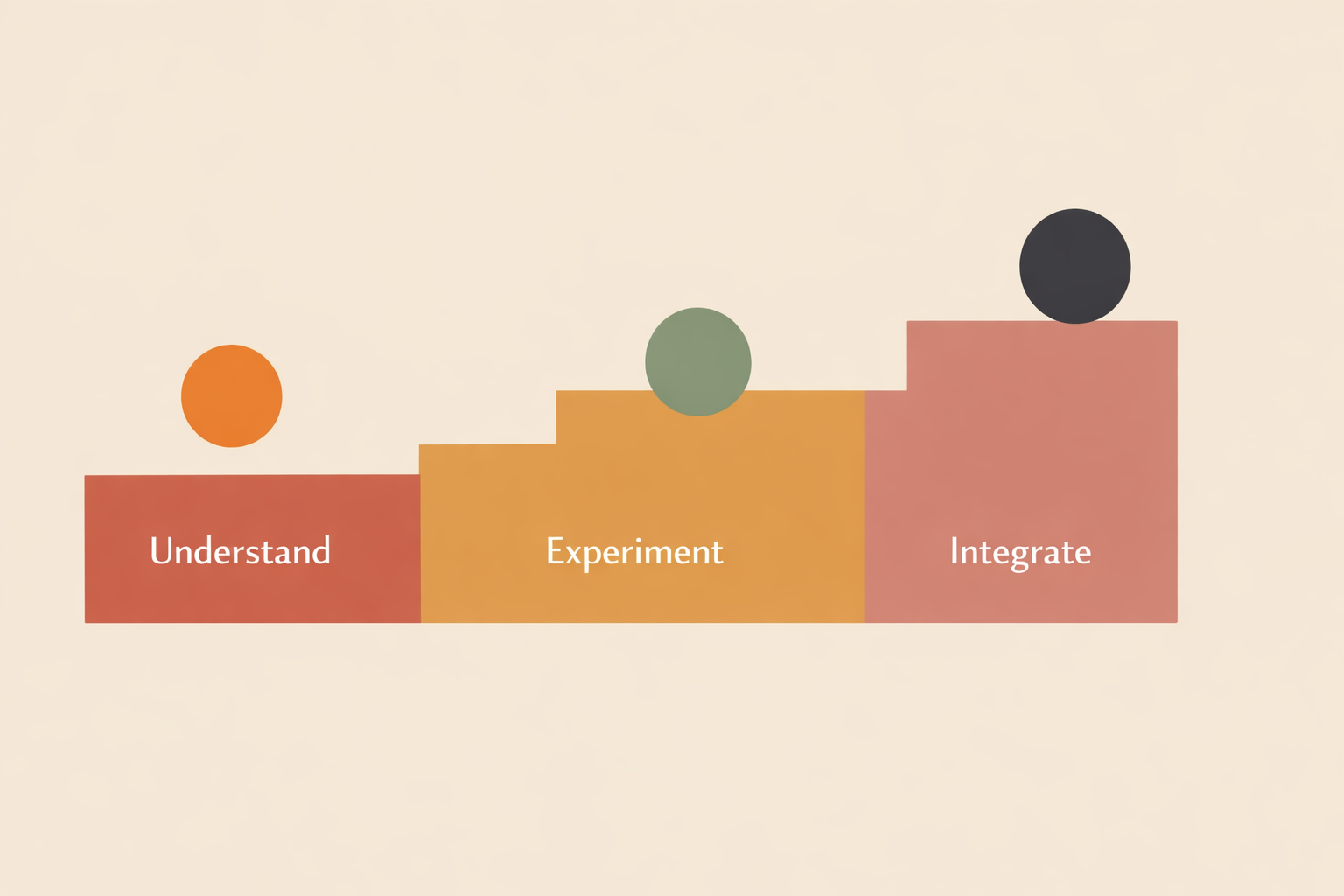
A steadier approach is a three-phase workshop arc: Understand, Experiment, Integrate. First, participants build a shared map of what’s changing. Then they test a few grounded practices. Finally, they turn what they learned into one realistic next step they can repeat in daily life.
Key Takeaway: Strong perimenopause and menopause workshops are easier to follow when they move through three clear phases: Understand, Experiment, Integrate. This flow helps participants locate themselves in the transition, explore practical responses without overwhelm, and leave with one usable plan for the coming days.
Mapping perimenopause, menopause, and postmenopause clearly
Start with orientation. People relax when they can place themselves on a shared map and stop guessing where they “should” be.
Menopause is the point of 12 months without a menstrual period. The phase after that milestone is postmenopause. The years leading up to it are perimenopause, when cycles, sleep, mood, energy, and temperature regulation can shift in uneven ways.
During perimenopause, ovarian hormones can fluctuate widely. That alone explains why two people of the same age can have very different experiences, and why symptoms don’t always follow a neat sequence.
This framing often brings relief. Many people expect menopause to arrive suddenly, or believe changes only “count” later in the transition. Naming the gradual, changeable nature of this phase softens self-blame and helps the group feel more compassionate from the start.
- Use a simple timeline: premenopause, perimenopause, menopause, postmenopause.
- Keep stage language visible on slides, whiteboards, or handouts.
- Invite participants to notice patterns rather than forcing a label too quickly.
A helpful facilitator line is: “Labels can be useful, but what matters most for today is what you’re noticing in daily life and what support feels realistic now.”
Phase 1: Understand through shared language and group safety
The first phase should lower pressure. Make the space feel clear, respectful, and voluntary.
Set the ground early: confidentiality, choice, non-judgment, and permission to pass. Participants don’t need to tell their full story to benefit from the session.
Then build shared language. A visual timeline works well, especially when paired with a few common statements that invite nuance rather than debate:
- “Menopause starts when symptoms start.”
- “Everyone gains weight.”
- “One hormone explains mood changes.”
Invite the group to sort statements into “accurate,” “partly accurate,” or “needs context.” Myths get corrected without shaming anyone for believing them.
Anonymous symptom mapping also fits beautifully here. Participants can mark concerns as current, occasional, not relevant, or private, giving you a live heatmap of what the room actually needs—without pressure to disclose.
When you reflect patterns back, keep it observational: “A lot of us are noticing sleep disruption and energy dips; some are tracking heat changes; others are more curious about mood or strength.” People feel seen, and the session stays group-centered.
- Opening line: “We’re building shared language first. Share only what feels useful.”
- Timeline prompt: “Mark any shifts you’ve noticed in cycles, sleep, energy, mood, movement, nourishment, or stress.”
- Facilitator reminder: variation is normal, and no one pattern defines everyone.
Phase 2: Experiment with practical support for everyday symptoms
Once the group has language for what’s happening, move into experiments. This is where participants stop collecting ideas and start learning what genuinely supports them.
A simple structure keeps things grounded: Symptom → Context → Possible trigger → Response tried → Result. The goal becomes observation and learning, not getting it “right.”
Invite each participant to choose one main focus for the week ahead, such as heat surges, sleep, mood, or fatigue. Then keep the experiments small enough to feel doable on an ordinary day.
Hot flashes, sleep, mood, and fatigue: simple experiments to test
Some participants will already see patterns around heat, energy, and stress. Others need a starting point. Offer options as prompts for exploration, not rules.
Warm environments, alcohol, spicy foods, stress spikes, sleep debt, irregular meals, caffeine timing, and over- or under-training are common triggers worth testing in practice, with plenty of individual variation.
- Hot flashes: try lighter layers, breathable fabrics, a bedside fan, planned hydration, or a cooler bedroom. Many people also benefit from pausing the moment and using grounding such as a 5-4-3-2-1 senses check.
- Sleep: test a fixed wake time for a week, a 45-minute wind-down with dimmer light and less stimulation, and a simple middle-of-the-night plan such as slow breathing, water, and avoiding clock-checking.
- Mood: experiment with morning light, easy movement, a brief check-in with someone supportive, or naming what you feel in a sentence instead of pushing it away.
- Fatigue: try a protein-forward breakfast, a midday walk or stretch, and a short non-scrolling rest break before the evening rush.
A concrete example helps: “Symptom: heat surge during a late-afternoon work call. Context: warm room, stress, second coffee. Possible trigger: caffeine plus tension. Response: water, stepped outside, three slow exhales. Result: shorter wave, less distress. Next experiment: decaf after noon and a two-minute reset before calls.”
Movement fits well here too. A broadly accepted baseline is 150 minutes of moderate movement each week, plus strength-focused work, adjusted to energy, capacity, and schedule. In workshops, the key is consistency and enjoyment, not intensity.
Weaving traditional practices into modern workshop plans
This phase is also where ancestral practices shine. Many people respond deeply when practical planning includes sensory anchors, familiar rituals, and culturally rooted ways of caring for themselves.
Nadi shodhana, or alternate-nostril breathing, can be a gentle evening practice for a busy mind. Restorative yoga or supported forward folds may feel soothing when heat or irritability is high. Short qi gong sequences can help some people meet the morning with more steadiness. Gentle self-massage with cooling oils may also deepen body awareness and comfort.
Herbal and food rituals can be explored in the same spirit. A cooling infusion such as peppermint, tulsi, or lemon balm may become a meaningful evening marker for winding down. Others feel steadier with warm, protein-rich breakfasts rooted in family tradition and simple menopause nutrition habits.
The important thing is respect. Invite participants to work with practices that feel accessible, grounded, and culturally honest to them, rather than borrowing symbols or rituals without context.
- “Choose two practices to test this week.”
- “Keep them small enough that you would still do them on a tired day.”
- “Notice what supports you, not what sounds ideal on paper.”
Perimenopause tends to evolve over time, so workshop plans work best when they stay flexible. What supports someone now may need adjusting later, and that’s a normal part of the transition.
Phase 3: Integrate learning into one realistic plan
The final phase is where the session becomes useful after the room empties. Participants don’t need an ambitious overhaul. They need one plan they are likely to follow.
Keep the focus on behavior rather than abstract outcomes. “I want more steady evenings” becomes “I will dim lights at 9 p.m. and do five slow breaths before bed.”
A simple reflection canvas can help:
- What I notice
- What may influence it
- What I will try
- What support I need
- When I will review it
This is also a good moment for implementation intentions. Framed as “If X happens, then I will do Y,” they make plans easier to follow when energy is low or symptoms flare. Research suggests implementation intentions can help turn intention into action.
- Sleep example: “If I wake in the night, then I will change layers, sip water, and take five slow breaths.”
- Heat example: “If a wave rises during a meeting, then I will pause, exhale slowly, and cool the room if I can.”
- Energy example: “If I miss my full walk, then I will do a five-minute stretch instead.”
Before closing, ask for a confidence score from 0 to 10. If the plan feels shaky, shrink it. A minimum version and a full version often work better than one perfect-looking plan, because participants can stay connected to the practice on difficult days too.
Holding clear boundaries with warmth and integrity
Menopause workshops are strongest when boundaries are clear. Participants usually feel safer when they understand what the space is for, and what it cannot provide.
Name your scope early. Let people know the session is for education, reflection, skill practice, and planning. It is not a space for individualized medical guidance, interpretation of lab work, or pressure to disclose private details.
You can be warm and firm at the same time. If someone asks something outside your role, acknowledge it and redirect with care: “That sounds important and personal. Let’s note what you’re noticing and what questions you may want to bring to a one-to-one professional conversation.”
Emotional safety matters too. Opt-in sharing, content warnings for sensitive topics, and agency-centered language make the room workable for more people, including those with complicated histories around body changes.
- In scope: education, group reflection, habit coaching, movement basics, breathwork, supportive planning.
- Out of scope: adjusting products or prescriptions, interpreting tests, handling crises in-session, or promising outcomes.
- Helpful guardrails: a short intake form, a private check-in route, and a clearly posted crisis support pathway.
Inclusive language should be visible throughout. Welcome all women and anyone with lived experience of perimenopause or menopause, including trans and nonbinary participants, and allow people to name themselves in the language that feels right to them.
Closing the workshop with clarity
A strong menopause workshop feels less like a lecture and more like a guided passage: first understanding, then experimentation, then integration. That arc matches how confidence is built during change.
Begin with a shared map. Move into a few compassionate experiments. End with one plan that fits real life. When you hold the structure well, participants leave with something more valuable than a pile of tips: practices they can return to tonight, next week, and as the transition continues to unfold in menopause coaching work and broader women's health coaching settings.
Menopause Coaching Certification
Build workshops that stick using the same Understand–Experiment–Integrate structure in the Menopause Coaching Certification.
Explore Menopause Coaching →










