When sessions stall, it’s tempting to add more: another technique, a longer protocol, another worksheet. Often, the real shift comes from spotting the pattern underneath. Mushroom-informed coaching borrows from fungal biology to give clients a grounded, shame-free way to see what’s happening and choose one small next step that actually fits.
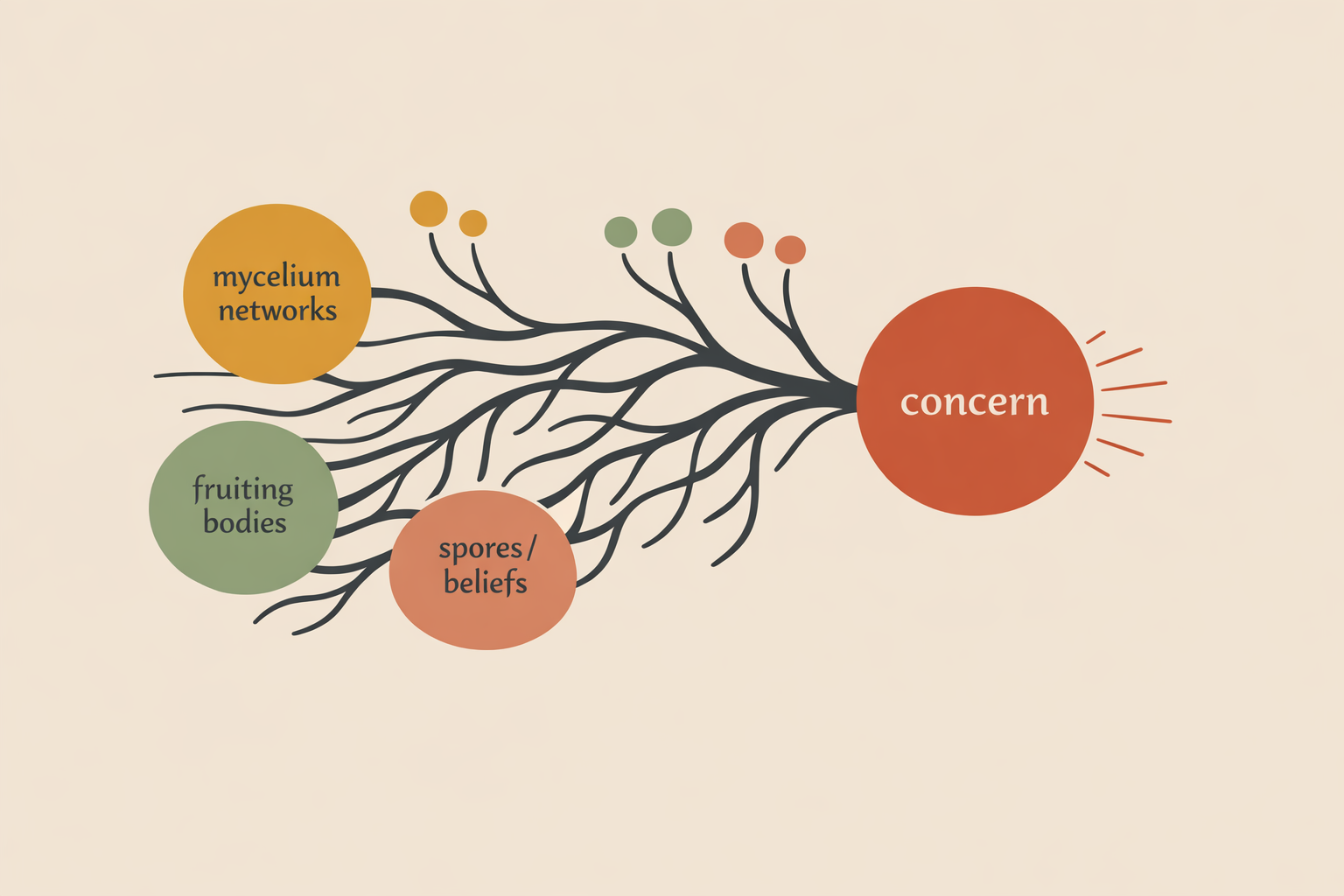
Three fungal ideas tend to translate especially well. Mycelium helps you map the hidden web shaping a client’s experience. Fruiting bodies help you treat visible flare-ups as signals worth listening to. Spores help you notice which beliefs and phrases are being repeated often enough to take root.
Key Takeaway: Use fungal biology as a practical session framework that turns insight into small, reliable moves. Mycelium helps you co-create a branching “hidden web” on paper, surface safety and stress nodes, and choose one tiny experiment. Fruiting bodies reframe visible flare-ups as temporary outputs that reveal conditions. Spores and stories help clients notice inherited beliefs, compost what no longer fits, and practice language aligned with the life they want to grow.
Mycelium Networks: Mapping the Hidden Web Beneath a Session
Start with what can’t be seen directly. In fungi, mycelium is the mostly hidden body that senses, explores, and responds to its environment. In sessions, that’s a helpful parallel for the “below-the-surface” forces that shape daily well-being: habits, protective strategies, relationship dynamics, internal rules, and quiet sources of steadiness.
Mycelium grows as a branching network, adapting around obstacles as it moves toward nourishment. Many clients soften when you name this. The focus shifts from self-blame to curiosity: what has their system been growing toward, and what conditions would help it grow differently now?
Bring the idea to life with a simple map. Put the current concern in a circle at the center of a page, then branch outward into conditions around it: sleep rhythm, food timing, work pressure, money strain, family expectations, movement, solitude, community, digital load, seasonal changes, or ancestral patterns. Let each branch split again where it’s useful. The goal is to see the ecosystem, not to create a “problem list.”
Here is a simple 7-minute structure:
- Minute 1: Name the visible issue in plain language.
- Minutes 2–4: Ask, “What feeds this?” and “What protects you here?” Go deeper if it helps.
- Minute 5: Circle two supportive nodes that could be nourished this week.
- Minutes 6–7: Choose one tiny daily experiment and write it as a single sentence.
This can create clarity fast. A client might arrive focused on irritability at work and then see the real web: broken sleep, no pause between tasks, people-pleasing, and no transition between work and home. Once the web is visible, the next move becomes smaller and wiser.
Repetition strengthens what you’re building. Fungal networks reinforce resource pathways, forming durable routes. Humans also consolidate learning through task repetition. In practice, a two-minute daily touchpoint often outperforms a grand plan that happens once.
A helpful script is: “Let’s choose one pathway you want more of. What’s the smallest daily touchpoint that would feed it?” If it’s too big, scale it down until it’s genuinely doable. Mycelial change is steady work.
Keep the client’s adaptations honored. “Your system learned this for a reason. We don’t need to fight it. We can feed a different pathway.” That tone invites collaboration and reduces inner resistance.
Hold clear scope as you map. If the process brings up serious safety concerns or needs beyond your role, name that directly and support the client in accessing appropriate help, while keeping your own work grounded in manageable, supportive practices.
Fruiting Bodies: Turning Flare-Ups into Insight
Once the hidden web is on the page, visible spikes start to make sense. In fungal life, the mushroom isn’t the whole organism; it’s the visible expression that appears when underlying conditions are right. Flare-ups often work the same way.
When a client says, “I lost it again” or “I’m back at square one,” you can reframe the moment as a “fruiting body.” The outburst, shutdown, tears, overworking, or sharp self-talk is the visible cap. The coaching question becomes: which conditions made it more likely to appear?
This shift reduces shame and increases usefulness. Instead of arguing about failure, you explore the ecology underneath: overextension, unmet needs, conflict, sensory overload, lack of rest, isolation, or an old protective script activating quickly.
A quick five-minute practice works well here:
- Name the cap: describe what happened in one concrete sentence.
- Trace the hyphae: list three conditions in the hours beforehand.
- Circle one condition that can be influenced next time.
Clients often feel immediate relief because the moment becomes workable. Pattern recognition builds, too. When people track timelines or spike dates, they frequently notice clusters around certain triggers or times of week, which can guide more precise support.
You can deepen this with a simple rhythm check: weekdays, weekends, recurring meetings, family contact, travel days, menstrual cycle phases if relevant, or any meaningful cycle. Ask, “Which patterns repeat most often?” Then choose one anticipatory action for that window.
Language helps keep the client in relationship with what happened:
- “This was a signal, not a personal failure.”
- “Something in the conditions lined up. Let’s see what it was.”
- “What would support look like before the next cap appears?”
A simple phone note after a tough moment can be enough to keep momentum:
- What was the cap?
- What three conditions fed it?
- What is one two-minute support for tomorrow?
Over time, clients learn that spikes aren’t random. They carry information the nervous system and daily schedule are already offering.
Spores and Stories: Choosing What Gets Repeated
The third fungal idea is propagation. Spores travel widely and, when conditions fit, begin new growth. As a coaching frame, spores map neatly onto repeated phrases, inherited beliefs, family rules, and cultural messages. Some pass through. Others settle in and shape choices, posture, and inner voice for years.
That’s why story work matters. It’s less about “winning an argument” with old language and more about noticing what’s being repeated often enough to take root.
A practical starting point is a Spore Inventory. Invite the client to make three columns:
- Kept Spores
- Compost
- New Seeds
They list phrases absorbed from family, school, work, community, and media. A kept spore might be, “We show up for one another.” A composted spore might be, “Rest is lazy.” A new seed might be, “Boundaries protect what matters.” Even before deeper discussion, clients often notice which phrases tighten the body and which create space.
Next, anchor new language in values rather than performance. Ask, “What do you want your life to grow toward here: steadiness, courage, tenderness, creativity, honesty?” When a phrase is connected to a value, it has roots and tends to feel more believable.
Here is a straightforward 10-minute structure:
- List five inherited phrases that surface during stress.
- Circle one that consistently narrows the body or inner world.
- Move it to Compost.
- Write one values-aligned counter-seed.
- Say the new phrase aloud twice.
For clients who appreciate a research bridge, it can help to note that mushroom scholarship increasingly discusses NGF and BDNF in relation to certain mushroom compounds and learning-related pathways. The practical takeaway stays the same: repeated, nourishing contact reshapes both stories and conditions over time. More broadly, practice improves skills and supports lasting change.
A compassionate line here is: “Some spores land without our consent. We can still choose which ones we tend.” It respects history while restoring agency.
If you want to keep the work mushroom-informed without making it product-centered, non-ingestive practices can be especially elegant within plant medicine learning:
- Sit beside a decaying log and journal on what is breaking down and what is feeding new life.
- Draw three spores you want to keep this season and give each one a color or texture.
- Write an old phrase on paper, tear it up, and place it in compost. Speak the new phrase aloud.
Small rituals like these help new language become embodied, not just discussed.
Weaving the Three Ideas Together in Real Sessions
Together, these ideas create an easy session rhythm. Mycelium maps the hidden web. Fruiting bodies help clients learn from visible spikes without shame. Spores keep attention on what’s being repeated and what the client wants to grow next.
Over a month, a simple progression can look like this:
- Week 1: Build the mycelium map and choose one two-minute daily support.
- Week 2: Track flare-up patterns and identify one predictable trigger window.
- Week 3: Complete a Spore Inventory and practice one new values-aligned phrase.
- Week 4: Reflect on what actually helped, keep what nourished, and compost what did not.
This pace stays practical while still feeling human. It also fits a traditional way of learning: observe nature closely, notice patterns, then adjust gently and consistently, a rhythm that also suits medicinal mushrooms study.
Like fungal networks, growth often happens quietly through repetition and the right conditions. Map the web, learn from the caps, and choose your spores with care. For most clients, that’s enough to get sessions moving again.
To close with a grounded caution: keep your scope clear, avoid making health claims, and treat these frameworks as reflective tools rather than guarantees. When something bigger than coaching shows up, it deserves the right kind of support. Within your role, though, these three fungal lenses can bring steadiness, clarity, and forward motion.
Explore Mushroom Foundations
Connect these coaching frameworks to core mycology with the Foundations of Medicinal Mushrooms Certification.
Explore Foundations →