


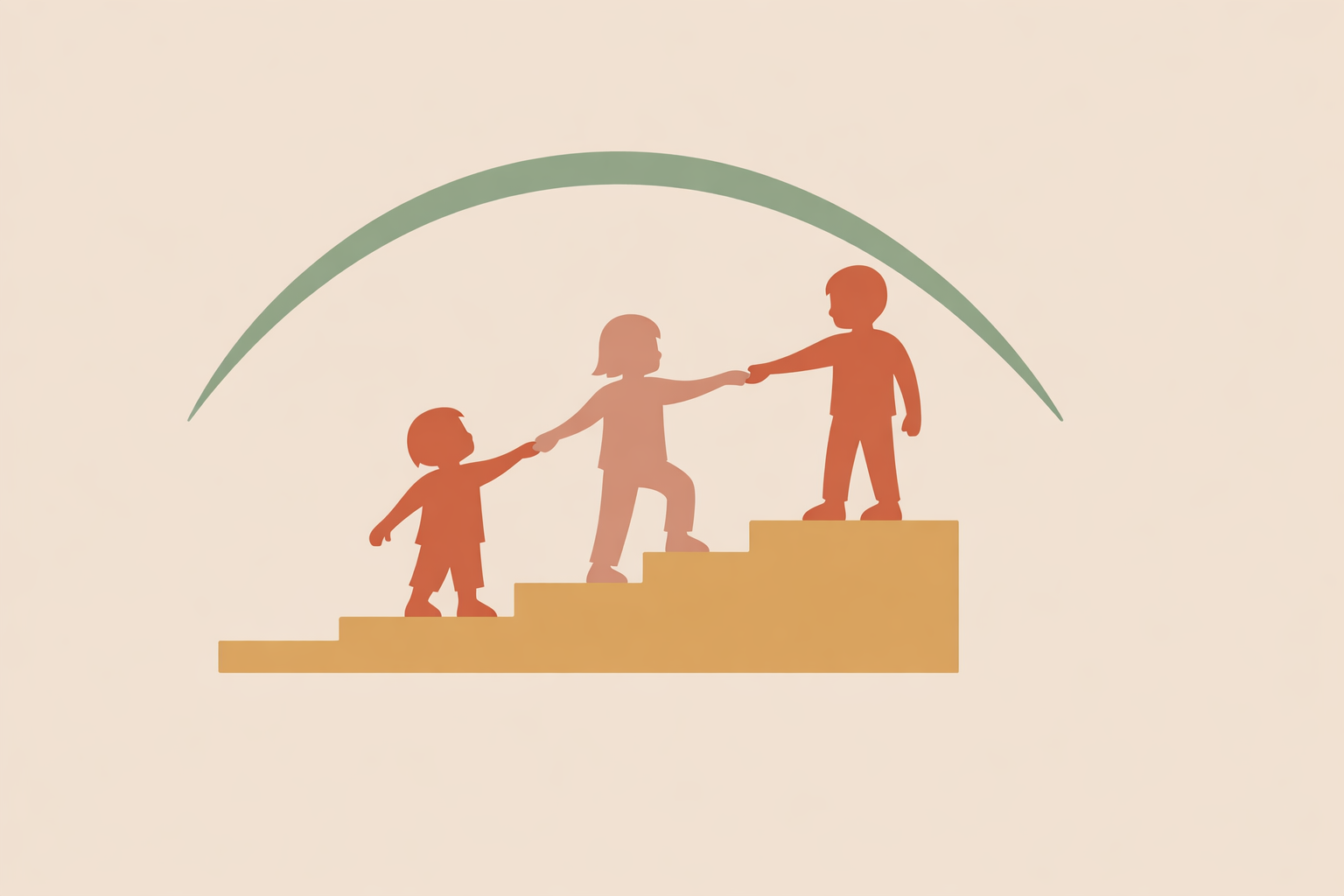
Age-based plans can fall apart quickly in child coaching. A child who speaks in full sentences may still struggle with transitions. Another may reason well in one area but find it hard to read social cues or pause before reacting.
Plans hold better when they start with developmental fit. When you plan around attention span, language level, play style, and self-regulation, you can choose supports the child can use right now, then stretch one step further. That usually leads to calmer sessions, clearer notes, and learning that travels into daily life.
Key Takeaway: Effective child coaching plans to current developmental capacities and then stretches one step. Stage-informed planning helps you replace fixed scripts with a live view of what the child can do now, what support helps, and what the next small challenge should be. For younger children, that usually means co-regulation, play, brief rituals, and tiny goals. For school-age children, it means concrete maps, shared problem-solving, and observable targets. For teens, it means collaborative structure, clear boundaries, and respect for autonomy. Across all ages, culture and family wisdom help make the work more relevant, respectful, and effective.
Why developmental stages matter more than fixed scripts
Developmental stages are most helpful when they sharpen your view of the child in front of you, rather than turning into labels. Scripts often break down because they assume readiness that isn’t there. Early-childhood guidance consistently emphasizes following interests instead of forcing fixed, age-based activities.
Observed capacities usually guide planning better than age alone. Attention span, language, play style, flexibility, and how quickly a child recovers after frustration tell you what will work today. When practice stays within reach, skills build more steadily and carry beyond the coaching space.
Keep it grounded in real life. What looks like “poor attention” late in the day can be tiredness, hunger, or sensory overload. And if a child can’t yet notice body signals or name basic feelings, long verbal reflection tends to miss the mark. Awareness comes first, and the conversation deepens as the child gains language for what they feel.
Small shifts change the tone fast. Instead of “Why did you get angry?” try, “Show me what happened first, next, and last.” Concrete sequencing, movement, props, and visual choices often bring the most useful information to the surface.
Turn developmental stages into a live planning lens
A practical planning lens begins with three questions: Where is this child now? What helps them join in? What is the next small stretch?
This keeps the focus on participation rather than judgment. You’re observing what happens, what conditions support success, and what kind of help makes the next step doable.
- Can the child follow one- or two-step directions?
- Do they show meaning better through words, movement, pictures, or play?
- What helps them settle: rhythm, movement, routine, visual structure, or a familiar adult?
- How quickly do they recover when something changes?
Then you match the session to what you see. That might mean simpler language, shorter activity cycles, visual supports, movement breaks, or involving a trusted adult for co-regulation. Meet the child where they are, then stretch gently.
Modeling matters. Children learn most reliably through demonstration and guided repetition. So rather than explaining “calm down,” you breathe first, pause first, and practice the sequence together before inviting independence.
Clear boundaries support the process. Explain in simple language what stays private, what may be shared with parents or caregivers, and why. In notes, capture what happened plainly: “Ari left their seat three times during writing and returned after a stand-stretch-breathe prompt.” Then keep interpretation separate: “Short movement breaks may support task re-entry.”
Planning early childhood sessions: co-regulation, play, and tiny goals
With toddlers and preschoolers, sessions work best when they’re brief, concrete, and strongly supported by adult calm. At this stage, play is a primary learning language, and the adult’s steadiness becomes part of the learning environment. UNICEF guidance emphasizes that young children learn through play and that supportive relationships matter deeply for well-being.
So plan for short cycles, repetition, and simple rituals. Participation is the win: naming, choosing, waiting, and trying again.
- Use short activities with a clear beginning and end.
- Prefer “show me” over “tell me why.”
- Use puppets, cards, rhythm, movement, and sensory cues.
- Keep goals tiny and observable.
- Include the adult’s calm presence as part of the plan, not as an afterthought.
Co-regulation is foundational here. The adult helps organize the moment first, and self-direction grows from that repeated experience. Rituals add predictability: a bell, a song, three breaths, a feelings card, a closing phrase.
A simple plan for a four-year-old who hits when frustrated might include:
- Opening ritual: three breaths and a familiar object.
- Feelings match: choose a card that fits the moment.
- Puppet story: act out a conflict using body-signal language.
- Pause practice: stop, choose, try again.
- Caregiver bridge: one short home cue to repeat during the week.
Family culture can strengthen this work. A familiar melody, household phrase, or story pattern often helps a child settle and recognize the skill as part of everyday life. Traditional stories and home rituals are especially helpful when they genuinely belong to the child’s own world.
Planning middle childhood sessions: concrete skills and shared problem-solving
In middle childhood, many children can think through concrete events, compare options, and reflect on rules, fairness, and consequences. That opens the door to collaborative skill-building, as long as the work stays practical.
A reliable tool is an event map: situation, thought, feeling or body signal, and action. Sketch it together, then explore what another action could look like next time.
Problem-solving can also be taught as a visible process: define the problem, name the goal, generate options, choose one, test it, and review what happened. When it feels game-like and clear, participation often rises.
At this age, specific goals work well:
- Listen without interrupting for one minute.
- Ask what happened before reacting.
- Offer two possible solutions.
- Use an agreed pause phrase during conflict.
Track progress with practical markers, not vague outcomes. Did the child use the phrase? Did they return after a pause? Could they name the feeling before acting? Concrete progress is easier to celebrate and build on.
Planning adolescent sessions: autonomy with structure
Adolescents typically engage best when the work is collaborative. They want respect, clarity, and room to think for themselves. Structure still matters, and it works best when it supports ownership.
That’s why frameworks such as GROW or CLEAR can be helpful in coaching. They offer enough shape to organize reflection while leaving space for the teen’s own language and priorities.
A teen planning conversation may move through:
- What do you want?
- What is getting in the way right now?
- What options seem realistic?
- What will you actually try this week?
Many teens stay engaged longer when sessions include variety rather than one continuous conversation. Journaling, scenario analysis, brief rehearsal, scaling questions, and between-session experiments work well in combination.
Explain privacy expectations early and plainly. Teens often share more openly when they understand what will remain private, what may be shared, and how boundaries are handled. Clear agreements reduce guesswork and build trust.
Developmental fit still matters here. A teen may sound highly articulate and still need strong support with organization, follow-through, or emotional pacing. Respecting autonomy includes offering structure without talking down.
Weaving culture, family, and traditional wisdom into developmental planning
A developmental plan gets stronger when it’s grounded in the child’s cultural world. Communication norms, emotional expression, ideas about independence, and meanings of respect are shaped by context. WHO-linked guidance notes that development and learning are influenced culturally.
So ask families direct, respectful questions:
- What helps your child feel safe enough to join in?
- What does respect look like in your home?
- Which words, rhythms, stories, or routines feel familiar and supportive?
- Are there any approaches that would feel uncomfortable or out of place?
Traditional stories can be powerful when they truly belong to the child’s culture. UNICEF guidance supports the use of traditional stories to connect children with community culture. In coaching, these stories often become natural bridges for discussing courage, patience, choice, responsibility, or repair.
Family rituals can serve the same role. A repeated phrase from a grandparent, a rhythm used before meals, a blessing, a song, or a familiar pause in the day can become an anchor for regulation and reflection when used respectfully and with consent.
This work calls for care. Cultural responsiveness means listening well, staying within what the family recognizes as theirs, and adapting in ways that feel grounded rather than decorative.
Make developmental planning a steady habit
Developmentally attuned coaching comes down to a reliable habit: match today’s plan to today’s capacity, then stretch gently through experience.
A short pre-session checklist helps keep that habit steady:
- What are today’s likely capacities for attention, language, regulation, and independence?
- What is the one primary skill for this session?
- What support will help the child participate?
- How will the skill be practiced in a concrete way?
- What choice can the child meaningfully make?
- How will culture, family rhythm, or familiar language be reflected?
- What is one small between-session experiment?
- What will you record about what helped?
Across traditional wisdom and contemporary developmental thinking, the same principle keeps returning: children grow best through respectful relationships and well-matched practice. Supportive relationships are widely recognized as central to healthy development, echoed in supportive relationships research and long-standing practitioner experience.
To close, stay close to what you can observe and what the family already does well. Start with strengths, interests, existing coping, and home resources. Measure progress by participation, flexibility, recovery, and real-world use of the skill, whether you work in child and adolescent development more broadly or in a focused child psychology coaching role.
As with any work with children, plans should be adapted to the individual, the setting, and the family’s values. When something feels stuck, reduce complexity, return to co-regulation and concrete practice, and consult appropriately within your professional scope.
Train in Child Psychology Coaching
Build stage-matched coaching plans with deeper skills in the Child Psychology Coach Certification.
Explore Child Psychology Coach Certification →










