


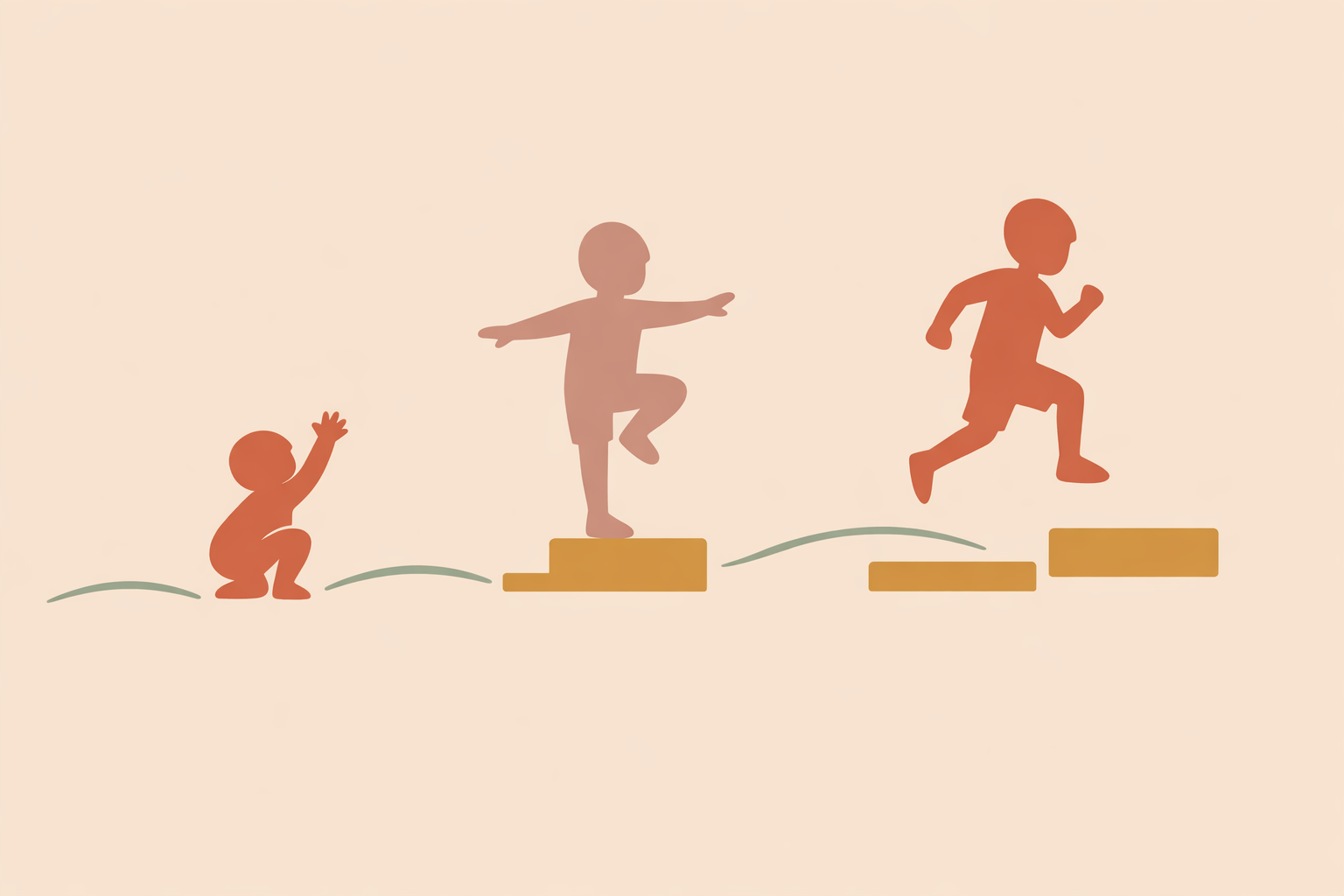
Goal-setting with children tends to lose steam when the plan is borrowed from adult templates instead of shaped around the child’s body. A session aimed at attention or fine-motor skills can stall fast when a three-year-old needs to climb, a seven-year-old hits an awkward coordination week, or a caregiver points out the activities don’t fit family life. That’s often when coaches get pulled into pushing drills and chasing compliance—right when engagement could have been easiest.
Physical development is often the most reliable starting point. When the body is treated as a first teacher, coaching naturally organizes itself around movement, sensation, and stage-appropriate challenge. From there, attention, language, emotional steadiness, and relationships become much easier to support because the child is already “in” the learning.
Key Takeaway: Let physical development lead goal-setting by anchoring plans in movement and sensory experience the child can succeed with and enjoy. Clear, body-based targets stay aligned with real-life family rhythms while creating natural entry points into attention, self-regulation, communication, and social confidence.
Turn physical milestones into clear, playful coaching targets
Milestones work best as guideposts, not grades. They help translate development into observable, playful targets that respect pace, personality, and context.
A simple approach is to choose one or two physical skills and build a few small activities around them. Instead of “improve focus,” aim for hopping, catching, climbing, balance, grip strength, or hand coordination—skills children can feel in their bodies and adults can easily notice.
These movement targets don’t stay “just physical.” Research suggests movement interventions can support cognitive domains, which is part of why playful physical goals often create surprisingly broad progress.
Keep it light and workable:
- Select 1–2 stage-appropriate skills (for example, hopping on one foot or opening and closing scissors).
- Create 2–3 playful micro-activities for each skill.
- Track one visible behavior, such as “balances for 5 seconds” or “catches the ball after one bounce.”
- Increase challenge gently as confidence grows.
Concrete goals create quicker wins, and those wins build momentum. Repeated success and specific movement prompts can encourage participation—and participation is where focus, identity, and joyful effort start to show up.
Use movement to support attention, feelings, and relationships
Physical goals don’t need to stay in a “physical” box. In practice, they’re often the easiest place to build attention, self-regulation, communication, and social confidence because children are already engaged.
Movement-rich experiences can support multiple developmental areas at once. Children often tune in more fully when they can move, and movement can increase attention, along with memory, perception, language, emotion, and decision-making. What this means is you can work on “whole-child” outcomes without making the session feel heavy or overly verbal.
Group movement creates real-time social practice. Cooperative games and partner tasks can strengthen teamwork, belonging, and resilience. Turn-taking, waiting, encouraging a peer, and trying again after a wobble become part of the learning—naturally.
Physical challenge is also one of the most practical places to build emotional steadiness. A missed throw or a frustrating new pattern gives you a live moment to name feelings, pause, and reset. Guidance for physical development highlights acknowledging emotions and encouraging children to try again after setbacks.
Helpful micro-goals include:
- Pause for two breaths after a miss.
- Listen for three cues before moving.
- Encourage a partner during a shared game.
- Ask for help instead of giving up.
Confidence is the quiet engine under all of this. As Christine Derengowski reminds us, “Never miss an opportunity to make a kid feel better about themselves. When they feel good… they learn better, behave better, and act better toward others.” Strength built through the body often travels into school, friendships, and home life.
Adapt goals for growth spurts, uneven development, and individual differences
Development is rarely linear. Children can look coordinated one week and awkward the next, especially when growth spurts, fatigue, confidence, or life changes are in the mix.
That’s why rigid plans so often fall apart. One child may temporarily need more climbing and less fine-motor demand, shorter practice bursts, or more recovery between efforts. Another may need simpler movement patterns before returning to a skill that seemed easy a month ago. Put simply: when the body is reorganizing, the plan should reorganize too.
Chronological age only tells part of the story. Two children the same age can differ widely in movement experience, maturity, and readiness for challenge. A body-led coach watches the child in front of them rather than assuming age provides the full answer.
When coordination dips or behavior deteriorates, treat it as information rather than resistance. Lower the load, simplify the task, model more, and protect dignity. The fastest progress usually comes from a better match between today’s capacity and today’s demand—not from more pressure.
Co-create movement goals with families and communities
Shared goals last longer. When families help shape the plan, movement practice fits daily life more naturally and feels less like another task to manage.
Family-centered coaching works best when it builds on what already exists: home routines, cultural games, walks, dancing, helping tasks, neighborhood play, and the space the family actually has. This approach respects family knowledge rather than replacing it.
Research on family-centered support emphasizes using everyday routines and strengthening development through the important adults around the child. Essentially, the plan becomes more durable when it lives inside ordinary moments.
Co-creation can stay very simple:
- Ask what movement already happens at home.
- Choose goals that would make daily life smoother.
- Attach practice to routines the family already keeps.
- Use the family’s own words for qualities like calm, strong, steady, or brave.
For educators and child-development professionals, high-quality coaching depends on careful observation and individualized feedback. With families, the principle is the same: listen well, notice what’s working, and decide the next step together.
Blend simple self-awareness and social-emotional language into movement coaching
Movement gives immediate feedback, which makes it an ideal place to build self-awareness. Short, concrete language helps children notice what’s happening, steady themselves, and make better choices in the moment.
This doesn’t need to be complicated. During a balance task, obstacle course, or partner game, simple scripts can support reflection and action:
- Notice–Pause–Choose
- Stop–Think–Act
- “This is new, not impossible.”
- “What is the safe choice?”
- “What is the kind choice?”
These cues work because movement creates fast learning loops: wobble, breathe, adjust, try again. Miss, recalibrate, and improve. Children benefit from repeated success and encouragement during movement activities, and over time that supports readiness and confidence.
As Flaherty framed coaching, it’s “not telling people what to do,” but giving them a chance to examine intentions and build self-esteem. With children, movement often makes that process more tangible—something they can feel and practice immediately.
Review and recalibrate goals as the child changes
A good plan stays alive. Children change quickly, so goals need a simple review rhythm to stay relevant.
You don’t need a heavy system. A light cycle of planning, observing, practicing, reflecting, and adjusting usually keeps the work on track:
- Plan: Choose 1–2 goals and name why they matter.
- Observe: Watch movement quality, energy, attention, and social responses.
- Practice: Keep repetitions short, playful, and achievable.
- Reflect: Ask what felt easy, hard, fun, or frustrating.
- Adjust: Change the challenge, pace, or support based on what you learned.
Keep cues brief and concrete, and pair words with demonstration. Look beyond task completion: stance stability, willingness to try again, comfort with peers, and overall effort quality often tell you more than a pass/fail outcome.
Over time, this protects against narrow coaching. Instead of chasing early performance ideals, you stay focused on broad skill foundations, social ease, and durable confidence.
Let the body lead the plan
When coaching begins in the body, the whole plan becomes clearer. Watching how a child balances, climbs, breathes, coordinates, and plays gives a practical compass for goals that also support thinking, emotional steadiness, and relationships.
Prioritize joy, safety, and well-being over adult-style performance. Treat milestones as guideposts, not deadlines. Build with families, respect cultural rhythms, and keep goals flexible enough to move with growth, fatigue, curiosity, and changing seasons of development.
A body-led approach often looks refreshingly simple: regular movement, playful repetition, short bursts of effort, quick wins, and enough freedom for the child to stay engaged. With time, that simplicity becomes powerful—supporting not only strength and coordination, but a steadier, more connected way of showing up in everyday life.
Master Child Psychology Coaching
Connect movement-led goals to deeper behavior and development work in the Child Psychology Coach Certification.
Explore Child Psychology Coach Certification →










