Many practitioners use mapping at the start of a client series, then set it aside. It often feels clarifying in the moment, but a static map stops matching real life. Context changes, roles shift, and the work can drift back into isolated problem-solving.
Systems mapping stays useful when it’s treated as a living practice from intake through wrap-up. As the map evolves with the client, it becomes a steady way to notice patterns, choose grounded next steps, and keep choices anchored in real context.
Key Takeaway: Systems mapping becomes far more useful when it is revisited across a full client series rather than used as a one-off exercise. A living map helps clients see how relationships, routines, resources, timing, and boundaries shape outcomes. With clear agreements around scope, visibility, and information handling, the map can guide small, reversible experiments from intake to wrap-up while supporting reflection, choice, and integration.
Before session one: scope the system and agree a map contract
Good mapping starts before the first line is drawn. Agree the purpose, boundaries, and handling of the map so you and the client both know what you’re creating and how it will be used.
A helpful opening question is: “What would become clearer if we mapped this together?” Then define a bounded system of interest, such as a transition, a decision, a relationship pattern, or a recurring challenge.
Use plain, pressure-free language. For example: “This is a working picture of your perspective today. It isn’t objective truth. We can revise it whenever needed.”
A short map contract can sit inside intake or your working agreement. Useful points include:
- Purpose: clarify a change, understand obstacles, prepare a decision, or review progress.
- Scope: what is in and out of the map, including any cultural or family boundaries that should be respected.
- Visibility: who can see it, if anyone beyond the client.
- Storage: where it is kept, for how long, and how deletion works.
- Permission: the client can pause, redirect, or stop mapping at any time.
Clear agreements around confidentiality, information exchange, and record handling are part of sound professional practice, and clear agreements matter especially when the work is visual.
If a third party is involved, clarify whose goals you’re prioritizing from the outset. Ethical guidance emphasizes clarifying expectations with both the individual and any sponsor so boundaries stay clean.
Even a small footer can help: “Visible to: client only. Purpose: decision clarity. Delete on request anytime.” Simple wording often lowers tension more effectively than a long disclaimer.
Intake as your first systems map
Intake already functions as mapping. Even before you sketch anything, clients naturally describe connections between goals, relationships, constraints, environments, and resources.
Listen for layers rather than isolated facts. Useful layers often include:
- goals and values
- people and roles
- environments and material realities
- beliefs and assumptions
- resources and supports
- timing, cycles, and pressure points
This creates a rough context map in words. It also highlights what’s already working, not only what feels hard, which leads to stronger next steps.
For example, an intake note might read: “Aim: calmer evenings with two young children. Stakeholders: partner on late shifts, neighbor for carpool, grandmother at weekends, teacher with homework expectations. Environment: small kitchen, shared bedroom. Resources: slow cooker, story ritual, noise-cancelling headphones. Constraints: 7:15 bedtime and rotating schedules.” By the end of the first conversation, the system is already visible.
Designing the baseline map: actors, factors, and context
The best baseline map is usually the simplest one that fits the client’s question. Complexity is optional; clarity isn’t.
A practical client map often blends two layers:
- Actors: the people, groups, or institutions involved.
- Factors: the beliefs, routines, constraints, timings, places, and resources shaping the pattern.
Then you add relationships. Placement, direction, distance, and clustering often reveal more than a long explanation.
A steady baseline structure uses five layers:
- Situation: the central focus.
- Actors: key people or groups.
- Factors: pressures, assumptions, resources, habits, or structures.
- Relationships: arrows, supports, tensions, dependencies.
- Time: deadlines, seasons, weekly rhythms, recurring cycles.
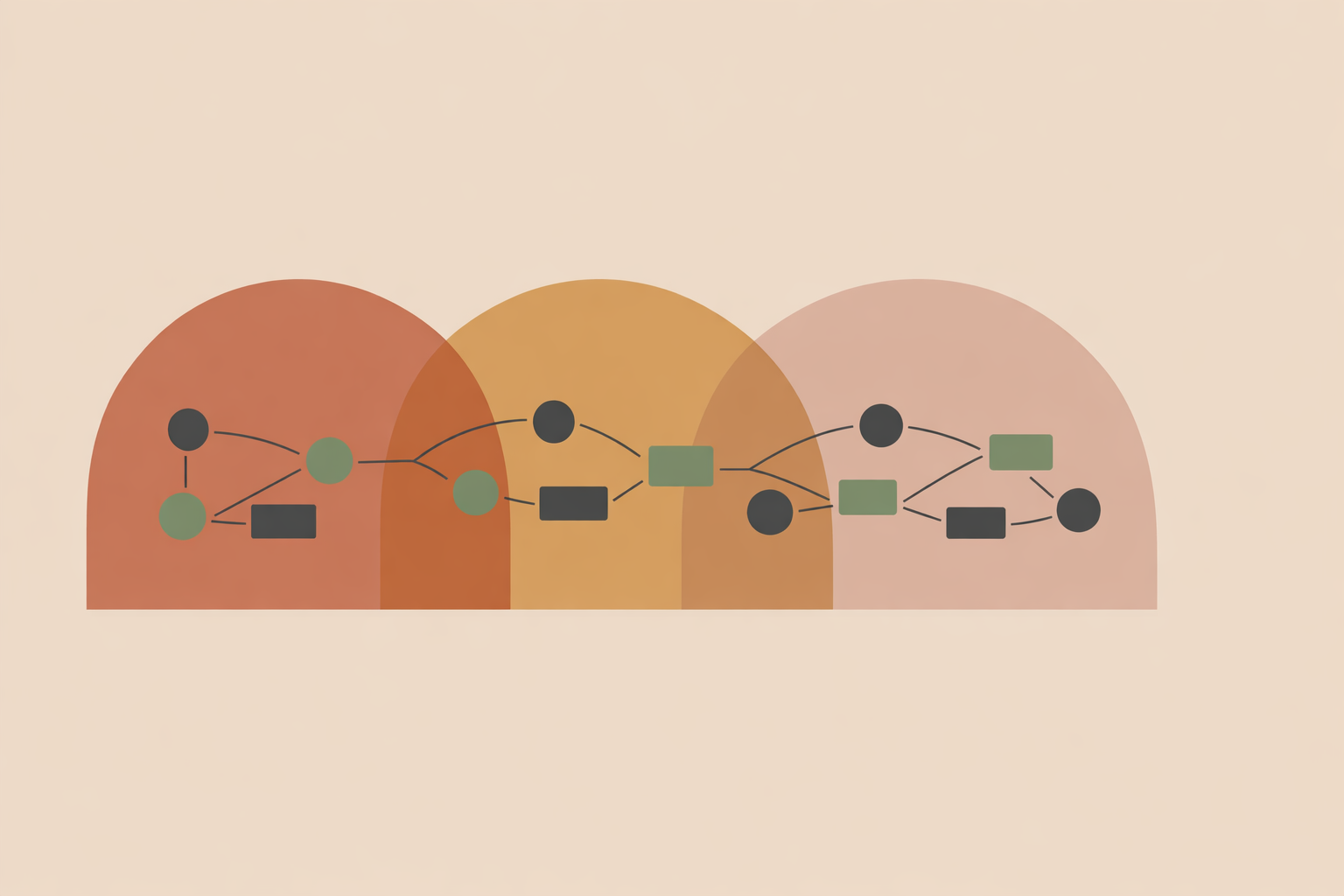
If the situation is fairly clear, a clustered center-out map works well. If it feels emotionally dense or layered, a richer picture with places, symbols, and short annotations can hold nuance without over-explaining.
Small visual shifts can change the work. Moving “Mentor” closer to “Confidence,” or “Childcare waitlist” closer to “Available hours,” often reveals the next experiment. The map becomes a shared way of thinking, not just a record.
Using the map across sessions: feedback loops and small experiments
A systems map becomes powerful when it’s updated. Revisit it each session, change what no longer fits, and look for loops rather than one-way explanations in line with systems thinking.
Feedback loops keep the work grounded. Some loops reinforce a pattern; others stabilize it. When the loop becomes visible, the next step often becomes obvious and practical.
For example:
- Reinforcing loop: late-night work leads to praise, which leads to more late-night work.
- Balancing loop: an evening boundary leads to less email, which supports earlier rest and less spillover the next day.
Versioning helps clients feel continuity. A light label like “v1.2, Session 3, testing evening phone boundary” makes progress tangible and reduces the sense of starting over each time.
From there, choose small, reversible experiments at likely leverage points. Communication boundaries, routines, environmental cues, assumptions, and supportive relationships all count. The aim is learning from the system, not forcing a perfect answer.
A two-week experiment might be placing the phone outside the bedroom at 8 pm, or arranging a recurring childcare swap one evening a week. Small moves placed well can influence several connected nodes at once.
This approach also reduces the pull to explain everything through willpower. When loops and supports are visible, change becomes a matter of smarter design.
Staying ethical: information flows, consent, and digital tools
Visual work can hold a lot of personal detail, so information handling deserves as much care as the mapping itself. A clear, helpful map can still create exposure if access, retention, or sharing are vague.
Map your own information flow with the same discipline you bring to client mapping. Notice where details travel: intake forms, email, calendars, video calls, digital boards, notes, client portals, billing tools, or supervision records.
For each place, ask:
- What is being collected?
- Why is it needed?
- Who can access it?
- How long is it kept?
- How can it be removed if requested?
Professional guidance supports secure handling of records and communications, including electronic files, so secure storage belongs in your process from the beginning.
Use the minimum level of detail needed on any shared visual. Initials, roles, or neutral labels are often enough. Broad categories such as “family pressure” or “legal issue” can be more appropriate than highly specific wording.
Digital whiteboards make maps easy to update and share, but they also raise practical questions about access and retention. Consent matters here too. Ethical guidance stresses consent before recording, which is why many practitioners avoid recording or auto-transcription unless there’s a clear reason and explicit agreement.
It also helps to stay within your competence and keep scope clean. Ethical standards advise practitioners to work within competence and refer onward when needs move beyond what’s agreed.
Finally, remember that diagrams are optional. Some clients do better with spoken reflection, story, metaphor, or seasonal review. The method should serve the person.
Final map and wrap-up: handing the system back to the client
Wrap-up is part of the mapping practice, not an afterthought. It’s a chance to return the client to their own way of seeing and choosing.
A simple method is to place the opening map beside the current one and reflect on what changed. Sometimes the later map becomes simpler because priorities sharpen. Sometimes it becomes richer because the client can finally see the full system.
Useful closing questions include:
- Which relationships or influences proved most significant?
- What experiments shifted the pattern?
- What supports are now clearly worth protecting?
- What early signs suggest the old pattern is returning?
- What practices or boundaries feel sustainable going forward?
A one-page closing map can include:
- Original focus
- Key shifts
- Experiments tried
- Supports to keep
- Watch-fors
- Next steps
It’s also reasonable to evaluate the series using client-defined indicators such as clearer priorities, stronger pattern language, steadier boundaries, or more confidence in responding to change. Those markers often reflect the real value of systems work better than forced scoring.
What matters most is that the client leaves with something they can keep using. For some, that’s a final visual map. For others, it’s a seasonal journaling practice, a reflection ritual, or a small set of questions to return to when life gets tangled again.
Conclusion: systems mapping from intake to wrap-up
Systems mapping works best as a steady rhythm: scope, agree, listen, map, test, revisit, and integrate. Used across a full client series, it helps people see their context clearly and make choices that fit the reality they’re living.
Start small. Choose one well-bounded question, co-create a baseline map, and return to it often enough that it stays alive. Let modest experiments show you where support, friction, and leverage actually sit.
A few cautions keep the work clean: be explicit about visibility and storage, use only the detail you truly need, and keep mapping within your agreed scope and competence. With those boundaries in place, a living map becomes a dependable companion throughout the series and within broader purpose and life design work.
Master Systems-Based Coaching
Deepen this approach with the Systems Based Life Coaching Certification and learn to guide ethical, iterative systems change.
Explore the Certification →