Many couples-coaching sessions lean heavily on communication tips and fair-fighting rules. Those tools matter, but they often fall apart the moment a small trigger lands: one partner leans in, the other leans away, and the same argument returns under a new headline.
Inner child work gives couples a grounded way to understand why ordinary moments can feel so charged. It helps partners move from blame into pattern awareness, and when it’s paired with regulation tools, clear language, and healthy boundaries, the repeat fight loop starts to loosen.
Key Takeaway: Breaking repeat fight loops in couples work starts with treating the loop as the problem, not either person. Inner child mapping helps partners understand the younger meanings underneath conflict, while co-regulation, clear pauses, and boundaried communication create enough steadiness for repair. Together, these practices help couples name patterns earlier, soften blame, and build more supportive ways of relating.
Seeing the repeat fight loop in couples coaching
Most repeat conflicts start small: a late reply, a distracted glance, a missed household task. One partner reaches for reassurance, the other reaches for space, and within minutes both feel misunderstood.
Relationship research has long described the pursue–withdraw pattern, where one partner seeks closeness through talking while the other pulls back. Each person experiences themselves as reacting, because pursuit intensifies withdrawal and withdrawal intensifies pursuit.
Once intensity rises, listening narrows. Ordinary remarks start to feel loaded, and both partners respond to old meaning rather than present reality. Framing the loop as the shared adversary reduces shame and creates room for teamwork.
A quick field note helps couples spot the pattern: “Monday 7:10 p.m.—I asked, ‘Are we okay?’ My partner looked at their phone. I raised my voice. They went to the bedroom. I followed. Then we both shut down.” A few lines like this make it easier to say, “We’re in our repeat fight loop.”
In session, a short reset often interrupts momentum: “Pause. Can we name the loop together?” Then shift into a team frame: “Us versus the loop.” From there, couples can practice simple language like, “I notice I’m starting to pursue, so I’m going to slow down,” or, “I notice I’m withdrawing, so I’m going to ask for a pause and promise a return.”
Why old hurts drive new fights
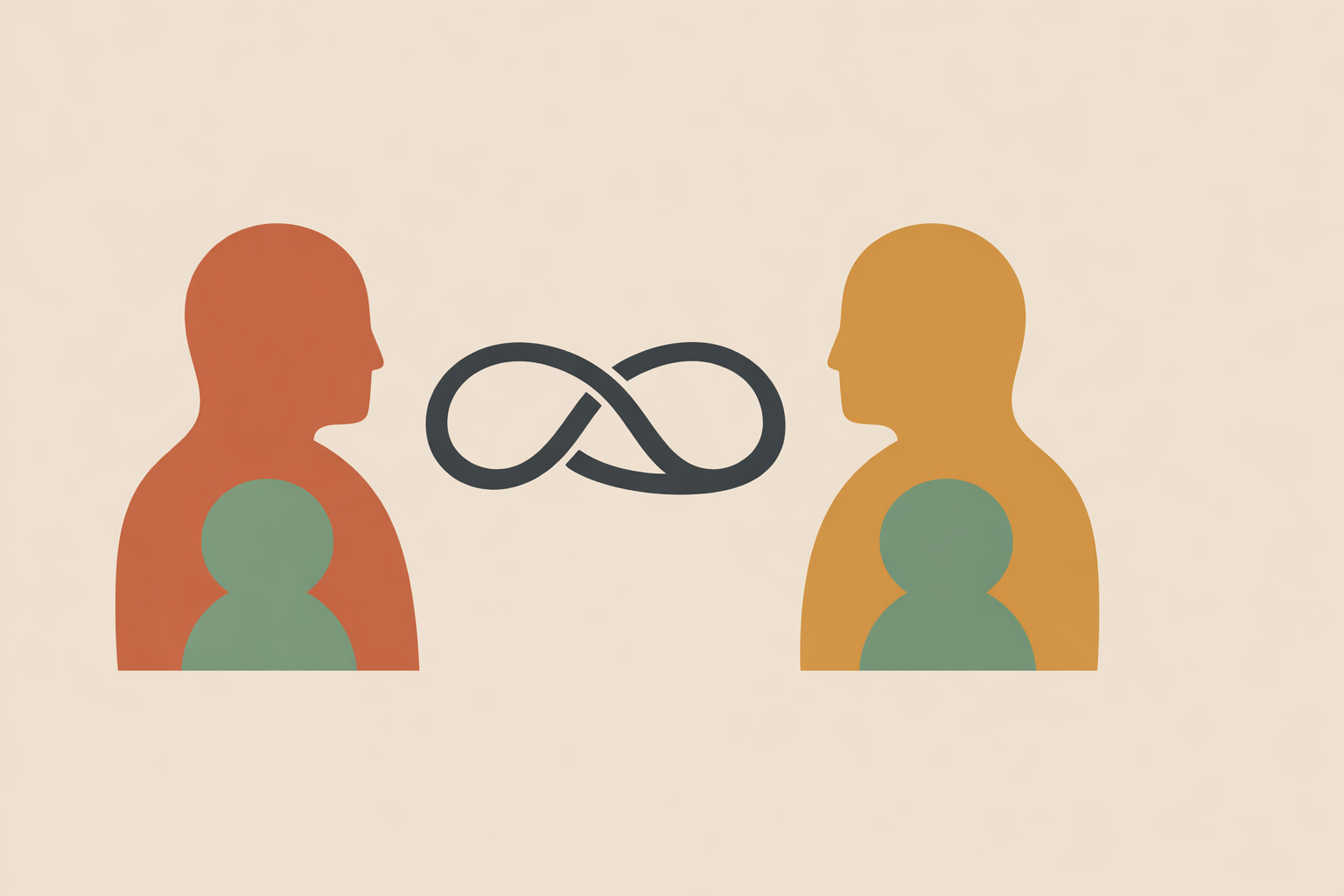
The topic of the argument rarely explains the intensity. The deeper charge often comes from younger parts of us that learned what closeness, belonging, and emotional safety seemed to require. The child-self works best as a map, not a label.
For many people, inner child work means meeting younger feelings and unmet needs with respect, honesty, and warmth; if clients ask what that means in practice, a simple explanation of inner child work can help. It gives clients language for the tender layer underneath defensiveness, silence, pursuit, or over-explaining.
Attachment language can help if it stays flexible. Under strain, one person may move toward connection while another moves toward distance. These are patterns, not identities. Traditional cultures have long made space for younger or wounded aspects of self through story, song, ritual, and community witnessing, even without modern psychological terms.
Consider a composite example. Maya learned early, “Don’t be too much; keep the peace.” When tension rises, she gets quiet and careful. Luis learned, “If you don’t try harder, you’ll lose people.” When tension rises, he talks faster and follows. Both are using strategies that once helped them preserve connection, and seeing that often softens blame. The argument is no longer only about the bin, the tone, or the timing; it’s also about older beliefs like “I do not matter” or “I will be left.”
Mapping triggers, younger meanings, and protection patterns
Once the couple can see the loop, the next step is to make it concrete. A simple five-lens map works well: trigger, deeper wound, protector, unmet need, and adult capacity. This turns a spiral into something visible and workable.
- Trigger: the visible cue, such as a raised eyebrow, silence, or a delayed reply.
- Deeper wound: the older meaning that gets activated, such as “I do not matter,” “I will be left,” or “I can never get it right.”
- Protector: the learned strategy that tries to keep the person safe, such as criticism, pursuit, shutdown, sarcasm, compliance, perfectionism, or over-explaining.
- Unmet need: often reassurance, clarity, connection, respect, or space with reassurance.
- Adult capacity: the choices available now that were not available then, such as naming a need clearly, taking a pause with a return plan, or setting a boundary.
This reflection aligns with noticing how past experiences echo in present reactions. Keep the tone curious and non-shaming: “Something about this moment feels high-stakes.” Or, “Does this feeling remind you of an earlier kind of experience?”
For Maya, the map might look like this: Trigger—partner walks away mid-sentence. Deeper wound—“I do not matter.” Protector—shutting down. Unmet need—“Please show me I matter even when you need a break.” Adult capacity—“If you need space, tell me when you will return.”
For Luis, it might be: Trigger—partner’s quiet face. Deeper wound—“I will be left.” Protector—pursuit. Unmet need—“Please reassure me you are not going anywhere.” Adult capacity—“I can ask directly for reassurance and agree to a timed pause.” One page like this can shift the tone of an entire week.
Regulating together before talking
In couples work, regulation first and repair second is often the steadier path. When bodies are overwhelmed, thoughtful conversation is harder, and partners influence each other’s capacity to settle. Research on partner influence supports what many practitioners see in real life: nervous systems co-regulate.
A pause protocol helps partners step back without abandoning the conversation. The pause works best with reassurance, a clear time to reconnect, and a simple grounding practice. Disappearing without context usually deepens the loop.
A useful script is: “I want to continue this conversation. I am too activated to do it well right now. I am going to take a pause, and I will come back at 7 p.m.” The exact timing can stay flexible; what matters is that the break is intentional and the return is reliable.
These somatic tools can help couples settle enough to reconnect:
- Ground and name: place both feet on the floor, look around the room, and name five colors you can see.
- Hand-to-heart breathing: one hand on the chest, one on the belly, then breathe a little longer on the exhale than the inhale for two minutes.
- Wall lean reset: stand with your back supported by a wall for about a minute and notice where your body can soften.
In practice, it can be enough to say, “Let’s pause words and notice bodies.” When the charge comes down, couples can hear each other again and speak from adult capacities instead of raw protection.
Speaking for the child-self, not from it
After a pause, invite each person to speak for their younger part rather than from it. The adult self stays present and responsible, while still honoring what the younger part fears, needs, or remembers.
This is a practical form of reparenting yourself, and a paced approach to reparenting can help keep that work steady: offering steadiness, compassion, and guidance that may have been missing earlier. In relationship coaching, it supports clearer requests and fewer reactive spirals.
These prompts make it easier:
- The story I am telling myself is…
- The feeling underneath is…
- What I need right now is…
- The choice I can make is…
Luis might say, “The story I am telling myself is that you are pulling away for good. The feeling underneath is fear. What I need right now is reassurance that you will come back after a break. The choice I can make is to ask for a return time instead of following you.”
Maya might say, “The story I am telling myself is that I do not matter when you are upset. The feeling underneath is grief. What I need right now is to hear that I still matter even when we need space. The choice I can make is to ask for clarity instead of shutting down.”
This supports compassion without excusing harmful behaviour. A useful question is: “Of course this part of me is scared; what will I do differently next time?”
Expressive arts, play, and symbolic work
Some couples name patterns easily. Others do better with a less direct doorway, especially when words feel stuck or too sharp. Expressive arts, gentle play, and symbolic exercises can help.
Drawing, collage, clay, movement, music, or short written reflections can all externalize what’s hard to say. One example is an art-based approach to wounded-inner-child exploration. Practitioner experience echoes this: hands sometimes reach material that conversation can’t.
A simple home exercise is for each partner to create two images: “What my younger self learned about conflict” and “What my adult self wants to teach that part now.” Then share using only “I” statements.
Another practice is turning the fight loop into a symbol. One partner may draw a cyclone, another a locked gate, another a blaring alarm. Then the couple creates a shared symbol for the pattern they want instead: two chairs facing each other, a bridge, a lighthouse, a steady flame. The symbol becomes a quick reminder that they’re building shared culture, not just solving isolated arguments.
If both partners enjoy lightness, a little humour can help too. A nickname for the loop or a small hand signal makes interruption easier without shaming either person. In that spirit, symbolic shadow work means making room for disowned emotions without turning them into identity statements.
Ethical, boundaried inner child work with couples
Inner child work is tender, so pacing and boundaries matter. Safety, choice, collaboration, and cultural respect need to stay stronger than momentum, especially when earlier life experiences are involved.
There are times when conjoint vulnerability is not appropriate. If one partner cannot speak freely, fears retaliation, is being pressured to disclose private material, or is living inside coercive dynamics, slow down and orient first to immediate well-being and informed choice. Joint exercises should never become a stage for pressure, intimidation, or forced disclosure.
It’s also essential to be clear about what this framework does not justify. Younger pain does not excuse contempt, coercion, repeated boundary violations, intimidation, or violence. Compassion and accountability belong together.
Boundaries work best when they describe what the speaker will do:
- If voices rise, I will pause the conversation and return when we can speak respectfully.
- If I feel cornered, I will step outside for ten minutes and message my return time.
- If I need space, I will name that need clearly rather than disappearing.
In coaching, the focus stays on reflection, emotional literacy, self-regulation, boundaries, values, and sustainable behaviour change. It is not the place to push someone into overwhelming reliving. When in doubt, go more slowly, widen consent, and support each person in ways that preserve dignity and choice.
Conclusion: turning the repeat fight loop into a new relationship practice
When couples learn to name the loop, map the younger meanings beneath it, regulate before pressing for resolution, and speak from adult capacity, the emotional climate can change. Research also links stronger self-regulation and co-regulation with higher relationship satisfaction for both partners.
Look for visible signs of progress: shorter arguments, earlier recognition of activation, fewer personal attacks, more reliable returns after pauses, and more frequent repair attempts. In lived practice, steadiness often comes first; once intensity drops, listening returns and responsibility becomes easier to take.
The aim is not perfection. It is to build a relationship within oneself and with one another that can hold tenderness, difference, and repair. Start small: name the loop, map one hot moment, try one pause, practice one adult-self script, make one image together, and hold one clear boundary. For practitioners wanting to go deeper into trauma and emotional healing, this kind of paced, repair-oriented work fits naturally within that broader lens.
Train in Inner Child Work
Deepen these couples tools with the Inner Child Work Certification and build safer, clearer repair practices.
Explore Inner Child Work →