When someone comes in with unexplained aches, it’s easy for an intake to become a quick set of boxes and 0–10 ratings. That structure is fast, but it can lock you into labels before you’ve heard the body’s full story. The result is often scattered notes, lots of “maybe” directions, and a first session that lacks a clear starting point.
A more reliable approach is layered. You begin with the person’s own words, then you map location and sensation, track timing, connect the ache to daily life, gently explore stress and emotional load, clarify touch preferences, and finish with a straightforward safety screen. Each layer adds clarity without narrowing too soon, and the full intake becomes a working map you can refine over time.
Key Takeaway: A reliable intake for unexplained aches should build a working map step by step, turning vague complaints into decisions you can act on. Layer 1 opens with a single free-text question that privileges the client’s language; Layer 2 maps location, quality, intensity, and radiation with diagrams and descriptors; Layer 3 captures onset, aggravators, easers, and change over time to reveal patterns; Layer 4 links symptoms to sleep, energy, function, and mood to define meaningful goals; Layer 5 gently checks stress, emotions, and fear-avoidance with choice-based prompts; Layer 6 establishes consent, touch preferences, boundaries, and sensory sensitivity; Layer 7 screens red flags and situations that warrant adaptation or outside support; the conclusion ties the layered data to muscle-meridian testing, acupressure choices, and outcome tracking.
Layer 2: Map where the ache is and how it feels
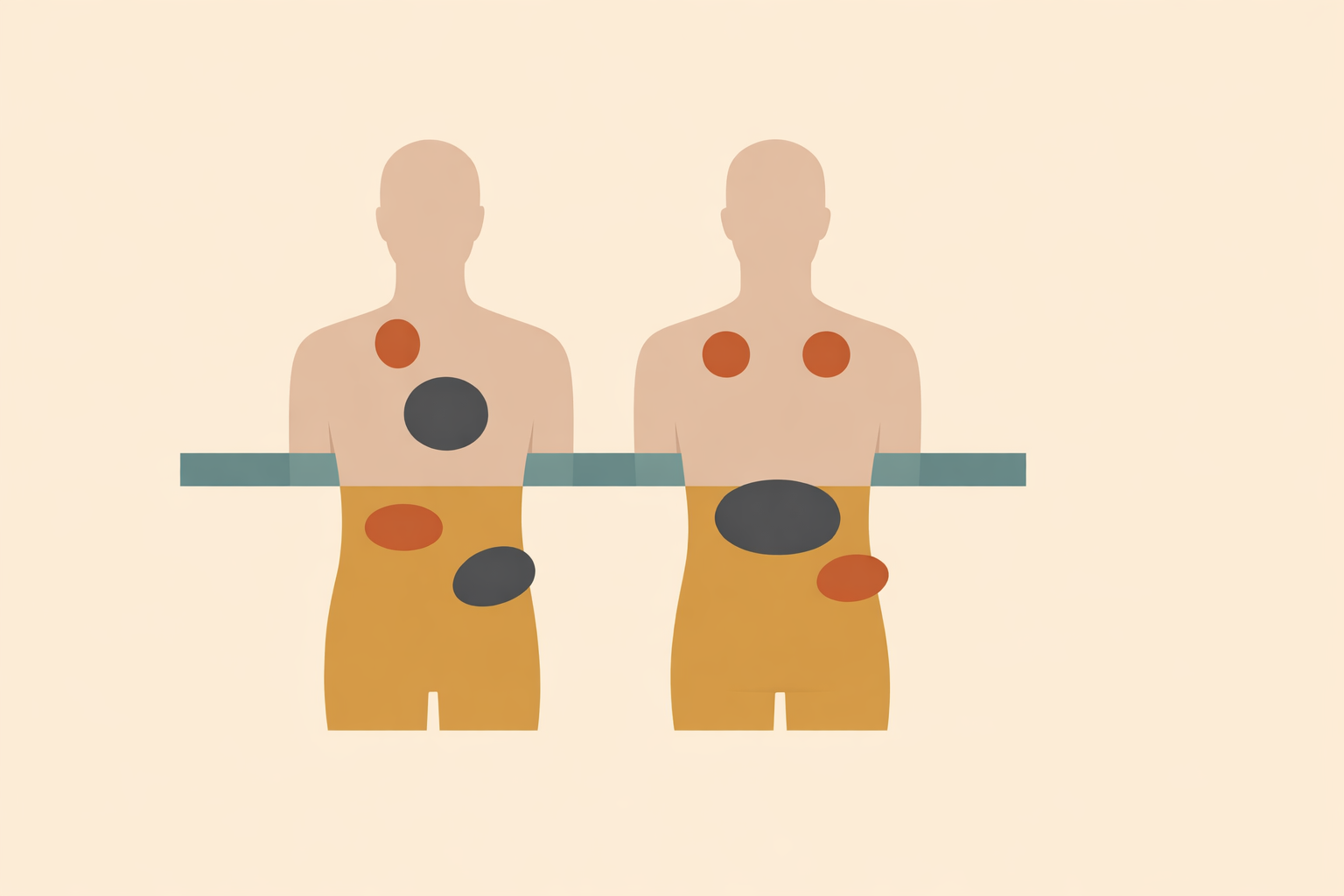
When someone says, “It’s everywhere,” your next step is to help the pattern take shape. A simple body map plus a short list of sensation words often turns a diffuse complaint into something you can work with.
Use a front-and-back body diagram (or a compact location list), then ask about quality and intensity in plain language. Helpful descriptors include aching, dull, sharp, stabbing, burning, throbbing, cramping, tight, spasming, tingling, numb, electric, and pins-and-needles.
Terms like burning, electric shocks, and pins-and-needles are common neuropathic descriptors, which can point toward nerve-like sensations rather than simple stiffness.
Also clarify whether the sensation stays put or travels. In kinesiology, that “line of travel” can guide which pathways you explore. A pathway from neck into arm, or low back into leg, often gives you a cleaner starting point than a single number on a scale.
Practical intake prompts:
- “Where do you feel the ache? Mark the diagram or list the areas.”
- “How would you describe the sensation? Choose all that fit.”
- “Does it stay in one place or spread? If it spreads, where to?”
- “How intense is it right now? 0–10.”
A note like “Every afternoon around 3 p.m., a tight band starts at my temples and moves to my jaw” gives you timing, quality, and direction in one go.
Layer 3: Trace when it started, what aggravates it, and what helps
Once you’ve mapped the “where” and “what,” look for the “when” and “why now.” Onset, aggravators, and easers often reveal the most practical entry point for your first session.
Three questions carry a lot of value:
- “When did this begin? Was it sudden or gradual?”
- “Did anything seem to set it off?”
- “What makes it feel worse, and what makes it feel better?”
Then add a simple way to track change over time:
- Worst in the last week: 0–10
- Best in the last week: 0–10
- Right now: 0–10
“Gradual over months since my workstation changed; worse after meetings; a walk in fresh air helps for an hour” already points toward posture, breath, rhythm, and repeated strain. It also gives you a grounded direction for muscle checks and point selection.
Finish this layer by asking what they’ve already tried and how it landed: rest, heat, cold, stretching, acupressure, supplements, movement breaks, self-touch, or Brain Gym. Often, their answers show you what the system responds to, even in small ways.
Layer 4: Ask about sleep, energy, and daily life
An ache matters because of what it changes. Daily impact is where you find meaningful goals and measures of progress.
There’s also a practical reason to ask: pain and poor sleep can reinforce each other, and pain and high stress can, too. Tracking these helps you understand the wider pattern you’re supporting.
Add a short block such as:
- “Does this ache disrupt your sleep or wake you at night?”
- “How is your energy lately?”
- “Is anything harder to do right now?”
- “Has your mood shifted around this?”
This is also a strong place to focus on function. In older adults, touch-based work has been associated with shifts in sleep quality, which is a helpful reminder to track real-life outcomes, not only intensity ratings.
A coaching-style prompt that often opens up clarity: “What would a 10% better morning look like?” If someone answers, “I’d get out of bed without bracing, make tea, and start work feeling steady,” you now have an outcome you can check in on session by session.
Layer 5: Explore stress, emotions, and life load with care
After the physical pattern is clear, widen the lens. Many people with ongoing aches also describe emotional strain, high life load, low confidence in movement, or a habit of bracing.
Research suggests fear of movement and distress are common in persistent musculoskeletal pain. You don’t need to interrogate this to make it useful. A few choice-based questions are usually enough.
Set a respectful tone: “The next questions are optional and here to support whole-person work. Share only what feels right.” Then ask:
- “What’s your current stress load: light, medium, or heavy?”
- “Any major life changes in the last year?”
- “Any movements you avoid because you worry they will make things worse?”
- “When the ache flares, which emotions tend to be nearby?”
Traditional frameworks can add valuable structure here. Many kinesiology practitioners notice recurring links between emotional themes and meridian patterns. For example, in traditional Chinese medicine, grief and sadness are linked with Lung energy. Used respectfully, this becomes a practical lens for observation and session planning, rather than a rigid rule.
Keep it easy to skip. Even without personal context, you can still support change through breath, rhythm, grounding, and gentle corrections common in energy healing work.
Layer 6: Clarify touch preferences, boundaries, and sensory sensitivity
Before any hands-on work, establish clear consent and preferences. Some people want light, predictable contact. Others prefer firmer pressure, guided self-touch, or no touch at all, especially early on.
Include questions like:
- “How do you feel about touch during sessions: no touch, light touch, firm touch, or unsure?”
- “Are there areas you would like me to avoid or handle with extra care?”
- “Would you like me to explain each step before I do it?”
- “What helps you feel settled during a session?”
It’s also useful to ask about allodynia, where light touch, clothing, or gentle pressure feels unusually painful. When that’s present, you can adapt with off-body cues, touch through clothing, or guided self-contact.
Guided self-touch is a strong option for some people, and it can feel more settling when the system is already on alert.
A simple form line can strengthen clarity: “My stop-signal is _____. If touch is used, I would like clear explanation first: yes/no.” These small agreements build trust quickly.
Layer 7: Add safety questions so you know when to pause or adapt
Safety belongs in every intake. Supporting well-being includes knowing when to adapt the plan, pause hands-on work, or encourage timely outside support.
Use clear yes/no questions such as:
- “Any new or progressive weakness in an arm or leg?”
- “Any new numbness in the inner thighs or groin area?”
- “Any new changes in bladder or bowel control?”
- “High fever with aches, or feeling suddenly very unwell?”
- “Unexplained weight loss, or constant worsening pain not eased by rest?”
- “Pain that wakes you every night and does not seem position-related?”
Many initial consultations in movement-based professions include red-flag screening. In kinesiology, it’s the same principle, expressed in non-clinical, everyday language.
You can also ask about factors that affect how you work:
- Easy bruising or bleeding tendencies
- Open skin, infection, or marked skin sensitivity in the area
- Current use of blood-thinning support
- Special positioning needs or device considerations
- Periods of significantly reduced resilience or recovery capacity
A helpful line on the form: “If any of the above apply, we may adapt the session plan or pause hands-on work and help you find the right next step.” This keeps safety calm and practical.
Conclusion: Turn the intake into a working map
A strong kinesiology intake moves in a deliberate sequence: open story, mapping, timing, daily impact, personal context, consent, and safety. Each layer adds a different kind of clarity, and together they create a picture you can actually work with.
That’s why a multidimensional assessment so often offers better guidance than a single-focus approach. By the time you begin muscle testing or choose self-touch, you already know what matters most to the person, what progress should look like in real life, and which boundaries must be respected.
Touch and energy-based approaches land differently for different people, yet reviews have reported minimal risk in the studies reviewed. In day-to-day practice, the biggest safety tools are steady listening, clear consent, and the willingness to adapt as new information emerges.
Keep intake forms spacious and human. Ask only what supports real decisions in session, then link each answer to action: meridian focus, muscle checks, acupressure choices, pacing, consent, and outcome tracking. That’s how the intake becomes part of the work, not an obstacle to it.
Explore Kinesiology Certification
Apply this layered intake approach with practical assessment skills in the Kinesiology Certification.
Explore Kinesiology Certification →