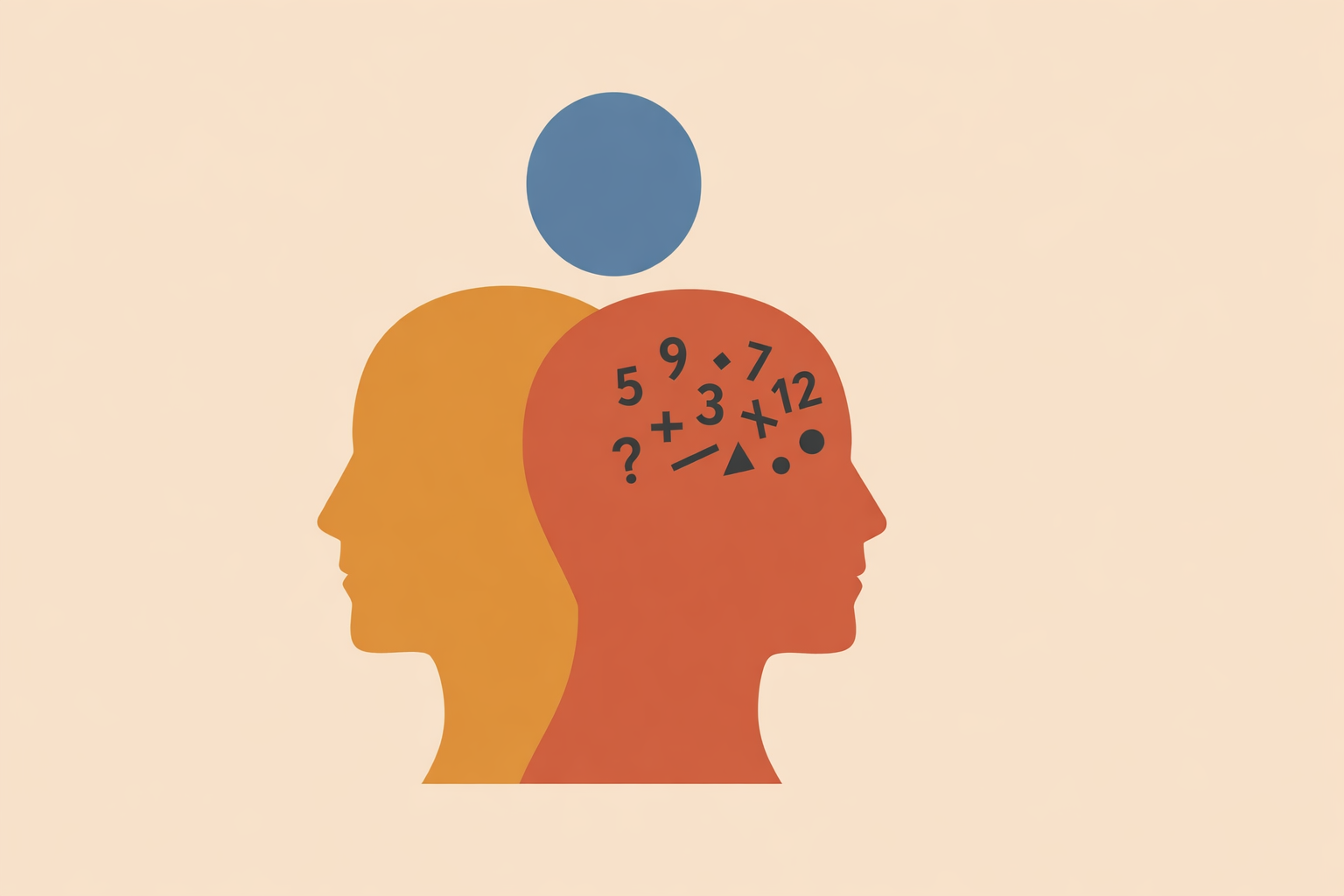
Many practitioners recognize the moment a client freezes around numbers: the shoulders lift, the breath gets shallow, and confidence disappears. A few calming cues often help in the moment. Yet when the same distress returns at every checkout line, tip split, or time estimate, it’s worth looking beyond stress alone.
For some adults, visible anxiety sits on top of a steadier pattern of numeracy difficulty. Number-sense difficulties and math anxiety often overlap, but they aren’t identical. When you learn to spot the pattern, your support becomes more targeted and far more useful in daily life.
Key Takeaway: Adult math distress often looks like anxiety, but a stable pattern of numeracy difficulties can point to dyscalculia and calls for different support. In practice, it helps to calm the stress response first, then look for what remains difficult when the person is settled, unhurried, and well supported. Lifelong cross-context struggles, friction with money and time, and recurring sequence or symbol errors can all offer useful clues. From there, practical tools such as written steps, calculators, visual supports, and extra time can reduce load and protect dignity.
Math Anxiety vs. Dyscalculia: State vs. Pattern
A helpful way to frame it is that anxiety tends to be state-based, while dyscalculia shows up as a more stable pattern of difficulty with numerical relationships. In adults, dyscalculia is often mistaken for anxiety, low effort, or carelessness—especially when someone has spent years masking.
The two can coexist. Longstanding numeracy strain often makes numbers feel threatening, and that threat response then amplifies the strain.
What matters most in practice is what remains when the person is calm, unhurried, and properly supported. If steadiness and extra time create a big shift, anxiety is likely driving much of the moment-to-moment difficulty. If confusion around magnitude, place value, symbol meaning, or sequence stays consistent, you may be looking at a deeper numeracy pattern that benefits from structured supports.
A low-stakes probe can help you observe without labeling. Ask the person to order 10, 20, 30, and 40, then insert 15 and 35. If number symbols feel charged, use objects, spacing, or a number line. You’re watching for whether the difficulty eases with calm or persists across formats.
Lifelong Number Difficulties Across Contexts
When an adult says, “I’ve always struggled with numbers,” it’s worth taking seriously. A long history across school, work, and daily life can point toward a more specific profile. Dyscalculia often involves persistent numeracy problems that don’t resolve with effort alone.
It can also be easy to miss because many adults are highly capable in other areas. Strong reading and verbal skills may hide just how much work numbers take, especially when someone has built sophisticated workarounds.
In adulthood, the struggle often shows up less in “math problems” and more in everyday numeracy. People may find money, fractions, and multistep information disproportionately draining, even while they thrive in communication, creativity, or leadership.
Many also describe inconsistency: a skill feels available one day and slippery the next, especially under fatigue or time pressure. That fluctuation is part of the lived pattern.
A quick timeline often clarifies things. Map early number memories, school friction, first money tasks at work, and current pinch points. People often feel relief just seeing the pattern—and recognizing the ingenuity they’ve already used to cope.
Money, Time, and Everyday Numeracy Clues
In day-to-day life, numeracy strain often shows up most clearly around money. Difficulties with budgeting and percentages commonly persist, along with tipping, splitting bills, comparing discounts, and tracking recurring expenses.
Time can be just as challenging. Tools like diaries, timers, and phone reminders often become essential because dates and times can be hard to manage reliably. This might look like misjudging travel time, underestimating task length, or struggling to feel what “10 minutes” actually means.
These clues tend to cluster. Research on adult numeracy links problems with time and money to broader functional numeracy difficulties in everyday life.
Support gets practical quickly here. A simple “Money and Minutes” sheet helps externalize repeat tasks: the task, the cue, the script, and the tool.
- Pay internet bill — first Friday, 10 a.m. — open checklist — calculator ready
- Split restaurant bill — subtotal, add tip, divide — use written steps
- Leave for appointment — map time plus buffer — set two alarms
When tools are planned in advance, people don’t have to rely on mental math in high-pressure moments, and shame tends to ease.
Sequences, Symbols, and Careless-Seeming Errors
Often, the most useful information is in the “small” errors. Adults may transpose digits, lose their place in a sequence, or mix up operations, especially under pressure. Inside the experience, it can feel like numbers won’t stay stable long enough to use them.
Dyscalculia is associated with difficulty understanding numerical symbols and linking number words, symbols, and quantities smoothly. Someone can memorize a method and still get stuck when the context shifts.
External supports are especially valuable here. Written steps, checklists, and prompts can support multi-step tasks by reducing how much must be held in mind at once.
A brief think-aloud can pinpoint the friction. Invite the person to narrate a simple task while you write each step. The snag often appears quickly—a symbol, a place-value shift, or a jump in sequence—so you can support something specific rather than treating it as a general “math problem.”
How to Support Without Overstepping Scope
The most helpful stance is curious, practical, and non-labeling. The aim is to notice patterns and build supports around real life tasks.
Watch what persists when the person is calm, has enough time, and can use tools openly. If certain difficulties stay steady across settings, that information is useful whether or not formal assessment is ever pursued.
Helpful prompts include:
- Which number tasks feel steady, and which feel slippery?
- What changes when you are calm and unhurried?
- Which tools already help: calculators, notes, visuals, reminders?
- What do you remember about numbers in school or early work life?
- What kind of support feels respectful rather than intrusive?
Language matters. Many adults have been taught that numeracy difficulty reflects character or intelligence. Framing it as a pattern of processing differences shifts the focus toward strategy and dignity.
It also helps to normalize accommodations. Supports such as extra time and calculators are appropriate tools, and presenting them without apology often brings immediate relief.
Blending Regulation With Practical Numeracy Support
When anxiety and numeracy difficulties intertwine, support works best when it’s blended: regulate first, reduce load next, then build repeatable routines.
Start with steadiness. Dyscalculia can have a significant impact on adult life, so speed rarely helps at the beginning. Many people need emotional safety around numbers before skills become accessible.
Then make the task lighter. Break sequences into smaller steps, put instructions on paper, and use tools from the outset. Concrete and visual approaches often help ideas settle before symbols carry the full load, aligning with guidance to use concrete and visual representations.
Finally, treat aids as standard equipment. Adult numeracy guidance supports the use of technological aids like calculators as part of everyday functioning, not as a last resort. This framing allows people to work with their minds instead of hiding what helps.
A simple blended routine might look like this:
- One settling breath and feet grounded
- Step card visible before starting
- Calculator and scratch paper ready from the outset
- Visual model first, symbols second
- Brief reflection afterward: what felt easier, what still felt sticky
This approach is practical and easy to adapt. It respects the stress people carry around numbers while meeting persistent numeracy differences with structure and care, much like math anxiety and dyscalculia coaching in adult life.
Conclusion: Reading the Pattern With More Care
When an adult freezes around math, anxiety may be the visible wave. Sometimes, a steadier current runs underneath: lifelong number friction, recurring trouble with money and time, or symbol and sequence slips that remain even after the body settles.
Seeing the pattern changes the quality of support. Rather than pushing harder, you help the person work differently and use tools openly. That shift protects dignity and keeps progress grounded in real life.
As always, stay within scope: focus on observation, skill-building, and supportive structures, and encourage appropriate professional pathways when someone wants formal clarification. With that balance, many adults find they can meet numbers with less shame and far more stability, whether through neurodiversity support or more focused dyscalculia support coach certification.
Train as a Dyscalculia Support Coach
Deepen your practical approach with the Dyscalculia Support Coach Certification.
Explore the Certification →