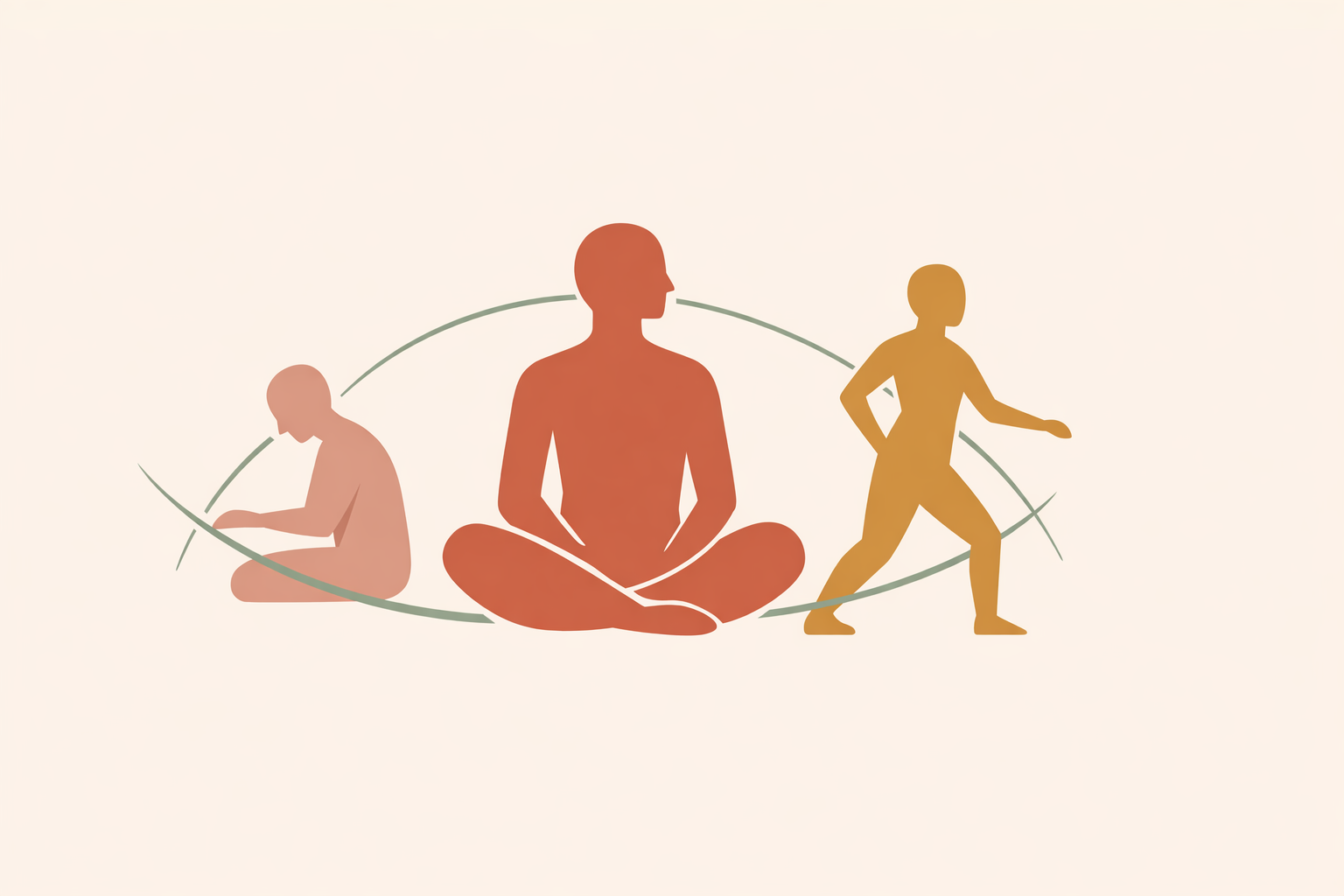
Massage therapists often reach for kinesiology because they want session results to last beyond the table. When someone returns with the same desk-shaped neck and shoulder tension, it’s a clear sign that hands-on work may need a partner. Pairing touch with brief movement checks, consented muscle testing, and client-led micro-movements turns a session into something clients can feel, understand, and carry into daily life.
From that blend, three practical offers tend to emerge naturally: a posture-and-comfort session for desk-based clients, a multi-visit reset for recurring patterns, and activity-specific support for everyday athletes. Each keeps the work collaborative, scope-appropriate, and grounded in both traditional bodywork wisdom and modern movement thinking.
Key Takeaway: Kinesiology-informed massage is most effective when touch is paired with quick movement re-checks and client-led micro-practices that translate into daily life. Package it as a repeatable offer—desk comfort sessions, a 3–6 visit reset series, or activity-specific support—so clients can feel progress, reinforce it, and sustain change.
Key Takeaway: Kinesiology-informed massage works best when it is offered as a clear, repeatable experience that blends touch, brief movement checks, and client participation. For desk-based clients, that may look like posture-and-comfort work with re-checks and simple daily practices. For more persistent patterns, a 3–6 session reset can create a steadier arc of change. For active clients, activity-specific checks and graded progressions help support comfort, coordination, and confidence.
Offer 1: Posture and comfort sessions for desk-based clients
For desk-based clients, the goal isn’t “perfect posture.” It’s more practical: help them feel at ease, spot what reduces strain, and leave with tools they’ll actually use. Kinesiology fits beautifully here—not as a separate add-on, but as a simple way to make the session more interactive and relevant to real life.
In practice, comfort tends to hold better when clients understand what helps and can repeat it. That direction aligns with guidance that supports movement education alongside hands-on care rather than relying on passive input alone.
Keep it tangible with quick before-and-after checks. Manual-plus-movement approaches commonly support reduced discomfort and easier movement in the short term—so re-checking a familiar motion (like turning the head or reaching overhead) helps clients “feel the difference” immediately.
That felt sense is the engine of change. When clients notice a shift, they participate more willingly—and they’re more likely to repeat the helpful bits at home. More active approaches are also broadly favored to improve function and build confidence over time.
Session flow for desk-based clients
Start with a warm, simple welcome and clear consent. A reliable opener: “We’ll do a few easy movement checks to notice what feels easier today. You can pause anything at any time. Sound okay?”
- Step 1: Quick body mapping
- Invite two or three functional motions: head turns, shoulder rolls, arms overhead.
- Ask: “Which side feels smoother? Where does your body hesitate?”
- Use their answers as the session anchors.
- Step 2: Respectful muscle testing
- Use one or two light, non-fatiguing checks in a comfortable position.
- Frame it as shared exploration, not a verdict.
- You might say: “Let’s see how this muscle wants to help you today.”
- Step 3: Hands-on focus
- Work neck, upper shoulders, chest, and upper back from broad to specific.
- Blend warming contact with slower detail work.
- Invite small movements (turning, nodding, side-bending) while you work.
- Step 4: Traditional body mapping
- If meridian language is part of your practice, keep it gentle and descriptive.
- Invite length through the back body or spaciousness through the side neck and shoulder.
- Keep it experiential rather than absolute.
- Step 5: Re-check and reflect
- Return to the original motions.
- Ask: “What changed? What felt most helpful?”
- Let their body be the “proof”—smoother turning, a lighter lift, easier reach.
- Step 6: Give 1–2 micro-practices
- Two-breath shoulder sigh each hour: inhale to float the shoulders, exhale long to soften.
- Doorway chest opener with a soft exhale, 20–30 seconds.
- Gentle yes/no/maybe head turns while seated, no strain.
Two scripts worth keeping close:
- Consent for checks: “We’ll try a light check to see what feels ready today. It’s just information, and we can stop anytime.”
- Meaning-making: “When you turn more easily now, your body is showing us it likes this approach. Let’s build on that.”
Keep this offer simple and repeatable. Think of it like teaching the body a short, friendly “new default,” then giving the client a couple of easy ways to reinforce it.
Offer 2: A holistic 3–6 session reset series
Some clients don’t need a one-off comfort session—they need a paced process. When someone feels stuck in a recurring pattern, a 3–6 session reset creates room to explore what supports change, what helps it hold, and what fits into everyday life.
This also matches how many people build lasting change: through repetition, reflection, and refinement. For movement and joint-related concerns, support is often offered across multiple sessions rather than as a single isolated visit.
This is where an integrative style shines. You can blend hands-on work, movement exploration, and breath awareness with traditional themes like flow, grounding, and expression—without becoming rigid about any one model. Essentially, you’re helping the client discover what their system consistently responds to.
Breath and gentle motion can be especially supportive over a series, because they give clients a way to settle and self-regulate between visits. Mind-body practices such as deep breathing are widely used to reduce stress and support relaxation, and they often soften protective holding patterns over time.
Designing a reset journey
- Session 1: Mapping and safety
- Use gentle movement checks and one or two light muscle tests.
- Focus hands-on work on settling overall tone.
- Finish with one easy daily practice and a question like: “When do I feel most supported?”
- Session 2: Flow
- Explore the side body and breathing spaces.
- Use contact around chest, side body, and hips with small client-led reaches.
- Offer a 90-second side-breath practice for home.
- Session 3: Grounding
- Bring attention to feet, hips, and lower back.
- Use slower work and simple stability-oriented movement.
- Invite reflection: “What helps me feel steady when life is fast?”
- Session 4: Expression
- Focus on upper back, shoulders, jaw, and throat space.
- Use breath-guided arm arcs or a humming exhale to soften effort.
- Session 5: Integration
- Re-check key movements from Session 1.
- Notice which shifts hold most easily.
- Refine two or three micro-practices with the biggest payoff.
- Session 6: Sustain
- Build a simple weekly rhythm: a short movement ritual, a breath anchor, and one supportive daily boundary.
- Discuss a later follow-up if useful.
Throughout the series, language sets the tone. A line that keeps sessions client-led is: “Your sensations lead; my hands follow.”
Traditional maps can fit naturally here too. Meridian and element language can be offered as respectful ways of noticing flow, weight, spaciousness, or expression in the body. When used carefully, they deepen the client’s relationship with their own signals—without turning the work into a belief test.
The real gift of a reset series is spaciousness. With time to map, breathe, re-check, and repeat what works, clients often start recognizing supportive patterns on their own.
Offer 3: Kinesiology-based support for everyday athletes
For runners, yogis, lifters, dancers, hikers, and cyclists, kinesiology-informed massage can be a steady companion to training and recovery. These clients usually want more than stillness—they’re looking for smoother movement, clearer coordination, and support that respects what they ask of their body.
The structure can stay simple: check the movements that matter for their activity, apply targeted hands-on work, then offer small progressions they can fold into their existing rhythm.
A useful guiding principle is graded exposure—gradually expanding into valued movements rather than forcing big leaps. Put simply, you’re building trust and capacity step by step.
Massage often lands best for active clients when it’s paired with low-impact strengthening, movement cues, and realistic self-care. Broader guidance supports combining physical support with low-impact exercise and related strategies rather than relying on passive care alone.
Activity-specific session ideas
- Runners
- Checks: single-leg balance, gentle head turn, calf capacity.
- Hands-on: feet, calves, hamstrings, lateral hips.
- Progressions: foot activation, calf lowers, easy hip hinge work.
- Yogis
- Checks: thoracic rotation, shoulder flexion, comfortable hip rotation.
- Hands-on: chest, lats, posterior shoulder, inner legs, suboccipitals.
- Progressions: strap-assisted shoulder work, supported twists, low-load cuff strength.
- Lifters
- Checks: bracing with ease, comfortable hinge, overhead reach.
- Hands-on: hips, adductors, side waist, lats, chest, forearms.
- Progressions: tempo work, split-stance hinges, face pulls, breath between sets.
- Dancers
- Checks: ankle control, turnout without gripping, side-bend fluidity.
- Hands-on: lower legs, inner and outer hips, lateral lines.
- Progressions: slow calf rises, low-effort turnout capacity, breath-led side arcs.
- Hikers and cyclists
- Checks: hip extension feel, mid-back rotation, ankle rock.
- Hands-on: hip flexors, glutes, calves, back body, chest.
- Progressions: hip opener work, bridges, mid-back mobility with breath.
Some bodies benefit most from extra-conservative pacing. With hypermobility-type presentations, neutral joint positions, smaller movement arcs, and conservative loading are often more supportive than chasing end range. With older adults, gentler intensity and longer recovery windows can be more appropriate, especially since aging is associated with slower healing and a greater chance of prolonged recovery.
Manual muscle testing can also guide priorities when it’s done carefully. It remains a widely used tool to evaluate strength and observe movement-related patterns. In session, that looks like brief efforts, consistent positioning, and humble interpretation. A helpful phrase is: “This is just a snapshot; your movement story is bigger than one test.”
Above all, keep these sessions enjoyable. Everyday athletes move because movement matters to them. The work is to support that relationship with better options, kinder pacing, and recovery strategies that fit real life, much like the broader kinesiology career paths built around helping people move with more ease.
Conclusion: A living, client-led way to work
These three offers share one core principle: touch opens the door, movement helps clients walk through it, and reflection helps the change stick. Whether you’re supporting a desk-based client, guiding a reset series, or working with an active body, kinesiology-informed massage is strongest when it stays collaborative, respectful, and easy to apply.
Consent and clarity are the foundation. Explain checks in everyday language, offer choices, re-check what matters, and let clients tell you what they notice. That simple loop changes the quality of the work—and the client’s sense of ownership.
It also helps to remember that not every useful part of practice needs a study attached to it. Traditional knowledge, careful observation, and repeatable client experience are meaningful evidence, especially when they’re applied with integrity and an evidence-informed mindset grounded in whole-person insight.
“Your sensations lead; my hands follow.”
“This course was helpful in that it was self paced.”
If you want to develop this style of work more fully, explore Naturalistico’s kinesiology training and see how it can support your sessions, client communication, and long-term practice growth.
Explore Kinesiology Certification
Build clearer movement checks and client-led session flows with the Kinesiology Certification.
Explore Kinesiology Certification →