When a cohort asks for work-life balance, group coaches often reach for the balance wheel. It’s quick, familiar, and easy to discuss. Yet the real friction usually lives between the slices: late-night messages disrupting sleep, caregiving draining focus, or scrolling that quietly steals rest.
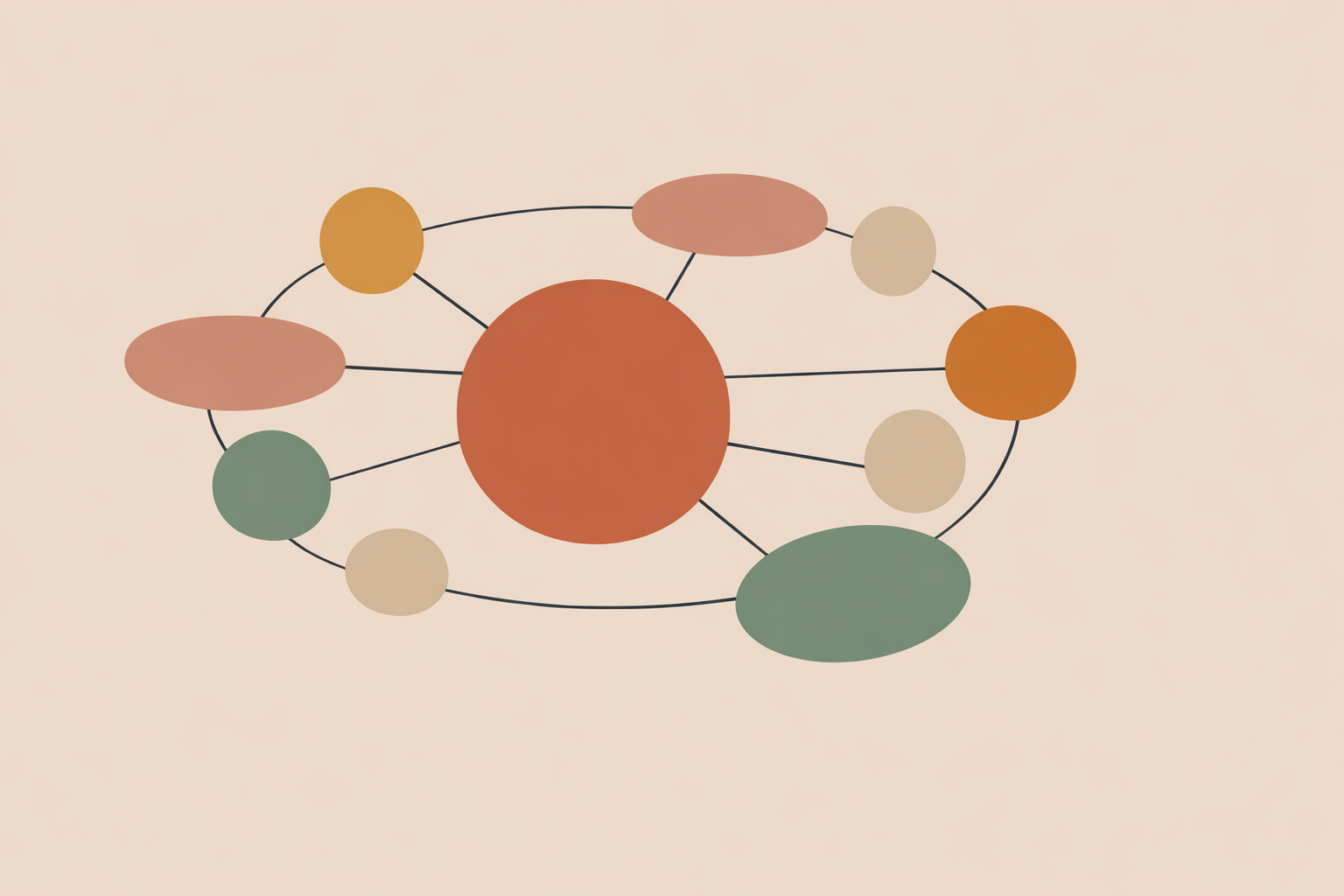
A steadier approach is life-system mapping. Participants create simple maps that show how domains, capacities, relationships, and everyday conditions influence one another. Instead of chasing “balance” as an abstract ideal, the group sees the design behind current results and chooses a humane leverage point. That keeps the work practical, respectful, and easy to revisit over time.
Key Takeaway: For 2026 group offers, life-system mapping can be a more useful alternative to balance wheels because it surfaces real connections, supports participant-defined outcomes, and fits a more thoughtful, ethical style of coaching. The most effective version is simple: map influence first, add layers such as capacity and context, choose one leverage point, turn it into a small experiment, and track change in a way that respects trade-offs rather than flattening people into numbers.
How to turn a balance wheel into a client-created life-system map
Instead of handing participants a pre-labeled wheel, invite them to sketch their own map in their own language. The tone often changes immediately. People name what’s truly alive for them: belonging, quiet mornings, mother tongue, financial pressure, shared meals, or recovery time.
Two simple activities are usually enough to begin:
- List what currently needs attention, provides energy, creates friction, or feels neglected. Invite 8 to 12 items.
- Ask which areas affect one another, then draw arrows between them. Use different line styles to show support, pressure, dependence, or conflict.
Map influence before measuring satisfaction. A low movement rating might reflect winter light, caregiving strain, commute patterns, or late-night phone use more than “motivation.” Once the pattern is visible, participants stop moralizing and start working with reality.
As you facilitate, keep distinctions clear. Simple tags such as events, patterns, interpretations, needs, choices, and outcomes help participants avoid turning a hard week into a fixed identity. “I missed two walks” lands differently than “I am inconsistent.”
If the group wants numbers, let participants define them in their own terms. A rating can be useful when it prompts curiosity rather than acting as a verdict.
A prompt that works well: “Circle one area that gives you energy. Draw three arrows from it to places it could nourish. What small move would strengthen that source this week?”
Layering capacity, context, values, relationships, and digital life
Maps get far more accurate when you add layers. This is where the exercise starts to reflect lived reality.
Capacity layer: time, energy, money, attention, support, skills, confidence, and access. Participants often see that the next step is clear, but too large for current capacity.
Context layer: work conditions, family responsibilities, culture, geography, finances, discrimination, social pressure, and technology access. Context turns generic advice into grounded decision-making.
Values layer: what feels deeply chosen, what is inherited, and what is negotiable. This helps when someone is pursuing a goal that looks impressive but doesn’t truly belong to them.
Relationships layer: who is affected, who can support, who may resist, and where negotiation is needed. Boundaries tend to hold better when the people involved help shape them.
Digital-life layer: notifications, platforms, screen transitions, information load, privacy, online work, and the ability to disconnect. For many people, digital life is one of the main environments where daily life is organized.
Picture a participant supporting an elder while working in a customer-facing role. Their values may show care and reliability as non-negotiable, while their capacity map shows very low evening energy. Add relationships and digital layers, and the next steps become more humane: move a check-in earlier, protect quieter evenings, and set clear notification boundaries.
How to find a leverage point on the map
Once the map is visible, don’t start with the loudest frustration. Start where a small shift could affect several lines at once. That’s usually the leverage point.
Invite participants to label arrows with words such as increases, reduces, delays, or triggers. Loops show up quickly. Poor sleep can reduce focus, delay tasks, raise worry, and then disrupt sleep again; once that cycle is on paper, it becomes easier to work with systems thinking.
Next, separate spheres of influence:
- Direct influence: I can do this myself.
- Shared influence: I can co-decide this with someone else.
- Indirect influence: I can request, signal, or negotiate.
- No current influence: not workable right now.
This keeps experiments realistic and reduces plans built around areas where the participant currently has little room to act.
Timing helps, too. Add a seasonal lens: what is temporary, what is stable, what is changing, and what can wait? Sometimes the wisest move is to support one season well instead of forcing a year-round ideal.
In many groups, leverage points are surprisingly small: a Sunday reset, a changed meeting default, a protected transition between work and home, or one negotiated boundary around evening availability. These modest shifts often touch several parts of the system at once.
Turning insight into outcomes and small experiments
Insight becomes useful when it turns into action. Momentum tends to grow when participants name a clear outcome and pair it with a small, reversible experiment.
A helpful frame is:
- Outcome: a meaningful change described in observable terms.
- Experiment: a question, a small action, a timeframe, and a review point.
Examples:
- “For four weeks, I will protect two evenings without work messages and note my energy the next morning.”
- “Does a 15-minute evening tidy reduce morning stress? I’ll try it for two weeks and review each Sunday.”
- “Once a week, I will have one honest pre-agreed conversation and note whether I made my request clearly.”
It often helps to define two levels of success:
- Minimum viable outcome: the smallest meaningful shift that would make the process worthwhile.
- Stretch outcome: a larger but still realistic shift if capacity allows.
This supports steadiness over intensity. In real group work, reliable small actions stay workable when life gets busy.
When reviewing progress, agree on what counts as evidence. That might include ratings, short notes, photos, step counts, or simple felt-sense scores. Evidence works best when it stays light enough to sustain and meaningful enough to reveal patterns, especially when tracking behavior change across a living system.
Modern behavior-change reviews also support this direction: goals and planning and feedback and monitoring show up repeatedly in approaches that help people change. In a group container, that translates into experiments participants can review and learn from, without turning the process rigid.
Holding the group process with ethics, inclusion, and cultural respect
Life-system mapping can go deep quickly, so the container matters. People need to know what’s optional, what stays private, and how the group will handle difference.
Recognized coaching standards offer a strong backbone. The ICF names ethical practice as its first competency, and its privacy expectations reinforce confidentiality, appropriate boundaries, and careful handling of participant information. Be clear about what your role includes, what it does not include, and how information is handled.
Useful group agreements often include:
- Confidentiality intent and its limits.
- The right to pass.
- Consent before advice.
- Respect for names, pronouns, and different life realities.
- Clear expectations for screenshots, recordings, and chat use.
- Transparent handling of urgent or difficult disclosures.
Cultural humility matters just as much as structure. Maps may touch family roles, money, spirituality, rest, identity, migration, community expectations, and inherited values. These areas deserve consent-led facilitation and language that doesn’t flatten backgrounds into trends or techniques.
A clean facilitation line can be enough: “You choose your depth today. Passing is welcome. If you want feedback, ask for it. Otherwise we witness without fixing.”
Designing a 4-6 week life-mapping journey
A short group journey works well when the rhythm is predictable and the tools stay light. Four to six weeks is enough for a full cycle of mapping, choosing, experimenting, reviewing, and integrating, whether you frame it within purpose and life design or broader group coaching.
A practical structure might look like this:
- Week 1: create the baseline map and identify initial outcomes.
- Week 2: add capacity and context layers, then choose one leverage point.
- Weeks 3 and 4: run small experiments and review what is shifting.
- Week 5 or 6: compare with the baseline, refine what matters, and decide what to sustain, pause, or evolve.
Track change with both numbers and narratives. A rating shows direction. A short story explains what shaped that direction.
People also tend to do better with accountability and personal feedback. The same review found feedback and monitoring present in many effective approaches. In groups, that can be as simple as peer check-ins, brief written reflections, or a facilitator’s steady noticing.
Your tools don’t need to be elaborate. A visual mapping board, downloadable worksheets, a few asynchronous prompts, and optional peer accountability are usually enough. The aim is to support attention, not add more digital noise.
If you use forms, reminders, or AI-supported prompts, be transparent. Participants should know what is collected, why it is collected, who can access it, how long it is kept, and how to opt out. This aligns with privacy responsibilities and basic respect.
A simple shared board for wins and trade-offs also keeps the group honest about change. For example: “Win: slept earlier three nights. Trade-off: answered fewer late messages.”
Conclusion: clearer group coaching through life-system mapping
Life-system mapping helps people see how their current results are being produced, not just how dissatisfied they feel. That shift alone makes group coaching more grounded and more respectful.
Instead of chasing balance in the abstract, participants notice patterns, choose one leverage point, and build change from there. Outcomes sharpen because they’re participant-defined, and progress gets easier to track because it’s tied to visible connections and lived evidence.
The path is rarely linear. Released pressure, steadier evenings, a more workable boundary, or a more honest goal all count because they change the conditions from which other results grow.
If you’re evolving a group offer for 2026, start simple. Map first, measure lightly, and respect trade-offs. As each cohort learns, the offer becomes a living practice that grows in clarity and care.
Master Systems-Based Coaching
Deepen your mapping and leverage-point skills in the Systems Based Life Coaching Certification.
Explore Systems Based Life Coaching →